Eben Perkins is chief strategy officer of Competitive Energy Services in Portland.
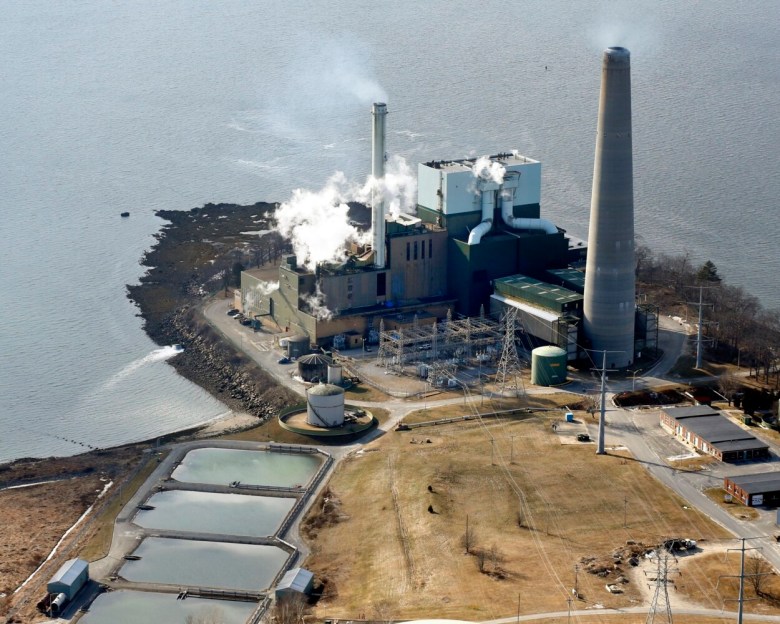
With its 421-foot stack, Wyman Station towers over Casco Bay from the tip of Cousins Island in Yarmouth. Wyman’s shadow similarly looms large over Maine’s energy future.
Wyman is Maine’s largest power plant and its contribution to winter grid reliability is well documented. On cold days, the facility burns residual fuel oil to generate electricity and backstop the regional power mix as the interstate natural gas pipelines that feed New England are maxed out and many gas-fired power plants in the region must shut down or switch fuels to use oil or liquified natural gas imported from around the world.
Despite Wyman’s old age and noncompliance with state air quality standards, Maine does not have a plan for how to replace Wyman’s on-demand power in the winter once the facility retires.
As we wait to see whether the Maine Department of Environmental Protection allows Wyman to avoid complying with new nitrous oxide emissions requirements, it is important for the public to understand three key issues related to Wyman’s future.
First, the owner of Wyman Station, Florida-based NextEra Energy Resources, is embarking on a mammoth acquisition of Dominion Energy, another major player in New England’s electric generation fleet. If the acquisition is approved, NextEra would own New England’s two remaining nuclear power plants, Seabrook Station in New Hampshire and Millstone Station in Connecticut, along with Wyman and numerous other generation assets throughout the region.
This consolidation poses serious concerns of market power and approval, at a minimum, should be conditioned on NextEra’s divestment of sufficient generation capacity in New England.
Second, NextEra is set to see a financial windfall starting in 2028 from Wyman and its other power plants in the region due to electricity market reforms being pushed by ISO New England, the regional grid operator.
ISO New England is proposing significant changes to its capacity market, which pays generators to be available to deliver power to the grid on peak demand days. NextEra should not be granted a financial windfall from higher capacity payments for a nearly 70-year-old facility that lacks adequate pollution controls and a long-term future.
Maine needs to build new sources of firm power in the coming years, and we cannot afford wasteful spending. If the ISO’s capacity market reforms are ultimately approved, policymakers should scrutinize whether NextEra and its peers are paying their fair share to use Maine’s grid.
Third, a strategy for replacing Wyman’s capacity is not going to come from ISO New England, despite the ISO being responsible for maintaining regional grid reliability.
ISO New England seems to believe that a reformed capacity market will provide the necessary price signal for private investors to build new dispatchable capacity to both replace retiring power plants, including Wyman, and to serve growing electric loads.
New England’s regional capacity market is broken, and the reforms currently being considered could substantially increase electricity supply costs for Maine ratepayers while failing to incentivize investment in a balanced mix of new resources. Investors increasingly require and expect state-sponsored contracts to finance new generation projects, which are backstopped by CMP and Versant ratepayers. The proposed reforms to the capacity market will not change this and should be considered accordingly.
Looking ahead, Maine’s next governor will need to lead on solving the Wyman problem. If Maine is going to successfully transition to a low-carbon electricity mix, we are going to need to tackle specific technical issues along the way like how to ensure there is firm power supplied to the grid throughout prolonged cold spells in future winters.
Maine’s current energy policies have encouraged growth in renewable electricity, particularly solar PV, but do not resolve the grid reliability issues we face during multi-day cold spells in the middle of winter, like what we saw this past January when power plants around the region consumed more than 65 million gallons of oil in a single week.
There is not a single solution to replace Wyman’s on-demand power in the winter. We will need to consider multiple options, including new wind power that is firmed up by large-scale energy storage in the right places on the grid, and collaborating with other Northeast states and provinces to increase winter access to natural gas supplies in the Mid-Atlantic.
While nuclear power has regained national attention with the advancement of small modular reactors, developing a new nuclear power plant in Maine faces very uncertain costs and could take a decade or longer to complete.
Having observed the backlash to NECEC, there would need to be a concerted, long-term effort to build public trust and support for new nuclear development in Maine. We cannot waste the next decade chasing a new nuclear power plant in Maine if it is ultimately going to be rejected in a public referendum.
It is time for Maine to come up with a plan and to get to work.