The BDN Opinion section operates independently and does not set news policies or contribute to reporting or editing articles elsewhere in the newspaper or on bangordailynews.com
Michael Tuell is a former hockey player, youth hockey coach, NCAA hockey referee and currently the color analyst for all UMaine home hockey games broadcast on ESPN+.
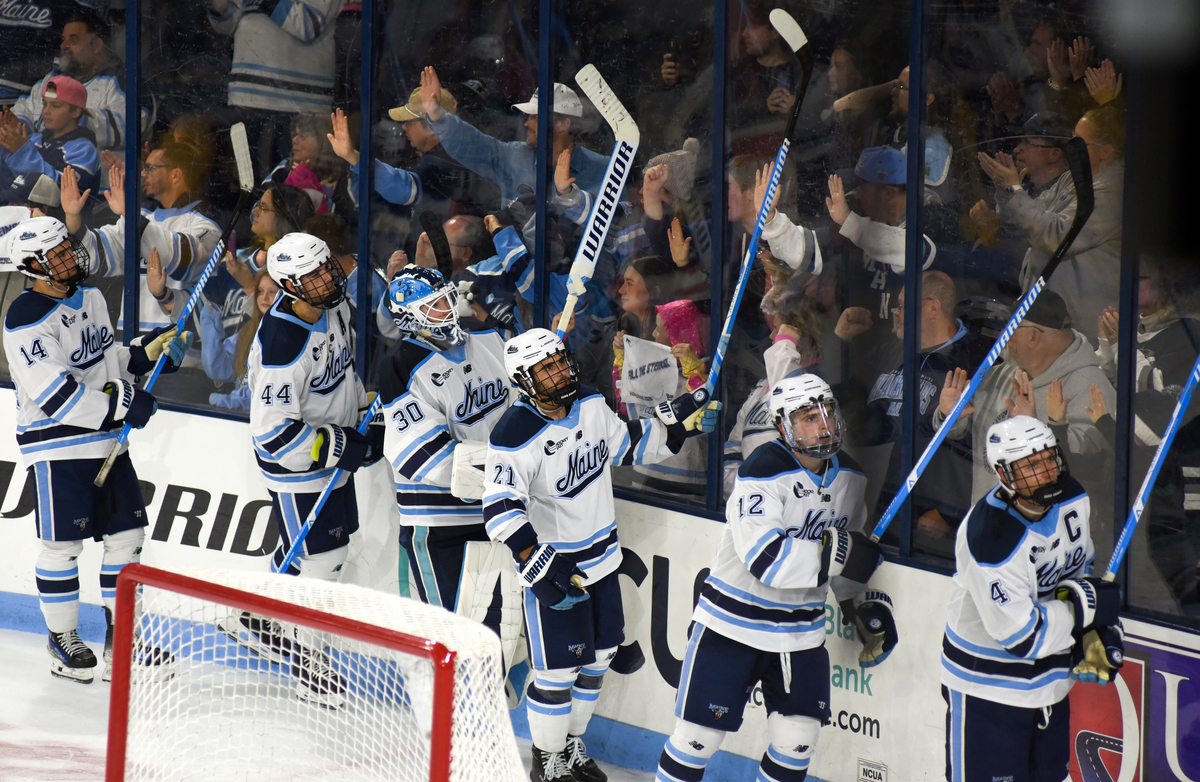
In the arms race that is modern college hockey, it’s tempting to assume that bigger budgets automatically translate into better results. The latest operating data tells a more nuanced story — and for the University of Maine, it’s a story worth paying attention to.
Start with the basics. Maine’s men’s hockey program reported $3.48 million in operating expenses for FY25, up significantly from $2.84 million the year prior. That’s a $644,000 increase — or 22.7% growth — one of the more aggressive spending jumps in the country. Among public programs analyzed, Maine ranks 13th nationally. Not elite, but far from irrelevant.
And that ranking comes with an important asterisk: the absence of private-school heavyweights like Boston University, Boston College, University of Denver, and Notre Dame. Because those programs are not subject to Freedom of Information Act disclosures, they remain financial black boxes. Still, even within an incomplete dataset, Maine’s position tells us something important — it is firmly in the competitive middle.
But here’s the real takeaway: Maine is not trying to win a spending war. It’s trying to win smarter.
Compared to the sport’s financial giants — Michigan State at over $9 million, Penn State near $8 million, and Minnesota approaching $7 million — Maine simply cannot keep pace dollar for dollar. Instead, it operates alongside programs like Western Michigan, University of Connecticut, and Minnesota State, all clustered around the $3 million to $3.5 million range. This is hockey’s “second tier” — programs that aren’t defined by massive resources, but by how efficiently they use what they have.
That’s where Maine stands out.
While many programs chase growth at any cost, Maine appears to be threading a rare needle: increasing investment while remaining profitable. With reported revenues of $4.5 million, the program generated a net surplus of just over $1 million. In an era where collegiate athletic departments routinely operate in the red, that’s not just impressive, it’s strategic.
This isn’t accidental. Across the sport, the biggest spending discrepancies are driven not by recruiting or coaching salaries, but by facility costs — massive debt payments, leases, and arena expenses that can exceed $2 million annually for top programs. Maine, by contrast, reflects a more traditional hockey cost structure. Fewer financial resources are tied up in infrastructure, leaving more flexibility in how the program allocates its dollars.
That has consequences. Programs like Michigan State or Arizona State can outspend Maine in almost every category. But Maine’s model forces discipline. It emphasizes player development, recruiting efficiency, and coaching impact over sheer financial muscle. In some ways, that’s a return to what college hockey has always been about.
Of course, the unavoidable question remains: Does spending actually lead to winning?
The answer, as always, is “somewhat.” High-spending programs are more likely to reach the NCAA tournament, but the correlation is far from perfect. Even in this dataset, a few big spenders underperformed, while mid-tier programs remained competitive. And with so many private schools missing from the financial picture, any conclusion must be tentative.
Still, for Maine, the implications are clear. Sitting in the upper-middle tier of spending means the program has enough resources to compete — but not enough to coast. Success will depend on outperforming richer programs, not outspending them.
And there’s another wrinkle: the numbers we’re analyzing don’t include NIL (name, image, and likeness) payments or direct athlete compensation. In today’s landscape, those off-the-books resources can shape recruiting and roster retention as much as any operating budget. For Maine, that reality raises an additional challenge — and opportunity. Continued competitiveness may depend not just on institutional spending, but on the ability to cultivate private support and NIL funding streams.
So where does that leave the program?
Maine hockey is investing aggressively, but doing so with restraint. It is financially competitive, but not dominant. And perhaps most importantly, it is proving that fiscal responsibility and athletic ambition don’t have to be mutually exclusive.
In a sport increasingly defined by financial escalation, Maine offers a different model — one built not on how much you spend, but on how well you spend it. Whether that model can consistently produce championships remains to be seen.
But in an era of excess, there’s something refreshing — and potentially powerful — about a program that refuses to lose its discipline.