The U.S. is one of the largest sugar producers in the world. And for more than 200 years, the sugar industry has gotten special protections from the government. Why?
Guests
Chloe Sorvino, staff writer at Forbes, where she leads coverage of food, drink and agriculture
Colin Grabow, associate director at the Herbert A. Stiefel Center for Trade Policy Studies at the Cato Institute, a libertarian think tank.
Also Featured
Neil Rockstad, sugar beet farmer in Ada, Minnesota. Former president of the American Sugar Beet Growers Association.
Rob Johansson, director of Economics and Policy Analysis for the American Sugar Alliance, the national coalition of sugar beet and sugarcane growers, processors and refiners.
The version of our broadcast available at the top of this page and via podcast apps is a condensed version of the full show. You can listen to the full, unedited broadcast here:
Part I
AMORY SIVERTSON: Last summer, President Donald Trump posed a question that, on its face, seemed low stakes. Why isn’t American Coca-Cola made with cane sugar?
DONALD TRUMP: I said to the head of Coca-Cola, “You gotta go to sugar. They do in other countries.” And you know what?
They went to sugar.
SIVERTSON: In places like Mexico and Australia, Coca-Cola is sweetened with cane sugar. In the U.S., Coke is made with high-fructose corn syrup and has been since the 1980s. But last July, Trump posted on social media, quote, “I’ve been speaking to Coca-Cola about using real cane sugar in Coke in the United States, and they have agreed to do. I’d like to thank all those in authority at Coca-Cola. This will be a very good move by them. You’ll see. It’s just better.”
Now, Trump is famously a Diet Coke fan. He has a Diet Coke call button on his desk in the Oval Office, and Diet Coke uses primarily an artificial sweetener, aspartame. Still, less than a week after this social media post, then-CEO of Coca-Cola, James Quincey, said this on CNBC.
JAMES QUINCEY: We’re going to launch a Coke a Coke option sweetened with U.S. cane sugar put in the marketplace. The president is a well-known, enjoys the Coca-Cola brand. We love that. He’s knowledgeable about the industry, and we think it’ll be a great option for consumers as we give people more choice and more ways to enjoy the Coca-Cola brand.
SIVERTSON: President Trump isn’t just knowledgeable about the sugar industry. He’s connected to it, as are a slew of politicians, past and present, including past presidents. The U.S. is one of the largest producers of sugar in the world, and for more than 200 years, the sugar industry here has had special government protections.
Big Sugar has big political influence in the U.S. So today we’re asking, does Donald Trump, the Diet Coke drinker, really care if regular Coca-Cola tastes better, or is there something more going on here that speaks to the government’s relationship to the sugar industry? How did sugar get a sweet deal from the U.S. government, and who’s really benefiting from it, and who’s paying the price?
Joining us now is Chloe Sorvino. She’s a staff writer at Forbes, where she leads coverage of food, drink, and agriculture. Chloe, welcome to On Point.
CHLOE SORVINO: Thanks for having me. It really is a sweet deal.
SIVERTSON: Okay, so we’re going to get into that. But first, I feel like we need to just understand a little about how sugar is grown in the United States.
What does this process look like?
SORVINO: Yeah, so there’s pretty much two types of sugar that’s grown in America. We’re going to be talking, I think, mostly about cane sugar, but there also are sugar beets out there, and that’s grown mostly in the north states like Minnesota. And cane sugar is mainly grown in places like Florida or the Caribbean, has to be pretty tropical.
Cane sugar can interestingly grow in very marshy or swampy lands that really can’t grow many other things which it makes it good in some ways. It’s using land that otherwise wouldn’t be going towards much. But there’s a lot more that goes into it.
SIVERTSON: Okay. And the sugar industry also involves processing the sugar once it’s been grown.
What does that entail?
SORVINO: So that can look like a lot of different things. There are some pretty big companies out there that are doing refining of sugars, and that can be a liquified form, that can be more of a block sugar form. It really depends on what types of companies are going to be buying the sugar at the end of the day, and what they’re going to be putting it in.
For a Coca-Cola product, they’re going to want a liquified cane sugar.
SIVERTSON: Okay. And how large of an industry is sugar in the U.S.? We’ve been saying it’s one of the biggest, but how does it compare to soy or corn here?
SORVINO: Corn and soy are definitely the biggest agricultural commodities we have, but sugar is a close third.
Corn and soy are definitely the biggest agricultural commodities we have, but sugar is a close third.
Chloe Sorvino
And it is massive, and it really is ubiquitous in probably 80 to 90-plus percent of what’s sold at grocery stores today.
SIVERTSON: Okay. So sold at grocery stores, but how else is this sugar being purchased? Who’s buying all of it?
SORVINO: Yeah, it’s not just grocery stores. These are, sugars are used as ingredients in beverages, in fountain sodas, in different products you would never expect them to be in, at fast food chains, like buns, and even in some meat patties.
Sugars are used as ingredients in beverages, in fountain sodas, in different products you would never expect them to be in.
Chloe Sorvino
And these are derivatives that are ending up in a lot of just the processed, high- highly processed foods that our food system has become known for.
SIVERTSON: Yeah, I have to say, it was some years ago now that I tried to do just a month without sugar, and it was transformative. It was, I was alarmed at the sugar in peanut butter and ketchup and cereal, and I’ve become a sugar counter, not so much of just my own diet, but just, I’m just so curious now how much sugar is in products that I never would have thought would have sugar.
SORVINO: Yeah, they really have been sneaking it into these formulations. It hides a matter of all sins, really, and that’s why it has been so used for so long, and we’re now starting to hear folks thinking about taking out of their diets, and it’s become more of this kind of four-letter word in some communities.
But at the same time, it’s still so deeply intertwined with how food is made in America.
SIVERTSON: Sugar hiding all sins. I think that phrase is gonna stay with me going forward. Can you talk about who some of the big players in the sugar industry are here in the U.S.?
SORVINO: Yeah. So U.S. Sugar is the kind of dominating biggest producer of sugar in America.
They’re based in Florida. It’s now owned by mostly an ESOP and the founder’s charitable foundations. And the second biggest player, and their neighbor also in Florida, is Florida Crystals, which is owned by the Fanjul family. They are the largest sugar refiner in the world. They own ASR and they own Domino Sugar and a lot of these other brands internationally.
So they’re a massive dominant player. And then you also have a Louisiana co-op that does a lot of refining of sugar that’s actually a joint venture with Cargill, which is America’s largest private company, and has billions and billions, over 100 billion-plus in revenue every year.
SIVERTSON: Okay. You mentioned the Fanjul family, whom you’ve profiled for Forbes and they are huge names in the sugar industry. Can you tell me a little more about them? Who are the Fanjuls? How did they become sugar royalty in the U.S.?
SORVINO: Yeah, they really are sugar royalty, and that’s because they come from actually sugar royalty in Cuba.
So the folks that are running this company today are Alfy and Pepe Fanjul. They are the co-chairman and co-CEOs of Florida Crystals. They also have three other brothers who are involved in the business as well, and this is a 100%-owned family business. They are actually the children of this marriage that united two of Cuba’s wealthiest sugar families back in the early 1900s.
And so their family business had around 10 sugar mills and real estate across Cuba, even a broker in New York by the time in 1959 when Fidel Castro led the Cuban Revolution. And when that happened, essentially everything was taken from them. Fidel Castro’s folks came in, they sat down with their lawyers.
Alfy recalls having a yellow pad and pencil, and they had machine guns on the table, and they chatted for a while. And then essentially what happened was, like, the leader grabbed the machine gun, pointed to the map on the wall where they had different properties and different sugar mills, and he looked at Alfy and said, “We’re going to take it all anyway.”
And so that’s how this started, right? So they flee to New York. They raise some money from other Cuban refugees, $640,000, $100,000. And the Fanjuls then bought, started from scratch and bought 4,000 acres of land off the shores of Lake Okeechobee in Florida and started to rebuild what they have always done, which is grow and mill sugar.
They purchased old parts from sugar mills in Louisiana, shipped them in by barge, and their first sugar mill opened in 1960, and they pretty much grew from there with Alfy and his father back then, starting this business, and Pepe, Andres, Alexander, and Lillian, these other brothers, joined.
And through the ’80s and ’90s, they did a lot of acquisitions, had some very big breaks, and became this ubiquitous, intractable sugar powerhouse in the U.S.
SIVERTSON: Yeah, and they’ve had relationships with the most powerful politicians in the country, including former President Bill Clinton and now President Donald Trump.
What do we know about these relationships and how they’ve been forged and strengthened over the years?
SORVINO: These are some of the kind of clearest ties to politicians that you’ll see, I think, with business leaders, especially in the food industry. And this example from Bill Clinton and Alfy’s relationship, I think is quite telling.
The Fanjul family and their company has been courting politicians over the years across both aisles for a long time. And clearly after their whole Cuba situation they found that to be beneficial. But there’s no better example historically for them than Alfy was the co-chairman of Bill Clinton’s Florida campaign in 1992.
The Fanjul family and their company has been courting politicians over the years across both aisles for a long time.
Chloe Sorvino
And then, through the ’90s, especially with Al Gore trying to do more environmentally and clean up the Florida Everglades, big sugar was getting really called out for polluting the Everglades, having water issues, air issues, and Al Gore really wanted to have ability to, you know, have some kind of retribution, and he wanted to tax Florida sugar growers a penny per pound to fund the cleanup of the Florida Everglades.
And so that’s all happening, but now you have to understand the timing of this, right? So Bill Clinton is now deep into the Monica Lewinsky scandal. It is 1996, it’s President’s Day, and he is documented through the hearings and all that later on, we now know that he was in the process of literally breaking up with Monica Lewinsky in the Oval Office when his phone rang and it was Alfy Fanjul calling.
Monica was still there, and they literally spent 20 minutes on the phone with Alfy complaining to Clinton all about this Florida sugar grower tax and cleaning up the Everglades. And it meant enough to Clinton for him to take the time to pause and hear what Alfy needed to talk about. And what we know is that what Alfy, whatever Alfy said did work according to reporting at the time and the great book The Swamp, which is all about Florida and the Everglades and Florida politics.
We know that Clinton quietly withdrew his support of this tax.
Part II
SIVERTSON: You were telling me about Bill Clinton’s relationship with the Fanjuls, taking that 20-minute phone call in the midst of breaking up with Monica Lewinsky back in the ’90s. Talking about today and President Trump’s relationship with the Fanjuls, what do we know about the origins of that relationship and the nature of it?
SORVINO: So we know that they’ve been friends, particularly Pepe, who leans more conservative compared to Alfy. Pepe and Trump have been friends for 40 plus years, decades. They’ve all been deep in these Palm Beach social circles for a long time, and those circles can be quite small. We know that Pepe particularly donated nearly a million dollars to the inauguration fund.
It was at Trump’s inauguration. We know that before that he’s always been a part of his inner circle. He’s hosted fundraisers during 2026 and 2020 presidential campaigns. And we know that even their friendship is strong enough that in May of 2024, on the day that Trump’s conviction in New York on 34 counts of falsifying business records, that Pepe himself co-hosted a fundraiser for Trump at his luxury co-op on Manhattan’s Upper East Side.
SIVERTSON: I’m also seeing, this is according to Bloomberg, that Pepe was one of the first financial backers of Trump’s ballroom, and at a donor event he congratulated, Trump congratulated Pepe on his, quote-unquote, “monopoly of sugar.” So this is a, yeah, this seems to be a warm, cordial relationship.
We also mentioned that Trump is known for being a Diet Coke drinker, and having that famous Diet Coke button on his desk and his advocacy for Coca-Cola to put a version of the drink on the market using U.S.-produced cane sugar. How do you think the Fanjuls potentially factor into this Coca-Cola campaign of sorts that Trump has taken up?
SORVINO: Yeah, we know that also Trump has pitted Pepe and the Fanjuls against Coca-Cola in some ways, right? Because when this Coca-Cola CEO came to Washington to talk to Trump about this and he was bringing up the cane sugar that when Trump believed that there wasn’t enough, that when he had heard there wasn’t enough supply, he called up his friend Pepe immediately to see if that was true or not.
And so there’s that. But there’s also just how, because they’re so big and so ubiquitous in the big sugar situation, the Fanjuls’ companies, Florida Crystals, ASR, they have for years and years sold sugars to different Coca-Cola lines. They’ve never been this exclusive supplier, they’ve never been for a specific line, but they have always, they’ve been a major sugar supplier for them for a long time.
SIVERTSON: A Coke spokesperson told On Point just yesterday in an email that all glass bottles of Coca-Cola original taste are now made with cane sugar and available nationwide. So on the one hand, it seems like Trump maybe got his way, but they did not respond to our question of whether the Coca-Cola is made with U.S. cane sugar.
So we are still waiting for a response on that. But Chloe, I wonder, this question of Coke being made with cane sugar in the U.S. and with U.S. cane sugar potentially, it seems low stakes, as I said, but is it? What does this move by Coca-Cola signify about the government’s involvement in the sugar industry?
SORVINO: It really shows that the government is not getting out of sugar any time soon. They continue to see it as this agricultural powerhouse. It in some ways has a hold on the kind of power levers politically. And we’re now in this situation where obviously, big food and big sugar and big pesticide companies have been trying to bend politics to their will for a long time.
But this is the clearest example in a lot of ways. And in a lot of ways, it’s also disappointment for Coca-Cola, right? Because they actually had an opportunity here to take it and run with it, with Trump’s kind of Made in America pushing, right?
Florida Crystals, despite some kind of controversial environmental aspects of their business and their farming they actually are 10,000 of their, over 100,000 acres of farmland or so, is actually America’s largest certified regenerative organic farm in the U.S., and it’s the only one growing sugar. And so if Coca-Cola had actually tried to create only made in the U.S., only Florida Crystals product, they actually could have put a stamp on creating actual sustainable traceable supply chains, something that actually would be quite American. And something that I do think consumers want, especially some of the consumers that voted for Trump and a lot of those MAHA voters.
But now you have just this meeting in the middle of, it’s cane sugar, we don’t know where it’s coming from, there’s no traceability. Is it even really made in the U.S.? Do people even then care? And we’re just now getting muddled in the middle.
SIVERTSON: Okay. Chloe, standby. I wanna bring another voice into this conversation, and that is Colin Grabow, Associate Director at the Herbert Stiefel Center for Trade Policy Studies at the Cato Institute, a libertarian think tank.
Colin, welcome to On Point.
COLIN GRABOW: Hi, Amory. Thanks for having me.
SIVERTSON: It’s great to have you. So we’ve heard Chloe say that the government is not getting out of sugar anytime soon, potentially. But the government has also been involved in the sugar industry for a long time. So I wanna trace some of this history of government protections for the sugar industry.
When did the government get involved and why? Why sugar?
GRABOW: Sure. So you can find examples of protection for sugar going back into the 1800s, so this is longstanding. Sugar has been very successful in getting protection for them, try to keep out foreign competition. And it’s been very steady with only very limited exceptions.
You can find examples of protection for sugar going back into the 1800s.
Colin Grabow
I think there was a brief period in the late 1800s when the government decided it had too much money on its hands, a big federal surplus, and to reduce that they decided to suspend tariffs on sugar. And then also in the 1970s there was a few years where there was no protection for sugar because of high international sugar prices.
But yeah, it’s been very steady, and the sugar industry is a great example of how special interests can get their policies in place to benefit them at the expense of the rest of us.
SIVERTSON: So what made sugar the chosen commodity 200 years ago and now?
GRABOW: Yeah, sugar it’s always been an important ingredient.
It’s a major industry, major crop. So I think it really speaks to political influence. Back in the 1800s, there was tension between the North and South in that you had in the North, they want to produce molasses, so they want access to cheap sugar.
So you’ve seen these tensions. But ultimately the sugar industry has always been very successful in getting their way. And once you get protectionism in place it’s very hard to undo. We have a certain number of people that are very invested in maintaining this protection.
The average American does not even know it exists, and I think our politics and our policy reflect that.
SIVERTSON: So the squeakiest, sweetest wheel gets the grease.
GRABOW: I think that’s a fair way to put it. Yes.
SIVERTSON: Okay. So what do these protections look like in their current iteration?
What benefits are the farmers and the companies receiving?
GRABOW: Yes, so it is U.S. government policy to restrict the amount of sugar made available for consumption. Now, if you just do a Google search, go to the U.S. Department of Agriculture’s website, they explicitly state this. They restrict the amount of sugar available, and they do this through a few different mechanisms.
It is U.S. government policy to restrict the amount of sugar made available for consumption.
Colin Grabow
One is that they limit the amount of domestic sugar that is made available. This is through something called marketing allotments. So they say, in the following year there’s going to be so much sugar beet sugar made available, so much sugar cane. And then they allocate the states of Texas, Louisiana, and Florida are allowed to produce so much cane sugar.
And the sugar beet processors, they can offer so much beet sugar. And then in addition to that, we have a system of tariffs to keep out foreign sugar. The end result is when you restrict supply of sugar and demand remains steady, this is Econ 101. You’re going to drive prices higher through supply restrictions.
When you restrict supply of sugar and demand remains steady, this is Econ 101. You’re going to drive prices higher through supply restrictions.
Colin Grabow
So it’s basically, trying to keep sugar off the market to keep prices high to benefit sugar processors and farmers.
SIVERTSON: Okay, and in talking about the high price of sugar, how does it compare in the U.S. to international markets?
GRABOW: Yeah, it depends on when these prices jump around.
But as of earlier this year, I think currently it’s around twice as much in the United States, the price of sugar, as what you find internationally. Sometimes we’ve seen three times as much. I believe there was a period back in the ’80s it was five times as much. So yes, Americans pay significantly more for the sugar they consume.
SIVERTSON: Okay, and so the idea is that even though the price is high here, the tariffs on international sugar are so high that it still makes it worth it to buy sugar in the U.S. as opposed to importing from other countries.
GRABOW: Yes. So we allow a certain quantity of sugar to come in at low tariffs, and then beyond that amount, anything beyond that is subject to these very high tariffs that I think are around, I wanna say 15 cents per ton.
It basically doubles, if you look at the current cost of international sugar, it basically doubles the cost of it to put it in context. So it’s meant to dissuade it, but sometimes the price of sugar here domestically will become so high or supply is so difficult to obtain that people sugar users, candy manufacturers, will turn to the international market.
I think last year or the year before, there was stories about this happening because of the high prices here at home. Occasionally can become economic irrational to import sugar from abroad despite the tariffs.
SIVERTSON: Okay and Chloe Sorvino, I’m curious if you know this, can speak to this.
When we think about where U.S. sugar is going, other than U.S. food companies buying it and using it to make their products, do we know what percentage of sugar that’s produced in the U.S. is purchased by the U.S. versus how much is exported?
SORVINO: It’s a lot more than I think people would realize. In the U.S., we actually export a lot of our food overall, and I believe for sugar it’s about two million metric tons that are eventually exported. A lot of that’s going to Mexico and Canada. Mexico obviously produces a lot of its own sugar, too.
And it’s going really around the world.
SIVERTSON: Okay. And Colin, are other countries as protective of their sugar industries? Do they keep their domestic sugar prices high as well?
GRABOW: So protecting sugar is not a uniquely American phenomenon, but I would say if you look around, the U.S. is definitely in the more protectionist end of the spectrum.
For a long time, the European Union had extreme protections, and for their sugar industry as well, sugar beets. They began reforming those, I believe, around a decade ago or so. Australia, also another major sugar producer, they had a pretty extensive protectionist system in place, but same, I think around 30 years ago, back in the ’90s or so, they started to make theirs more market-friendly.
So yes, you can find protectionism and supports elsewhere around the world, but I do think the United States is a little exceptional. Or definitely in the more protectionist end of that spectrum.
SIVERTSON: Okay. And if these protections didn’t exist, these market allotments that you’re talking about, and the tariff rate quotas, what would happen to the sugar industry in the U.S.?
GRABOW: Yeah, the U.S. government did a study I want to say about a decade ago or so, that looked at the impact of different import restraints, including the U.S. sugar program. And my recollection is they calculated industry would decline by about 10% something like that. So it would be lower, but it would still exist.
This is not existential. This doesn’t determine whether we have a sugar industry or not. But according to government studies, it would be somewhat smaller.
SIVERTSON: Okay. We’re going to be hearing from a sugar, someone in the sugar industry when we have to take another break here in just a couple of minutes.
But Colin, the government also loans money to sugar producers. Can you explain that for us?
GRABOW: Yes. So the U.S. government will loan money to sugar producers which they take this money and they buy up crops from farmers, and then they process it. And after processing it, they pay it back to the government, is the way it’s supposed to work.
Now these are called non-recourse loans, meaning that the collateral they put up is all they’re liable for. What happens is the government extends the loan, and collateral’s put up, and they say, so much sugar will get you, will secure the loan.
So the U.S. government has an interest in maintaining a certain minimum price of sugar to ensure they get paid back. Because if the price is too low, the processors will say that’s fine. You guys can just keep the collateral. We’re not interested in paying it back. So the U.S. government finds itself in a position where it is very invested in maintaining a price floor for sugar.
The U.S. government finds itself in a position where it is very invested in maintaining a price floor for sugar.
Colin Grabow
SIVERTSON: So we spoke to Rob Johansson, who’s the director of economics and policy analysis at the American Sugar Alliance. He’s also former chief economist at the U.S. Department of Agriculture. And when he was asked about whether the USDA’s sugar loan program sets a floor price for sugar, he said this.
ROB JOHANSSON: That’s true.
It does provide a floor price. We just haven’t ever really utilized that program. We haven’t hit that floor price since 2013. So we did see some forfeitures that happened back then. It becomes more expensive, essentially, to repay the loan. It’s more economical for the owner of the sugar to repay the loan by forfeiting sugar to the U.S. government at that loan rate, as opposed to repaying it at, or selling the sugar at an even lower price and then repaying the loan.
SIVERTSON: This is just an aspect of this industry that I truly knew nothing about, and it sounds like the government is potentially really taking a hit by offering loans to the sugar companies that they don’t end up repaying.
GRABOW: Yeah, so as Rob mentioned, back in 2013, I believe, there was a situation where the sugar was forfeited.
So the government had to buy up this sugar, and then figure out what to do with it. So it was a fairly embarrassing situation. It’s not the only time that’s happened, by the way. I believe in the late ’80s, there was another situation where the U.S. government had a bunch of sugar on its hands, bought it, I wanna say something, like 15 cents per ton, and then sold it to the Chinese at five cents just to get it off their hands.
So yeah, this is one of the dangers of running this program, is you can, if you don’t get your calculations right, you don’t restrict the sugar sufficiently, and the price goes too low, then you have all this excess sugar on your hands.
Part III
SIVERTSON: Chloe and Colin, I mentioned that we talked to a sugar beet farmer, so roughly a third of American beet sugar comes from the state of Minnesota. And we heard from Neil Rockstad, who’s a third-generation sugar beet grower in Ada, Minnesota.
NEIL ROCKSTAD: Many of your listeners may be familiar with the regular table beet.
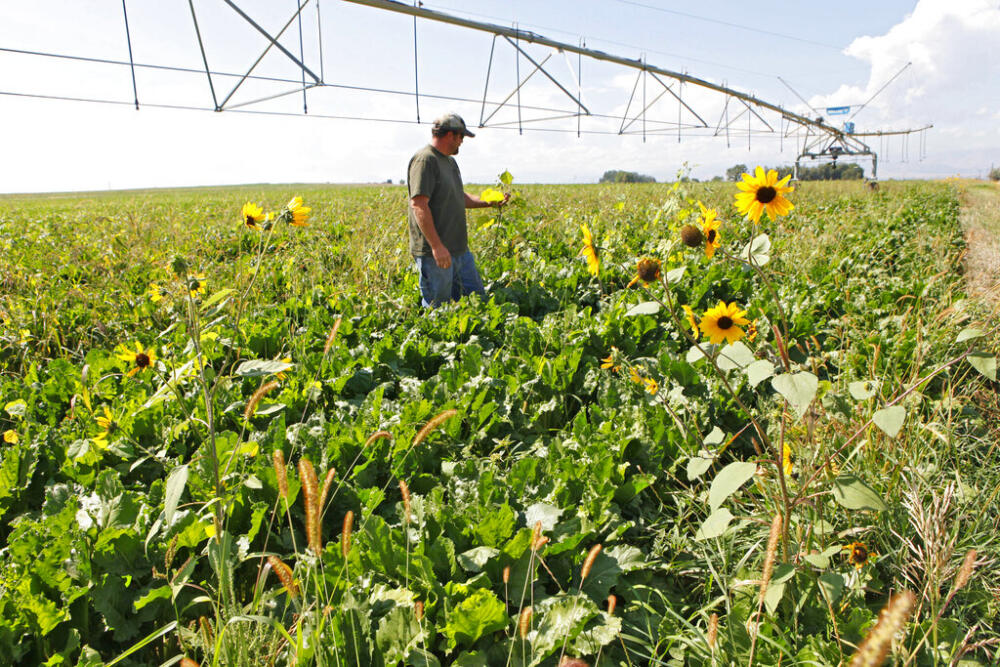
It’s grown in the ground. It’s red in color. That’s a cousin of the sugar beet, so the beet shape looks the same, except a sugar beet is white.
SIVERTSON: Rockstad says sugar beets make up about a quarter of his farm. He wouldn’t tell us how large his farm is, but the average Minnesota sugar beet farm is around 390 acres, according to the USDA’s data from 2022.
Rockstad says he plant sugar beets in the spring, and then about six months later:
ROCKSTAD: We harvest in the fall of the year when our Minnesota winters turn cold. We’re able to pile those sugar beets outside on the ground and let Mother Nature become our refrigerator and store those beets until we’re able to process them.
SIVERTSON: Now, growing sugar beets has its ups and downs, Rockstad says.
Bad weather can kill plants or make it tricky to harvest them. Insects like sugar beet root maggots or funguses like leaf spot can wipe out a crop.
ROCKSTAD: This year, we had an extremely significant wind event, sustained winds of 60 miles an hour, gusts up to 80 miles an hour. Some sugar beet fields, the beets actually blew out of the ground with that extreme wind and forced a replant.
SIVERTSON: When it’s time for processing, Rockstad takes his sugar beets to the American Crystal Sugar Company. There, they’ll get sliced up, soaked in hot water, and turned into bags of sugar for grocery store shelves, or be sold to food manufacturers for products like cereal or soda.
ROCKSTAD: I raise my sugar beets under contract as a cooperative member with American Crystal Sugar.
It provides me the right, it also is an obligation, even in a year like this year, where I’m expecting to not turn a profit or most likely lose money raising sugar beets, I’m obligated to deliver my share of beets to that factory.
Even in a year like this year, where I’m expecting to not turn a profit or most likely lose money raising sugar beets, I’m obligated to deliver my share of beets to [American Crystal Sugar].
Neil Rockstad
SIVERTSON: The American Crystal Sugar Company says it produces 3.5 billion pounds of sugar per year.
As a sugar beet grower, Rockstad supports limits on the amount of foreign sugar that can come into the U.S. He says it’s the USDA balancing the market and supporting domestic production.
ROCKSTAD: They make sure that there’s always a surplus of sugar on the market, but they also try to ensure that there isn’t too much sugar on the market, which would therefore collapse our prices.
We as Americans have enjoyed a stable balance of sugar forever. That’s sugar that’s produced domestically with American safety standards, American labor standards, produced by American farmers on American soil using American workers, and contributing $23 billion annually to the United States economy and supporting 151,000 jobs.
That’s been the benefit to the American consumer.
[Without a sugar program] I would be out of business. Our processing facilities would be gone. 151,000 jobs across the United States would be gone.
Neil Rockstad
SIVERTSON: Rockstad says meddling with the sugar program as it currently stands would decimate the domestic sugar industry.
ROCKSTAD: Small towns like mine in Ada, Minnesota, you would wipe them off the map. We wouldn’t have the hospitals we have. We wouldn’t have the school system we have.
I would be out of business. Our processing facilities would be gone. 151,000 jobs across the United States would be gone. And those buying sugar would be completely reliant on sugar being loaded on a slow boat and coming across the ocean and showing up whenever they decided it should get here.
SIVERTSON: That’s Neil Rockstad, a sugar beet grower in Ada, Minnesota.
And Chloe Sorvino, I’m curious to hear your thoughts on what we just heard from Neil and how familiar they sound to you.
SORVINO: Yeah, these are echoes that I hear constantly from different corners of America’s agricultural powerhouse producing regions. Unfortunately, there has been such a kind of loss in rural communities and as farms have had to get bigger, some of these smaller independent farmers who were selling to co-ops, like we just heard about have been really getting squeezed in the process.
And even in an industry like sugar, where there are such kind of protections and government supports happening, these are farmers that are still very much struggling, and that is something I see across the board. There are serious challenges that the farmers of our country face. And unfortunately, a price floor isn’t really totally going to fix that.
And Colin might say it may even hurt that, but these are intractable issues that run even deeper.
SIVERTSON: Yeah, so Colin, I do want your thoughts. Because you get the sense from Neil there that without the U.S. sugar program, farmers like him would be in dire straits. But do we know how sugar farmers are doing under this program generally?
GRABOW: No I can’t tell you specifically how they’re doing. But I just point out that Neil framed his comments, very pro-America, patriotic, about American workers, American companies. And I think that something America stands for is freedom, and I think if Americans want or want to buy sugar from Brazil or wherever else, they should be able to do that.
That’s part of being a free person. But furthermore, let’s talk about jobs and wiping out towns and businesses closing. That’s exactly what has happened with the sugar program. Let’s think about all the sugar-consuming industries, like candy manufacturers, for example, that have packed up and moved abroad, not necessarily because the wages are cheaper, lower regulation or taxes, anything like that.
It’s because they can actually get access to sugar at international prices, and I think that’s worth bearing in mind as part of this conversation.
SIVERTSON: Yeah, and we do have some tape here from someone at a candy company, to your point. Some companies like Spangler Candy buy sugar by the truckload, and Spangler is one of the last hard candy manufacturers that still operates in the U.S..
They make Dum-Dums, Bit-O-Honey, and candy canes. And Spangler CEO Kirk Vashaw spoke with NPR last year.
VASHAW: Chicago used to be the candy capital of the United States, and it’s not anymore. It’s been hollowed out. If you go out in the candy aisle and look at hard candy, you’ll see most of it is made outside the United States.
It’s not the cost of the labor. It’s the cost of the sugar.
SIVERTSON: Yeah, so say more about that, Colin. Is it the cost of the sugar is potentially closing companies here. What can we do to mitigate that?
GRABOW: Yeah, what we can do is give Americans access to market price sugar from abroad.
If we had access to cheaper sugar, that’d be a benefit to sugar-consuming industries. And we talk about candy, but it goes beyond that. I think earlier in the show you mentioned how ubiquitous sugar is in our food supply, and I’m not going to take a position on whether that’s good or bad, but it is what it is.
And all these industries have to pay more. And if they have to pay more, that means they have to make sacrifices elsewhere. That means lower pay for workers, or it means less investment. It means, fewer workers. Something, there has to be a trade-off there. And of course we started off very early about talking about Donald Trump and the desire for actual cane sugar in American Coke.
And I recall when that was announced thinking, “This is great. This should start a total conversation about the U.S. sugar program.” Because there’s a very easy way for the federal government to encourage the use of cane sugar, and that’s stop taxing the bejesus out of it and just let Americans buy it at international prices.
There’s a very easy way for the federal government to encourage the use of cane sugar, and that’s stop taxing the bejesus out of it and just let Americans buy it at international prices.
Chris Grabow;
So yes, I think you look at candy manufacturers would be a beneficiary. Other industries that consume sugar would be a beneficiary, and American consumers would be a beneficiary of getting access to reasonably market price sugar.
SIVERTSON: And it makes sense that a domestic candy company like Spangler is literally paying the price of these government protections.
But say more about the American consumer. How is the American consumer feeling the pain of the U.S. sugar program, if I can put it like that, in ways that they might not even be aware?
GRABOW: My model of how businesses work is they’re very reluctant to eat costs, and whenever they get the opportunity, they will pass those along to consumers.
And I think we all pay a higher price for different products we buy that involve sugar. There have been different studies performed on this, and I think the common number you hear cited is somewhere between $2.5 and $3.5 billion is about what Americans pay due to excess or inflated sugar prices.
Somewhere between $2.5 and $3.5 billion is about what Americans pay due to excess or inflated sugar prices.
Chris Grabow
But I’d argue we pay for it in other ways. When you go to the grocery store and Mexican Coke for sale, why is that? Why do we have to import Coke all the way from Mexico? It’s because that has cane sugar in it. In ways big and small, I think we would benefit from having access to, again, reasonably priced sugar.
SIVERTSON: Chloe Sorvino, I don’t have to tell anyone listening that sugar is delicious, but it’s not good for us. So I can imagine people hearing this and thinking, “Wait, why are we propping up an industry for a product that is fundamentally not good for us?” What might the industry’s answer to that be?
SORVINO: Yeah, take a number, right? You can look at any of the major diseases out there, diabetes, heart disease so many others. And sugar is a big driver of truly them all. And I would say to that, I would say that look at also the propping up of, that the government does of the corn industry, which is, makes a lot of ethanol, right?
And then also a lot, all the high fructose corn syrup. And there’s propping up happening on both sides of this. Corn probably perhaps even more so than sugar in some ways. Yeah, but you also have to think about too that just the farmers in America, you’re always gonna have a farmer on the other end of this saying that the government is now taking their livelihoods, ruining their farms, ruining their towns and no one wants to be on the receiving end of that.
SIVERTSON: Colin Grabow, we talked earlier in the show about politicians’ relationships with people like the Fanjul brothers and other powerful people in the sugar industry, which maybe gets at the point of why the government is propping this up. What is actually in it for the government? And why does the sugar industry have this hold on Washington?
GRABOW: Yeah, I think there’s a few different things going on here. Most fundamentally, this is a case of concentrated benefits and dispersed costs. So you have a relatively small number of people that benefit from the U.S. sugar program in the form of higher prices. That means, higher income for them.
And the rest of us, we pay the cost of that. But on a per person basis, it’s fairly small. The $2.5 to $3.5 billion figure I mentioned, you divide that by 335 million Americans, and it’s what? Less than $10 per person, something like that.
That’s not the kind of thing that prompts most people to write an angry letter to Congress or to pick up a torch and march on Washington over. So the people that are invested in it devote resources to ensuring that it stays in place. You mentioned the Fanjul brothers and their cultivation of prominent leaders from both parties.
I think there’s also a really revealing anecdote that was given by John Boehner in a book he wrote in which he mentioned he spent some time on the agricultural committee, and he didn’t like the sugar program. He thought it was an obvious rip-off, and he decided to rattle the cage of the sugar industry.
And he said he’s walking through one of the hallways of Congress and spotted a sugar lobbyist, and he said something like, we need to get rid of that sugar program that’s really putting the hammer to American taxpayers.” And he said he got back to his office and he said his phone did not stop ringing for the next five weeks.
He said, “I had no idea how many people in my district were somehow connected to the sugar industry.” People that made equipment that went into that were used by sugar processors were calling him. Mayors were calling him. “So this would be devastating for my community.” And most people don’t wanna have that fight on their hands.
The costs are obvious. You’ll make a powerful interest group angry at you, and the payoff is what? Again, most Americans don’t even know the program exists. And then lastly, it gets folded into the larger debate over the farm bill. And what you find is log rolling. One member of Congress say, “Look, you keep the sugar program in place, I’ll keep this thing you like in place,” and you get these kind of deals.
The sugar program doesn’t get voted on as a standalone item. It’s folded in within this broader farm bill. So you get those sort of dynamics. You put all that together, and the end result is that we have the sugar program that economists overwhelmingly oppose and see the costs, but politically it’s just very difficult to get rid of.
SIVERTSON: Yeah, we should note that in the One Big Beautiful Bill just last year, there was a little bit of progress, big candy on the other side of things and food manufacturers would say that was made in the sense that they were able to get some flexibility on the import cap for sugar and that sugarcane and sugar beet producers are getting more price supports.
And this was a big deal because there really have not been successful attempts to pare back the sugar program in the country, in decades. As we’ve mentioned with these protections being in place for two centuries now, Colin, is there a world in which the U.S. sugar program could ever be eliminated or significantly reduced?
And what would it take?
GRABOW: Ever is a long time. But history certainly suggests that it’s not going away anytime soon. And you mentioned this deal between candy manufacturers and the sugar industry. And what it was is basically we mentioned earlier that there are import restrictions, and those import restrictions, they give certain quantities of sugar to each to various countries.
And I believe the deal was making more efficient use of those allocations. Say if a country doesn’t use its full allocation more quickly shifting that allocation to other countries that can take advantage of it. And this seems very reasonable, but it’s also, I think, very instructive that what should be a pretty small, obvious move is being hailed as a big deal.
I think that speaks to just how difficult this is.
The first draft of this transcript was created by Descript, an AI transcription tool. An On Point producer then thoroughly reviewed, corrected, and reformatted the transcript before publication. The use of this AI tool creates the capacity to provide these transcripts.