Writing this month’s recipe and column made me think of a confluence of several important events that I will try to bring together in a cohesive whole. For starters, the end of crawfish season is near, so I had to make something with them while I had the chance.
Second, it’s Mother’s Day, and it’s only fitting that I share a story about my New York mother’s journey with the mudbug.
And finally, the end of May will mark the 30th anniversary of when my wife and I (along with our, at the time, one child) moved to Baton Rouge from Dallas, and so began my immersion into Louisiana’s culinary culture — so unique and so very different from where I grew up in New York and New Hampshire.
Boiled crawfish are served at the Breaux Bridge Crawfish Festival on Saturday, May 2, 2026, at Parc Hardy in Breaux Bridge.
STAFF PHOTO BY BRAD BOWIE
But if Louisiana food came as a revelation to me, it’s fair to say that it came as something of a shock to my mom.
I can remember one particular Sunday phone call, soon after moving to Baton Rouge and before my parents had yet to visit us, when the conversation wrapped up with the question that’s always included in my family’s conversations: “What are you eating tonight?”
I answered, “Rachel is making red beans and rice.” On the other end of the phone, there was silence. After a pregnant pause, my mom quietly cleared her throat and, in a whisper, asked, “Sweetie, are you doing OK financially? Do I need to send you some money?”
Pam Douglas holds a plate of red beans and rice during the first day of the New Orleans Jazz & Heritage Festival at the Fair Grounds in New Orleans, Thursday, April 23, 2026.
STAFF PHOTO BY SOPHIA GERMER
I laughed out loud, but I immediately grasped the misunderstanding.
My mom had assumed that her daughter-in-law was scrimping and forced to serve us plain rice and a can of pork and beans — and on no less than a Sunday, my own family’s traditional day of the week for the heartiest and most extravagant meals. I tried to explain that, in Louisiana, red beans and rice is exactly that, but I could picture my mom still shaking her head with worry and incredulity.
“You’ll understand when you and dad come to visit us in Louisiana,” I assured her.
Her understanding would take time and some help from a certain freshwater crustacean.
Michael DiResto uses an immersion blender to mix the contents for crawfish parma rosa.
By Rachel DiResto
The first time my mom laid eyes on a crawfish, it was still alive. Perhaps it wasn’t my best idea, during one of her first visits to Baton Rouge, to take her to a crawfish boil. She took one look at it and blurted out, “I’m not eating that thing!”
My dad, a gifted troll before trolling was a thing, declared, “Maa,” — his shorthand, pet name version of Marilyn — “stop being such a dunkey!” (Pronounced duhng-kee, which was my mom’s own label for anyone who turned up a nose at a new food without even trying it).
He got the side-eye, as only she could give it, but she stood her ground and would eat no crawfish that day, falling back on a flimsier excuse that she wasn’t about to go through all that work of peeling them for so small a payoff.
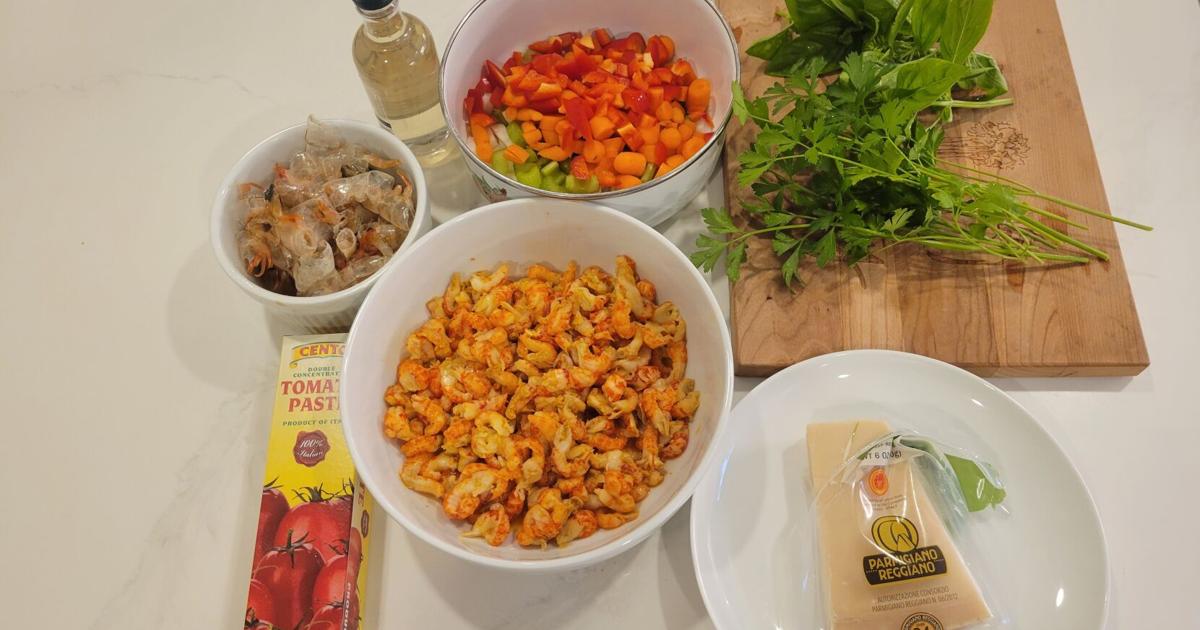
Michael DiResto’s recipe for crawfish parma rosa calls for shells from one pound of headless Louisiana shrimp.
By Rachel DiResto
And that was the opening: So, you’re saying you would try crawfish if the tails were already prepared in advance for you? Enter: crawfish étouffée.
Two days later, my wife made that dish for my parents. From that day forward, and on every occasion of my parents’ visits to Baton Rouge, it was a strict requirement that my wife make crawfish étouffée.
In my mom’s final years before her passing, when she was too frail to travel to Baton Rouge, I increased the frequency of my trips to see her in New York, and one of the last was a quick solo excursion without my wife and kids due to their school or work schedules. As a surprise, I put two packs of frozen crawfish tails in my carry-on bag and, to my astonishment, I got through airport security no questions asked.
A medley of vegetables for crawfish parma rosa.
By Rachel DiResto
My mom was delighted, until I informed her: No Rachel, no étouffée. I told her not to worry, that over the years I had concocted my own unique recipe marrying our Italian food heritage with Louisiana cuisine. Besides, maybe this would be the best way to introduce crawfish to the rest of our New York family.
It was a hit, with the word “luxuriant” uttered at the table to describe the flavor of the meal. Most importantly, mom took a bite and winked her approval. Happy Mother’s Day, mom. I extend the same sentiment to all the moms reading this story. If she were still with us, my mom would tell you, “When you make this recipe, serve it with good bread.”
Crawfish parma rosa
By Rachel DiResto
Crawfish parma rosa
Serving size two cups or two scoops from a pasta spoon
Recipe by Michael DiResto
1 pound pack of pre-cooked/frozen Louisiana crawfish tails
4 tablespoons extra virgin olive oil
Shells from one pound of headless Louisiana shrimp*
1/2 cup chopped white onion
1/2 cup chopped carrot
1/2 cup chopped celery
1/2 cup chopped red bell pepper
1/4 teaspoon fine sea salt and cracked black pepper
2 cloves garlic, coarsely diced
4 ounces tomato paste
1/2 cup dry white wine
2 cup water
Herb bouquet of fresh basil and Italian parsley
2 tablespoons salted butter
1 cup heavy whipping cream
3/4 cup freshly grated Parmigiano Reggiano
6 leaves fresh basil, torn by hand
1 pound pasta, fettuccine or rotini, plus one tablespoon sea salt
cup of pasta water (use as needed)
Note: If you do not happen to have leftover shrimp shells, use two cups of homemade seafood stock or store-bought seafood stock.
1. Thaw the frozen pack of crawfish tails at room temperature.
2. Heat olive oil in large saucepan over medium heat until bubbling.
3. Add shrimp shells, onion, carrot, celery, bell pepper, salt and pepper, and sauté for 15 minutes.
4. Add garlic and sauté for one minute.
5. Add tomato paste, wine and a cup of water. Whisk thoroughly until mixed and increase heat to bring to boil.
6. Stir in herb bouquet.
7. Cover and lower heat to medium low, and simmer for 30 minutes.
8. Take off the lid and simmer until the sauce is reduced by half.
9. Remove herb bouquet and mix the pan contents with a hand-held immersion blender or potato masher.
10. Press the tomato mixture through a fine metal sieve into a bowl, then return to pan.
11. Add butter, cream and Parmesan, then bring to boil over medium heat, whisking thoroughly, then simmer over low heat until the sauce thickens.
12. In the meantime, bring a large pot of water to boil and add one tablespoon of salt. Cook pasta to al dente, reserving one cup of salty, starchy pasta water.
13. Add crawfish and torn basil to the saucepan and continue to simmer until the crawfish is warm.
14. Add pasta to the saucepan, stir, and incorporate pasta water as needed for desired sauciness.
15. Serve on plates with extra grated Parmesan and good bread.