Hundreds of thousands of visitors encounter American history each year at the Museum of Fine Arts as they engage with period objects like Paul Revere’s silver “Liberty Bowl” and iconic portraits of founding fathers. But locals, tourists and students will experience a refresh when the MFA’s 18th century Art of the Americas galleries reopen to the public on June 19.
This major overhaul of eight rooms commemorates the nation’s 250th anniversary, and it’s been years in the making. The galleries have been closed since January for the installation of new displays that reexamine and confront histories. Curators also selected objects from other eras to illuminate, and in some cases challenge, the 18th century works.
Gilbert Stuart’s unfinished portrait of George Washington at the MFA in Boston. (Robin Lubbock/WBUR)
On a recent tour of the freshly-painted spaces, senior curator of American decorative arts and sculpture Nonie Gadsden said, of course, the collection’s stars play a role in the makeover. “You’ll see Paul Revere, George Washington, and a lot of the favorites from our galleries.”
All but one of the galleries’ 400 or so pieces have been shifted around to tell more complex stories. “They will be in different conversations with other works in our collection,” Gadsden said.
Those dialogues explore themes including colonial Boston’s connections to global culture, myth-making and artists as agents of resistance. Revere’s “Liberty Bowl” is paired with a clay vessel made by enslaved potter David Drake which the MFA acquired last year.
A large clay jar by enslaved artist David Drake stands on display by Paul Revere’s “Liberty Bowl” at the MFA in Boston. (Robin Lubbock/WBUR)
The museum has worked to diversify its perspectives since the massive Art of the Americas wing debuted in 2010. Senior curator of American paintings Erica Hirshler pointed to other additions from the Spanish Americas, the Caribbean and contemporary indigenous artists.
Then Hirshler walked over to a provocative display built around the only object that couldn’t be moved — because it’s enormous. At 12 feet tall and 17 feet wide, Thomas Sully’s “The Passage of the Delaware” occupies an entire wall and is the largest painting on display in the museum. It depicts a triumphant George Washington leading a surprise attack during the Revolutionary War.
“The event happened in 1776, and this painting was made in 1819,” Hirshler said. “So it is a look backward — it is an attempt to create an American history.”
Sully’s heroic vision of Washington dominates the room. Hirshler described how he’s at the center, more brightly lit than anybody else, “and, of course, he’s riding a white horse.”
George Washington crossing the Delaware in the painting by Thomas Sully. (Robin Lubbock/WBUR)
But a number of paradoxes live within the portrait. So the curators decided to contrast the painting’s mythic story with some darker truths about the founding father’s legacy.
“He is also complicated by the fact that he held enslaved people working on his plantation, and he also ordered General Sullivan to decimate many, many towns in upstate New York that were part of the Mohawk nation,” Hirshler said.
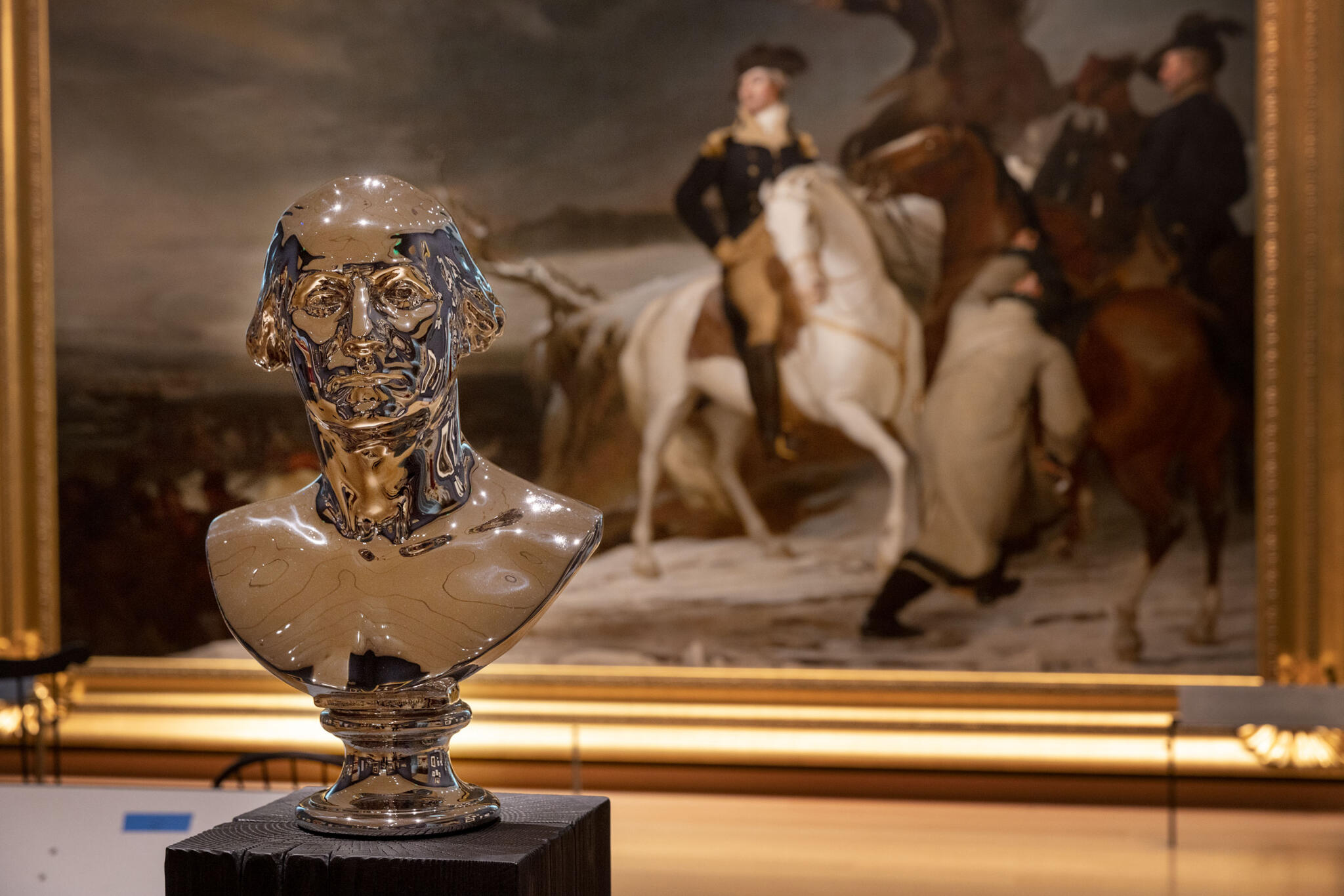
That story is revealed through a newly-acquired, stainless steel bust of Washington by contemporary Native American artist Alan Michelson. Its title is “Hanödaga:yas (Town Destroyer): Reflect,” and Michelson himself is a Mohawk member of the Six Nations of the Grand River.
Alan Michelson’s bust of George Washington. (Robin Lubbock/WBUR)
The artist explained how his highly-polished, life-sized head acts like a mirror. “So everybody has to face themselves in this hallowed founder’s face,” he said.
Michelson noted how the Cherokee Trail of Tears is infamous — but his ancestors’ tragedy is largely unknown.
“The Sullivan campaign was one of the biggest operations of the American Revolution, and it was a scorched earth campaign that destroyed 40 Haudenosaunee villages, towns, farms, orchards,” he said. “It was really an attack on the entire infrastructure of Haudenosaunee life.”
Washington also benefited personally from that violent dispossession of land.
“Nobody thinks of him as a very successful land speculator,” Michelson continued. “He inherited a 180-acre farm when he was eleven, and when he died in 1799 he had accumulated over 45,000 acres of what had been native land.”
Even so, Michelson made clear his bust is not an “I hate Washington” work. He hopes it reflects how different truths can coexist without cancelling each other out.
“One of the ironies of the founding of the United States is that American independence attacked Native independence,” Michelson said. “So, I think these revised histories — all that’s taking place in that room — is going to be a real challenge for people, and I think it’s a healthy one.”
That’s the goal of the re-installation, said MFA director Pierre Terjanian. Standing in the galleries he also acknowledged an institutional challenge that’s palpable in the space. The associate curator of Native American art who was instrumental in bringing more indigenous voices to the MFA was among 33 employees laid off in January.
According to Terjanian, the difficult decisions were driven by finances. But he sees how the optics could look to critics who say the cuts targeted diversity.
“We do understand that the connections we build with the communities have been strained with the loss of expertise and the connections have been forged by individual curators,” Terjanian said. “And we understand we have some work to do to rebuild trust.”
John Singleton Copley’s “Watson and the Shark” at the MFA in Boston. (Robin Lubbock/WBUR)
Terjanian hopes the updated galleries represent a step forward and said former Native American curator Marina Tyquiengco’s work lives on in these rooms.
Artist Alan Michelson feels the loss. He said he supports museums hiring and keeping Native American curators. At the same time he’s also honored his bust of George Washington has a permanent place in the MFA’s collection and the re-examined galleries.
Michelson believes the nation’s semiquincentennial is an opportunity to imagine the founding of the United States not just as something that happened 250 years ago, “but as an ongoing project in which we all have a real stake, and in which we participate every day.”
The 18th century Art of the Americas galleries open to the public on Friday, June 19. Admission is free to Massachusetts residents as part of the MFA’s Juneteenth celebrations and a two-day “America at 250” weekend.