U.S. Rep. Seth Moulton has amassed holdings worth at least $1 million in startups tied to the defense sector while serving on the House Armed Services Committee.
Those private investments — not available to average investors — have risen sharply in value, according to congressional filings reviewed by WBUR.
They include the smart-ring company Oura, which calls the Defense Department its largest enterprise customer and now appears headed for a public offering, as well as a 3D-printing company that contracts with the federal government and defense companies. A third is an AI firm that partners with the U.S. Army.
Congressional financial filings show the value of Moulton’s Oura stake alone has climbed from a disclosed range between $100,000 and $250,000 when he invested in 2021, to between $1 million and $5 million in 2024.
Moulton is running in the Democratic primary for the U.S. Senate seat currently held by Sen. Ed Markey.
Moulton campaign spokesperson Taylor Hebble told WBUR in a statement that the investments posed no conflict, saying none of the companies “had any ties to the defense sector when the investments were made” and described Oura as “fundamentally a wellness company.”
However, she did announce Wednesday that Moulton is “currently in the process of voluntarily placing these assets into a blind trust.”
The campaign said money behind the investments came from the private sector career of Moulton’s wife, Liz, the chief talent officer at Elevate, an executive search firm, and before that Activision, a video game company. That money was re-invested by a financial adviser, according to Hebble, who didn’t address how the family was invited into the investments. She stated the couple had “zero day-to-day input” with the financial advisor’s decisions. The financial disclosures show the investments are listed in Moulton’s filings as jointly held by the couple, rather than as belonging to his spouse alone.
Hebble said the couple have not profited from or traded the private holdings. Moulton’s investments in these companies do not violate congressional ethics rules, which require lawmakers to disclose their assets and investments in financial disclosure forms. These mandatory forms don’t include specific dollar amounts, rather a dollar range.
Their investment in Oura, for example, is listed in his filings as “preferred shares” — a class of equity typically issued to venture capitalists and angel investors during the private fundraising rounds of early-stage startups. Special funding rounds are typically limited to venture investors and a close circle of associates and clients. Early investors can make significant gains if a company’s value rises and they later sell their stakes.
Oura received an $11 billion valuation in its latest funding round and filed paperwork for a potential IPO.
Moulton also invested early in a firm called Iris Investment Holdings LLC, which later became webAI. The company builds artificial intelligence systems and was selected last year as a partner for a U.S. Army program. In 2023, Moulton made two investments in the company — totaling between $30,000 and $100,000. Just one year later, his stake in the company was worth between $500,000 and $1 million, according to his 2024 financial disclosure.
In 2023, Moulton and his wife invested between $50,000 and $100,000 in Divergent Technologies, a California 3D-printing company that manufactures components for contractors, including Lockheed Martin and Raytheon. The company also holds a contract with the Air Force and announced this month it would help produce Tomahawk missiles. The value of the Divergent shares remained between $50,000 and $100,000 in 2024. Last year, Moulton disclosed another $15,000 to $50,000 stake in the company.
After his second investment in Divergent with his wife, Moulton issued a statement in September acknowledging that Divergent had expanded into defense work and pledging not to “put forth policies or requests that principally benefit” the company.
The campaign described the three holdings as “cutting-edge companies bringing manufacturing and jobs back to America.”
How much Moulton’s investments are currently worth is unclear. He hasn’t filed his 2025 disclosure— which would show any increase or decrease in the value of his holdings.
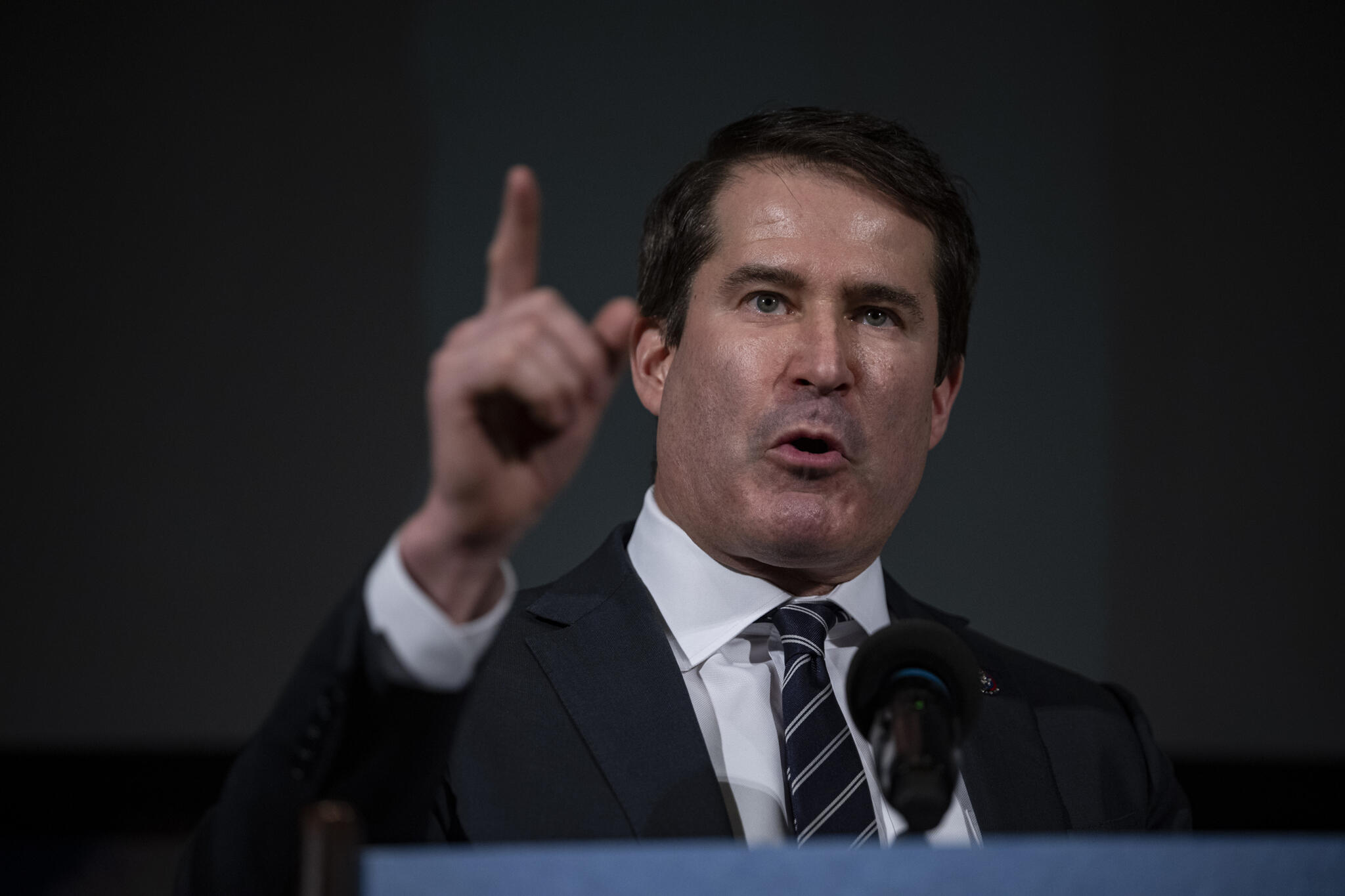
U.S. Rep. Seth Moulton speaks at the Massachusetts Democratic Party convention on May 30, 2026. (John Tlumacki/The Boston Globe via Getty Images)
Jordan Libowitz, a vice president at the watchdog group Citizens for Responsibility and Ethics in Washington, said Moulton’s decision to put these assets in a blind trust is “a great step forward, but it’s equally important to divest from possible conflicted assets.”
“If you just put what you already have in the blind trust, you still have a good idea of what you own,” he said.
Hebble said Moulton will recuse himself from any congressional votes that could benefit Oura, webAI or Divergent Technologies.
Moulton’s investments in question are in private companies, not publicly traded stocks. Efforts to bar members of Congress from trading individual stocks have been proposed in recent years, but none has become law — and many of the leading proposals are aimed at stock trades, not private investments.
Moulton has previously cosponsored legislation banning stock trading in Congress, according to his campaign.
Moulton’s investments have drawn scrutiny from his opponent in the Senate primary. Markey, who released his 2025 federal tax returns on Monday, called on Moulton to release his taxes and his latest financial disclosure. Federal records show he’s filed extensions for both.
Hebble said the filings will be public before the Sept. 1 primary.