Decades ago, I moved to Boston after college with no employment, no apartment and no plan.
I did, however, harbor an improbable ambition: to pedal passengers around the Public Garden lagoon in a swan boat.
Is there a more perfect seasonal gig? Every spring and summer, these whimsically-shaped boats allow locals and visitors from afar to glide through the oldest public botanical garden in America.
Robert Paget launched the swan boats in 1877, and today, his great-grandchildren run the business.
“It’s been the same thing for 149 years,” Phil Paget said, surveying a sunny afternoon on the lagoon. “You’re sitting down in the same seat that your grandmother or grandfather was in and, and possibly your great-grandmother or great-grandfather were in, because some of these boats go back over 100 years.”
Swan boats in the Boston Public Garden. (Jesse Costa/WBUR)
The vintage vibe is part of the draw. Ticket prices, too, feel like they’re from a bygone era: adults are $4.75, with a senior discount of $4.25; children are $3.25 and the under-2 set rides for free.
The swan boats show up in practically every quintessential-Boston montage ever filmed, and co-star in the 85-year-old beloved picture book “Make Way For Ducklings.” This is peak Boston, and I wanted a piece of it.
Finally, this spring, I convinced the Pagets to give me a chance.
Phil Paget told me the job requirements for swan boat operator are pretty straightforward. Applicants need to enjoy being outdoors, keeping active and dealing with the public.
“Be courteous, and remember that you’re an ambassador to Boston,” he said, noting the attraction draws lots of tourists.
But one attribute Paget looks for proved more problematic: An operator needs to be able to reach the pedals. The swan boat fleet consists of six boats, with the oldest dating back to 1910 and the newest arriving in 1993. Not a single one has adjustable operator seats.
He estimated that operators need to be at least 5-foot-5-inches tall. I am 5-foot-3.
Paget also pointed out that the infrastructure itself can present a challenge. The operator seat rests on a boxy metal pedestal with bike pedals on either side, which he said makes “it a little awkward to get started.”
“That paddle box is 8 or 9 inches wide, so your legs kind of have to splay out a little bit, and then you’ve got to come back in to get onto the pedals,” he explained.
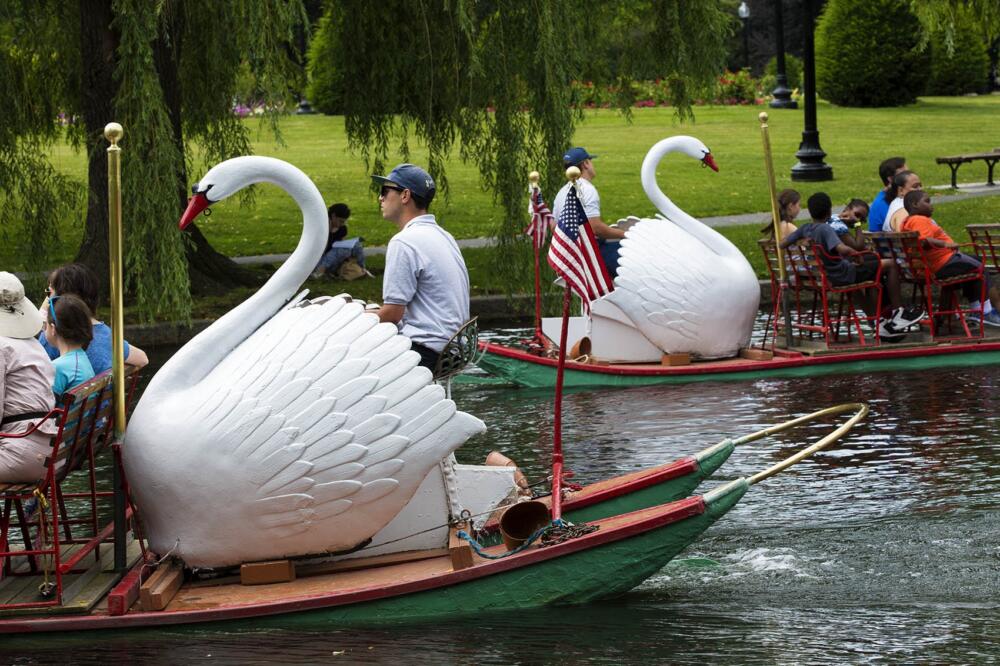
A swan boat operator pedals passengers across the lagoon in Boston’s Public Garden. (Sharon Brody/WBUR)
Could I stretch just enough to manipulate those pedals?
Paget asked me to sit inside the swan for the moment of truth. And, yes! My toes reached, sort of. As long as I contorted my body in goofy ways, my sneakers had access to the means of propulsion.
Next up: training. Like any new hire, I had to ride shotgun on an observation voyage. A few inches away from me, Paget navigated the lagoon with a boatload of customers on board. Grownups and kids perched on the benches, gazing around at the rippling water, ducks, willow trees, turtles, balloon vendors and their friends and relations on shore.
For the passengers, this was as tranquil as it gets. For me, the student, my focus was on managing my delight enough to pay attention to the lessons.
“I’m keeping tension on the ropes, right?” Paget said. “If you look behind me, there’s a rudder, and if I pull left, the rudder goes that way, and if I pull right, the rudder goes the opposite way. And that’s how we steer the boat.”
As it dawned on me that I’d need to simultaneously pedal and steer via gripping a rope in each hand, Paget offered a few nuanced tips for keeping the boat on course.
A brass pole used to help swan boat navigation sticks up out of the front of the vessel. (Sharon Brody/WBUR)
“You see the brass poles here?” he asked, gesturing to the prow. “Besides being a great decoration, they’re also giving me a little point of how to aim.”
He lined up his view of the pole with a Public Garden lamppost. The boat moved precisely the way he intended.
He made it seem so simple. Almost as simple as dropping a phone in the lagoon. Which is a thing passengers regularly do, Paget said. They also sometimes avail themselves of this iconic excursion to get engaged. Occasionally, this goes awry.
“One time, he had the ring out and she was so excited that she went to hug him, and she hit his hand, and the ring went off into the water,” Paget recalled. “And they were looking for that ring for an awful long time, not just that day.”
The stories, the operating instructions and the swan-boat-induced glee led me to lose track of time. It seemed like mere seconds later we had completed our loop around the duck house, under the bridge, around the island and back to where we began.
Swan boat operators pedal around the island in the Public Garden lagoon. (Sharon Brody/WBUR)
The cheerful passengers disembarked, another bunch lined up on the dock, and Paget turned to me with a question.
“Are you ready to give it a try?”
Ready is an understatement. I scrambled into the inanimate swan, and we were off.
With Paget by my side, and with a boat full of paying customers who had no clue I’d never piloted this (or any) watercraft, I wriggled to reach the pedals, and we floated forward.
Immediately, I realized that operating the boat wasn’t half as effortless as it looks. He acknowledged that getting tuckered out is part of the drill.
“It is a physically demanding job,” he said. “Kind of like pedaling a bike uphill. So it’s a pretty good workout.”
Even veteran swan boat operators, who typically pedal three laps around the pond over the course of a shift, sometimes need an assist, he said.
“On windy days, we have a person that will stay out here and can oar with you,” he said, grabbing a long, green oar, to demonstrate. “And just like a gondola, I can push on the bottom, because it’s only a few feet deep.”
His push of the oar on the lagoon floor did make pedaling easier, but I politely declined.
After all, people older than me were maneuvering the boats with no trouble. During summer vacation, most swan boat operators are in high school or college, according to Paget. But early in the season, retirees and other older folks dominate the ranks.
Paget said the more mature members of the swan boat workforce had devoted themselves to careers as wide-ranging as nurse, United Nations investigator, water and sewer professional, teacher and state police trooper. They converge on the lagoon because it’s fun, serene, historic and a quality workout.
Not to be outdone, I pedaled on.
Children gaze up as the swan boat passes under the bridge. (Sharon Brody/WBUR)
One might imagine that every detail of this epic expedition became permanently seared into my brain. But, in fact, lots of the lagoon adventure went by in a blissful blur.
And suddenly, it was “land ho!”
Pulling up to the dock, with a whole new set of laugh lines etched into my face, all I could utter was “Phew!”
And Paget, trainer extraordinaire, knew just how to make a newbie take pride: “Perfect landing!”
The passengers flowed back into the Public Garden, none the wiser that they played a starring role in my lifelong dream. The great-grandson of the originator of the Swan Boats joined me on a bench overlooking the scene of this triumph. I thanked him for facilitating my peak experience.
And I had to ask: Would he hire me?
“ Absolutely,” he promised. “When you retire from radio.”
Curses, foiled again. Retirement is not on my to-do list. But, still, what a trip. The memory is mine forevermore.
And ahoy, landlubbers, when next you admire this idyllic Boston destination, tip your hat to my title. Swan Boat Captain … Emerita.