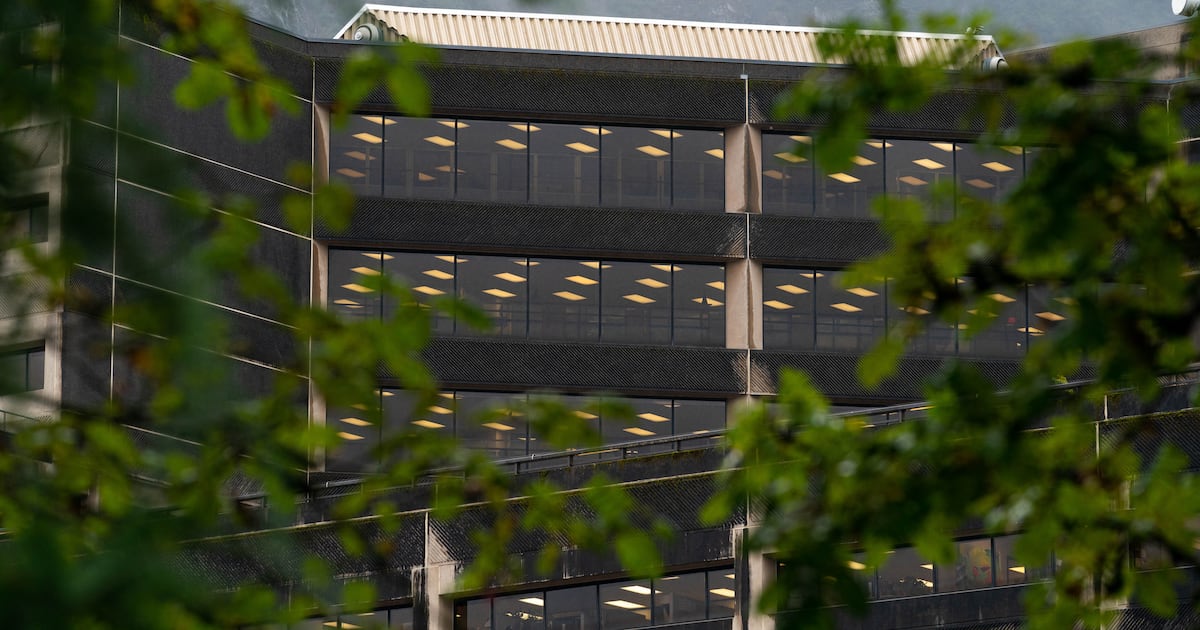
The Anchorage School District Education Center, photographed Feb. 21, 2025. (Loren Holmes / ADN)
Sitting in the Romig Middle School front office last month, Anchorage School District Chief Operating Officer Jim Anderson pointed to a diagram of the school littered with red circles denoting roof leaks.
“Dozens, dozens of leaks,” Anderson said. “We’ve got a lot of galvanized pipe throughout this whole building that — once you take the roof off and you’re replacing the boilers anyway — you would replace that galvanized pipe, which over the years corrodes, even if it was designed not to very quickly.”
Romig, built in 1963, is the district’s largest middle school with more than 1,100 students. It was included on this year’s bond package for repair work needed to keep students safe and dry.
Early returns show a pair of ballot propositions that could add funding for the Anchorage School District trailing after initial election results.
Results could still change as election officials continue to count thousands of additional ballots before the election is certified in late April. But, if the current results stand, Anchorage voters will have rejected three ballot propositions from the school district in the last five years, leading elected officials to consider whether Anchorage property owners have reached their limit for funding school capital improvements through property tax increases.
Proposition 1 — a $79 million bond package that could fund work for nine safety and security projects at 20 schools across the district — is trailing by less than two percentage points. Votes counted through Friday have only widened the gap between yes and no votes. The Legislature is also expected to consider school bond debt reimbursement payments for the bond, which would drop the total price to $39 million.
Proposition 9 — an $11.8 million special education tax levy that could pay for 80 additional teachers to reduce class size increases passed by the school board this year — is also failing by less than one percentage point, according to early returns.
When asked about the initial election results, district spokesperson Corey Allen Young said Friday: “We are continuing to monitor the election results.”
Kelly Lessens, an Anchorage School Board member who supported the bond, had expressed optimism that yet-uncounted ballots may turn the totals in favor of both Prop 1 and Prop 9.
“I am feeling more hopeful today. As I think about those untallied ballots, my curiosity is tipping more toward hope that Prop 1 will pass narrowly,” Lessens said Wednesday. “We have a long ways to go until every ballot is counted.”
In 2022, that year’s $111 million school bond — which included the controversial rebuild of Inlet View Elementary School — failed by 1.4%.
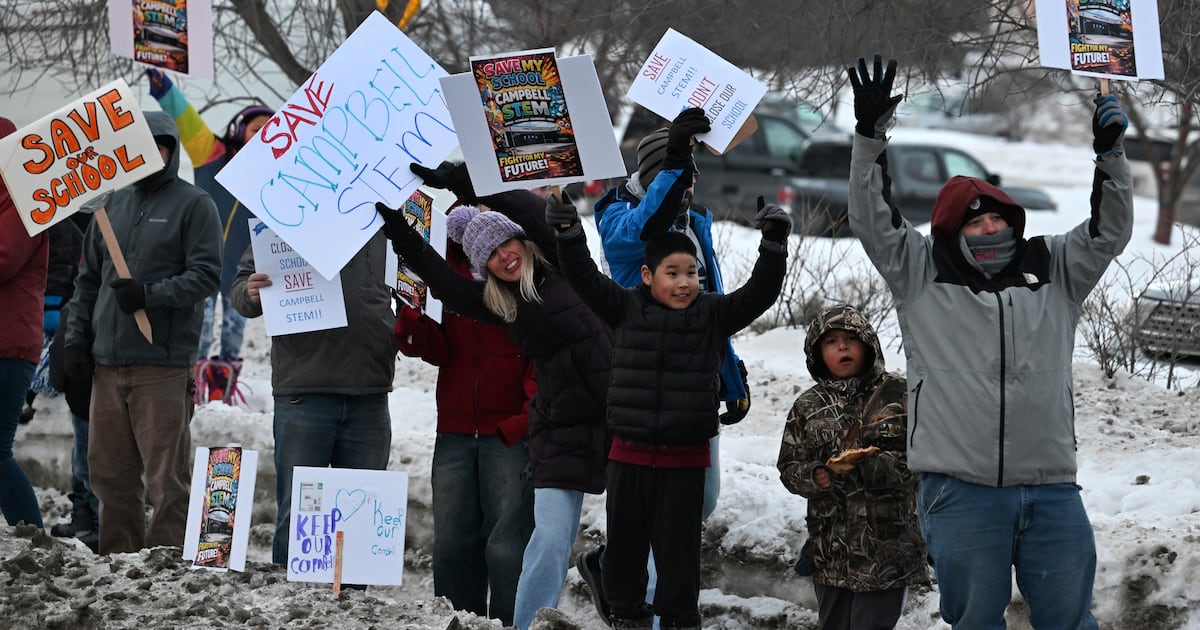
After the school board voted in February to close Campbell STEM and Lake Otis elementary schools, voters who were connected to the schools vocally opposed the bond.
Campbell STEM supporters waved signs before the Anchorage School Board meeting on Tuesday, Feb. 24, 2026. (Bill Roth / ADN)
Outgoing Anchorage Assembly Chair Chris Constant theorized that the response from voters is tied to recent decisions from the district and school board.
“My take on the question of the levy and the bond, the negative votes are a direct response to the school district,” Constant said. ”Last month, after making the decision to close a beloved school, and all of its advocates and supporters who would have been champions for the bond, came out the other way.”
If ballot measures pass or fail by less than half a percentage point, a recount is triggered.
No matter if the bond passes or fails, the school district still plans to put more than 1,600 students in classrooms at Lake Otis Elementary and Romig Middle School next year, the two most expensive single projects on the bond.
“The building is not falling apart,” Anderson said of Romig. “If it had to be delayed for a year or two or three, the building is not unsafe. It’s not going to fall apart.”
Where is state funding?
The status of the bond is a topic of concern far outside the municipality. Members of Anchorage’s delegation in the Legislature, several of whom are highly focused on education policy, are strategizing on ways the state can ease some of the damage from the bond’s potential failure.
Democratic Rep. Zack Fields said in an interview Wednesday that years of low state investment in Alaska public education has left many school districts decimated, and that lawmakers are struggling to keep situations from tipping into a “death spiral … where every family with a choice leaves” their public school.
Fields said the bond going down would be bad for ASD, making overdue repairs and structural upgrades more expensive when they can eventually be done. But his bigger priority is staving off increases in class sizes across schools. Prop 9, the special levy, was specifically aimed at raising money from Anchorage property owners to add more personnel to spread students out across more classrooms.
Proposition 9 “was about having a functional school system,” Fields said. “Class sizes are life and death for the district.”
He said there’s an effort to potentially add $30 million to the state’s education budget specifically to reduce average class sizes in ASD by about four students each. That would be part of a broader funding boost for school districts across the state paid for by the unexpectedly high revenues the state is currently anticipating from surging oil prices on the global market.
People show their support for Fire Lake Elementary School in Eagle River during the Anchorage School Board meeting on Feb. 24. (Bill Roth / ADN)
A more wonky measure in the works, according to Fields, is a bill from Democratic Rep. Andi Story of Juneau that would synchronize school district budget calendars with the state’s own fiscal timeline. The point, Fields said, would be to reduce uncertainty and guesswork in how local school entities make fiscal decisions while the Legislature is battling over larger budget politics each year.
“If you synchronize the budget cycles, you get more bang for your buck,” Fields said
Anchorage Democratic Sen. Löki Gale Tobin, chair of the Senate Education Committee, said there’s increasing talk of potentially using budget surplus funds to provide an energy rebate to schools that would help free up some of their other funds for operating and personnel costs.
But, she said, that would be a short-term measure that doesn’t address the larger issues faced by Alaska schools.
“The reality is we have completely neglected our public infrastructure for our schools,” Tobin said.
She and other lawmakers are putting more money in the education budget this year, she said, while preparing for more ambitious reforms to push in the Legislature next session. Those could include automatic inflation adjustments in per-pupil funding, among other measures.
What’s evident in the conversations she’s had with school district officials and members of the public around Alaska, Tobin said, is that the state is not fulfilling its obligations to provide “high-quality education” to its residents. She suspects one reason behind the school bond’s lack of majority support could be that Anchorage property owners aren’t willing to keep shouldering so much of the education costs without the state providing commensurate support.
“People have just been asked to bear the costs for basic state services for too long and at too high a price,” Tobin said. “There’s just a feeling and a frustration that we can’t keep going to the public to say, ‘Here’s how you need to pay for the infrastructure and the systems that not everybody pays for equally.’”
Campbell STEM supporters waved signs before the Anchorage School Board meeting on Feb. 24. (Bill Roth / ADN)
Anchorage repairs on the bond
The Anchorage School Board voted in February to close Lake Otis, Fire Lake and Campbell STEM elementary schools at the end of the school year. Despite the planned closure, the $19.6 million for repairs at Lake Otis remained on this year’s bond, leading several Lake Otis families to vocally oppose the bond.
Similarly, families voiced frustration that earlier bond money set aside for repairs at Campbell STEM had not been spent yet. On Wednesday, Campbell STEM families filed a lawsuit in Superior Court against the district seeking to prevent the school’s closure.
Repairs at Lake Otis Elementary were identified by board members in November 2020 and added to the list of projects to put before voters on a bond proposition.
Anderson, the district COO, said the way the state’s education funding formula was set up three decades ago assumes the Anchorage School District will need to seek bonding authority from voters for major capital repairs.
“We are the only school district that bonds in the state. Every other school district that’s in a borough, the municipality or their borough does the bonds for the school district,” Anderson said. “That’s what the state determined, this is how we’re going to maintain facilities.”
Lake Otis Elementary School in Anchorage in October 2025. (Marc Lester / ADN)
The bond’s projects include roof repair and structural upgrades at Lake Otis, Romig and Klatt Elementary, security improvements at over a dozen schools and student nutrition facility upgrades.
Rilke Schule German Immersion Charter School and its 500 students will move into Lake Otis for next school year, regardless of whether the repairs included on the bond are made.
Daily News reporter Bella Biondini contributed.