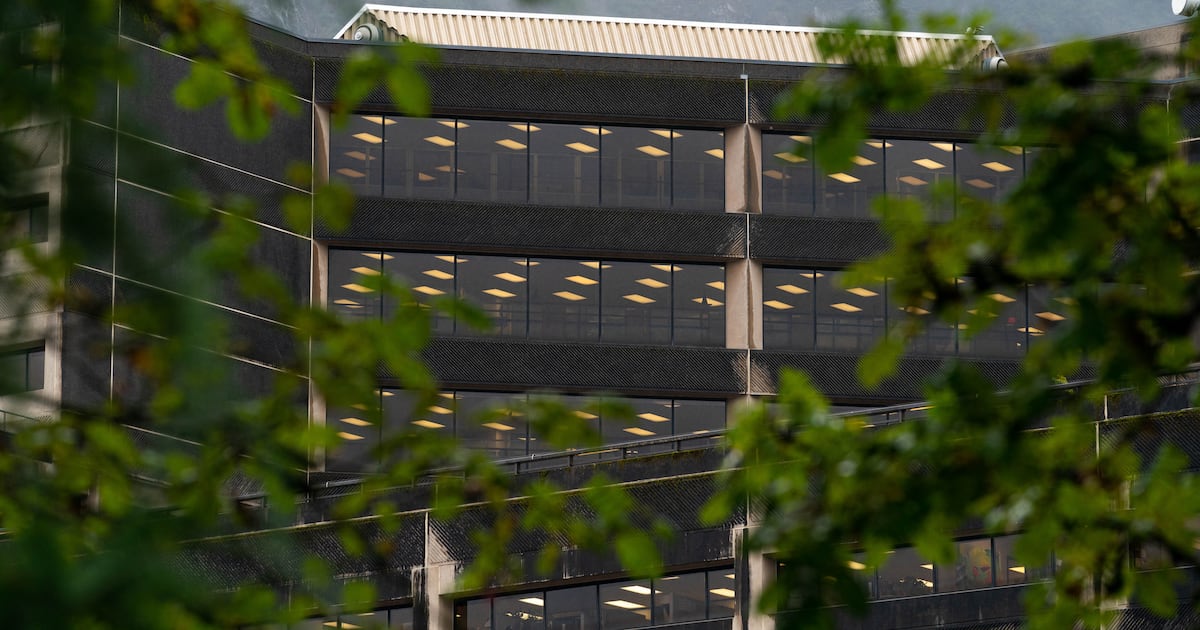
The State Office Building, photographed in 2021 in Juneau. (Loren Holmes / ADN archive)
The Alaska Senate on Tuesday passed a bill to reform the state’s pension system for public employees, ending months of debate on the benefits owed to Alaska’s retired state and municipal employees, including teachers and police officers.
The measure aims to address the consequences of a 2006 decision by Alaska lawmakers to eliminate the state pension plan that guaranteed income in retirement, and replace it with a 401(k) style plan that has since left many public-sector workers without the funds to retire securely.
Union leaders and other public-sector advocates have been warning since the 2006 decision that it would cause a crisis in recruiting and retaining qualified public-sector workers in the state.
Such a crisis has emerged in recent years, as the state struggles to provide basic services amid constant turnover. Supporters of pension reform say that a worst-in-the-nation public retirement system, which disincentivizes workers from committing to a career in Alaska’s public sector, is at least partially to blame.
“Today is a really big day,” said Heidi Drygas, director of the Alaska State Employees Association, the largest public-sector union in the state. “Everything that we said would happen — about recruitment and retention and problems in just basic government functions — has happened.”
Lawmakers for years have tried various avenues to recreate a bolstered public-sector pension plan. But such a plan has never passed both the House and Senate in a single session, until Tuesday.
The bill creating a new pension option passed the House last year in a 21-19 vote, along caucus lines. The Senate has since spent months considering changes to the bill, and it finally passed after several additional amendments on Tuesday, in a 12-8 vote. It must now return to the House, which will vote on whether to accept the changes.
House Majority Leader Chuck Kopp, an Anchorage Republican who sponsored the bill, said he approves of the changes.
“House Bill 78 comes down to a single fundamental question: Can Alaska attract and keep the people it needs to function effectively as a state and as local government?” said Senate Majority Leader Cathy Giessel, an Anchorage Republican who has spearheaded efforts to reform the retirement system since 2023. “Twenty years ago, we made a decision. We eliminated pensions, and since that moment, we have watched — not all at once — but steadily and unmistakably the erosion of our public workforce.”
The legislation is set to cost the state up to $89 million annually, depending on the number of employees who choose the new pension plan. But proponents of the measure say it will ultimately save the state far more by eliminating the need to constantly train new workers, pay fines for poorly managed federal programs, contend with degraded public services, and lure new employees with an increasing outlay in recruitment bonuses and overtime pay to compensate for unfilled positions.
“The real question is not, ‘does this bill cost money?’ The real question is, ‘why are we willing to keep paying more for a system that’s not working?’ ” said Giessel.
Anchorage Democratic Sen. Bill Wielechowski said the bill marks “the choice to move from managed chaos to managed stability.”
In months of hearings, the Senate amended the bill to add more choice for both employees and non-state public employers, like school districts and municipalities. Under the bill, employees will be able to choose between the new pension plan and staying in the existing defined contribution plan, which allows them to invest their own funds and reap the rewards — or losses — of the market. Employers will be able to opt out of offering the new pension if they view it as too expensive.
Throughout the legislative process, advocates for the bill have emphasized that the new plan will be vastly different from the pre-2006 pensions offered to Alaska employees. The new plan does not re-create the generous health insurance program that was previously offered. It also allows for the state to raise the contribution rate for individual employees if it becomes underfunded.
“These safeguards are not optional. They’re built into the design specifically to prevent what happened in the past,” said Giessel.
Prior to the 2006 closure of the pension system, Alaska’s retirement plan became underfunded by billions of dollars, in large part because of incorrect actuarial analyses provided to the state at the time. The state sued the actuarial firm, but recovered only a fraction of the unfunded liability that had developed. The state, school districts and municipalities have been paying it back ever since.
Despite the less-generous plan, Tuesday’s vote was seen as a long-fought victory for unions and lawmakers alike. Proponents of the measure said that it will begin to solve the problems stemming from workforce shortages in Alaska’s public sector.
“This is about the trooper who stays an extra 10 years because they know their family is taken care of. This is about the teacher who decides to buy a home in Fairbanks instead of looking at the job boards in Seattle,” said Wielechowski. The bill is “a hand extended to our workforce, saying ‘We value you. We want you to stay. We want you to grow old here,’” he added.
Opponents of the legislation, who include the two co-chairs of the powerful Senate Finance Committee, have consistently warned that the pension system risks a new unfunded liability, despite the protections added to the bill. They suggested that the state, school districts and other employers should instead raise wages, which are in many sectors not competitive with the Lower 48.
Drygas said that Alaska’s recruitment and retention problems are “multifaceted.”
“Do I believe that a lackluster retirement system that the state has right now is part of the problem? Absolutely,” she said, but added that uncompetitive pay is “part of the issue.”
Sen. Bert Stedman, a Sitka Republican, and Sen. Lyman Hoffman, a Bethel Democrat, are the only two members of the bipartisan majority caucus who joined all minority members in voting against advancing the bill.
“Think of the liability protection for the future generation,” said Stedman, speaking against the bill. “Let’s not do what our grandparents did to us back in the ’60s and give us a liability that we struggle with for 30 years.”
In an effort to offset some of the new costs to the state, Stedman led an effort last week to raise the cap on costs of public pensions for non-state employers, including school districts and municipalities, from 22% of their payroll to 24% of their payroll. Some municipalities responded with warnings of increased local taxes and cuts to already diminished staffing. The Senate voted narrowly on Tuesday to largely reverse the change, setting the new cap at 22.5% instead of 24%.
Alongside their concerns about costs, members of the all-Republican minority caucus claimed that younger workers aren’t attracted to pensions in the way that older generations have been.
“Things have changed. You know, people change. Younger people are not saying, ‘hey, I’m just going to sit there and do something for 30 years,’” said Republican Sen. Mike Cronk of Tok.
Although Cronk collects a state pension from his 25 years as a public school teacher, his view is similar to the one expressed previously by Republican Gov. Mike Dunleavy, who also earns a state pension from his years as a public educator. Dunleavy, too, has cast doubt on whether younger Alaska workers are as drawn to pensions as he had been.
Dunleavy has not commented on the pension bill in its current form. Kopp said he has spoken about the bill both with Dunleavy and members of his staff.
“All I can say is that they are absolutely keeping an open mind on this bill. They recognize that it is completely different than the legacy tiers of the past, and I have been encouraged by several conversations I have had with the administration,” he said.