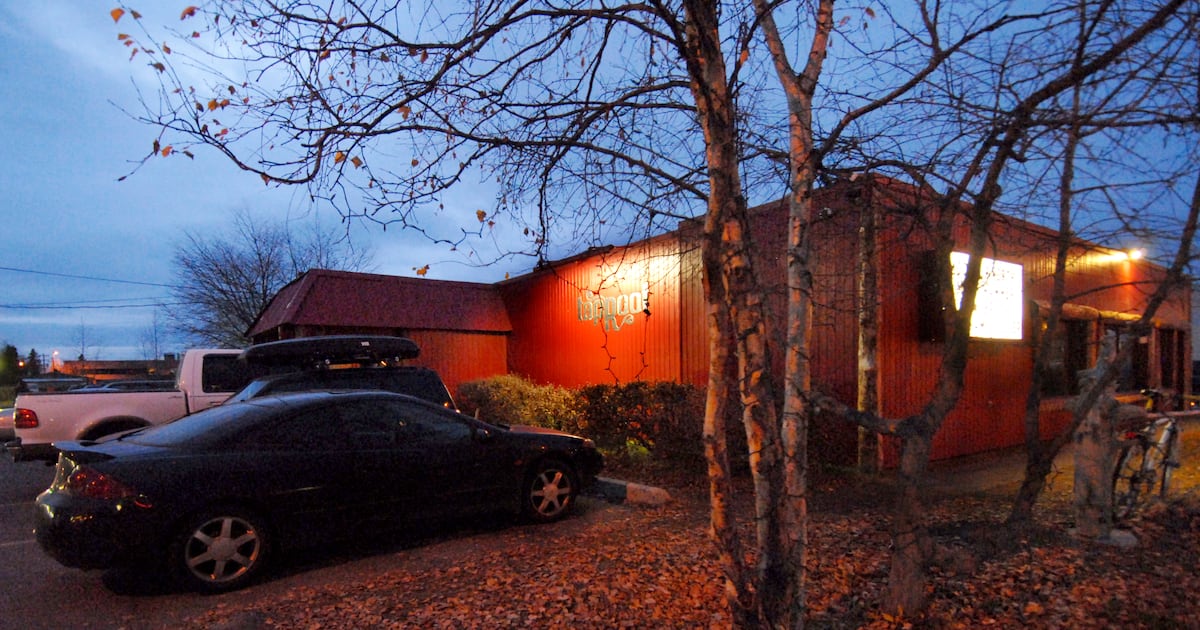
TapRoot moved into the old Fly By Night / Player’s House of Rock building at 3300 Spenard Road in this Oct. 21, 2010 photo. (Bill Roth / ADN)
Part of a continuing weekly series on Alaska history by local historian David Reamer. Have a question about Anchorage or Alaska history or an idea for a future article? Go to the form at the bottom of this story.
To corrupt the bard, commercial buildings die many times before their deaths. The structure may stand while the businesses within pass, often in a flash, flickering images in our memories eroded by the accumulation of years. To illustrate, consider a single local building, 3300 Spenard Road. For more than 75 years, it has been home to everything from family operations to one of the most legendary clubs in Anchorage history. In this column, we will travel backward in time. So, make a note when your memory falters.
For the past six years, the property has hosted several events and temporary tenants. There have been artist gatherings, car washes and trunk-or-treating. And there have been several churches, each seeking a more permanent home: Set Free Church, Response Church, Clear Water Church.
A restaurant called Charlou opened at 3300 Spenard Road, where pop-up restaurant La Potato used to be. Photographed May 22, 2019. (Annie Zak / ADN)
Charlou was the most recent establishment there with the intent of a long-term tenure. This restaurant described its fare as “coastal-inspired cuisine” with the expected emphasis on Alaska seafood. The name was derived from relatives of the co-founders, Nikole Moore’s grandmother Charlotte and Pamela Hatzis’ grandmother Louise. It opened in May 2019 but closed on May 30, 2000.
The restaurant was something of a direct evolution from the previous occupant, La Potato. That eatery was a pop-up collaboration between La Bodega, the Anchorage wine-and-spirits shop, and The Potato, a restaurant with locations in McCarthy and Valdez. The grand opening weekend covered Nov. 2 and 3, 2018. As a pop-up, a limited run was always the plan, and it closed in April 2019.
The recent pattern of short-lived residencies at this location began with La Potato’s predecessor, Route 33. That name was an acknowledgment of the location at 33rd Avenue and Spenard Road. It opened in June 2017 with a new coat of paint on the outside and a remodeled interior. Per Hans Nowka, one of the owners, “It’s done. It’s changed and revamped and will hopefully make Spenard a better place.” By that November, the Southern-food joint was closed.
The building on Spenard Road that once housed a Southern-style restaurant called Route 33 — and before that, the TapRoot restaurant and music venue — photographed in October 2018. (Marc Lester / ADN)
Worth mentioning, some businesses are so brief in their existence, so lacking in documentation, that they can be easily missed. For example, the Paragon nightclub was open from Dec. 30, 1991 to Jan. 23, 1992 at the nearby 3103 Spenard Road building that is now the Alano Club. The Paragon never had its own sign. When it closed, the marquee still said “The Roxy,” the previous bar in there.
Before Route 33, there was the TapRoot, a more enduring venue, beloved for the way it embraced the Anchorage music scene. Those who paid close attention to the details might remember it as the Tap Root Café or Taproot Public House. The bar opened as the Tap Root Café on Huffman Road in 2006 and closed there on May 30, 2010. It reopened at 3300 Spenard Road on June 7, 2010.
From regional beers to bands, it was the sort of club that planted its foot squarely on the local pulse. Founding owner Rebecca Mohlman told the Daily News in 2010, “If there is one word we stand on, it’s community.” It was an intimate, crowded ambiance, with little to nothing dividing observers from performers, though in the best of ways. Anchorage musician Laura Oden told True North Magazine in 2016, “What separates TapRoot from every other establishment is that they have a business model that centers around 1. providing a venue for Alaskans to play music, and 2. building bridges with high-quality indie musicians willing to come play here. There are no other venues that have music truly at the core of their mission.”
Martin Severin bought the bar from Mohlman in 2015. At that time, it was properly titled the Taproot Public House, the latter addition a reference to the tavern and inn combinations of late Middle Age to early modern England. The more modern pub, as a word and type of establishment, derives directly from public houses. Severin’s most notable alteration was to drop “public house” from the name, that or the second bar.
The TapRoot closed for good in 2017, a more than respectable 12-year run. More notably, they altered the building’s reputation. When the TapRoot moved to its Spenard location, the building was still widely known as the former home to the Fly By Night Club. Many Anchorage folk still call it that, and for good reason. Yet, many others now call it the TapRoot building. Any inherent virtues and sins aside, the TapRoot made a dent in the local consciousness. Being remembered is a rare honor.
Fewer people remember the previous tenant, the Player’s House of Rock, which went for a louder rock-and-sports vibe. Their soft opening was Sept. 11, 2006, meant to both commemorate the 9/11 tragedy and celebrate the return of Monday Night Football. Emailed invitations for the event also promised “the meanest midgets on the planet,” something that happened in this very town. The official grand opening took place a few days later, and it closed in 2010.
As fondly recalled as the TapRoot remains, the 3303 Spenard Road building remains most famous as the second home to the legendary Fly By Night Club, operated by the one and only Mr. Whitekeys, the self-described “sleazy piano player from Spenard.” He opened the club in 1980 at 4811 Spenard Road, out by Lake Spenard. That location has its own sordid history of fires and fiascos dating back to the opening of the Lake Shore Club in 1938, including the Fancy Moose, Red Baron, Flying Machine, Co-Pilot Club, Oar House and multiple iterations of the Idle Hour. As noted by Fly By Night advertising and merchandise, “Going out of business regularly in the same location for over thirty years.”
Mr. Whitekeys and his Fly By Night Club in the Spenard section of Anchorage have been Alaskan icons for decades. (Fran Durner / ADN archive)
At the club, Whitekeys led a misfit, musical collective of artistic souls, a combination of vaudeville, social commentary, jazz, risqué humor, slideshows, poop jokes, cheap booze and sleaze, one of the proprietor’s favorite words. And there was the Spam, to eat, observe and sing about. There were no pretensions; everyone and everything was fair game, naturally including the weather vane politicians, bent priests and crooked Spenard itself. From the Whitekeys original “Hookers in Spenard.”
I wanna be a hooker in Spenard,
I mean that job can’t be all that hard.
You just stand in the shadows of the sleazy bars
And flash your goods at the passin’ cars.
What a job, just lie back and relax—
No union dues, no income tax.
The Fly By Night crew in 1988 included “Sourdough” Mike McDonald, Douglas “Satchmo” Everton, Jessie Barksdale, Jill Bess and Mr. Whitekeys clowning around before a performance of The Whale Fat Follies. (Anchorage Daily News archive 1988) Partygoers hooted, hollered and laughed as Mr. Whitekeys filled the room with song, dance and double entendres on a Saturday night at the Fly By Night Club. (Joshua Borough / ADN archive)
There was, however, little patience for certain forms of soft rock. As noted in its early classified listings, “Barry Manilow fans need not apply.”
In 1984, the club was forced to relocate to 3300 Spenard Road, what Whitekeys described as an “even sleazier location.” If anything, the operation was now more appropriately situated in the heart of Spenard. The old building was torn down and replaced by the new Clarion Anchorage Hotel, since renamed the Regal Alaska Hotel, Millennium Alaska Hotel and Lakefront Anchorage Hotel.
[Clamorous and unconstrained, the history of rock bands playing in Alaska mirrors the state’s evolution]
In an email last week, Mr. Whitekeys wrote, “We moved out of the location on Spenard Lake because the whole building was being torn down to build the first hotel on that site—The Clarion. That had been the plan from the beginning, and I was just killing time until the hotel deal went through. The guys who owned the lakefront property, and who basically gave me the keys because everything they had tried there had failed, also owned the building where Hangar 18 was. They had somehow finagled a real estate deal for a property they wanted to develop, and Hangar 18 came with the deal. So, since the old building was being torn down, they said, ‘Why don’t you move into this other building that we own?’”
He continued, “So, since they were demolishing the entire old building, we got to take anything we wanted to the new location. Being cheap, we remodeled Hangar 18 (which was basically a cement block shell with no frills of any kind) by moving everything we could from the old building. We re-used the toilet stalls, the bathroom sinks, the interior doors, the exterior doors, the bar and kitchen equipment, and we even hired a crane, which picked the furnace off the old roof and put it on the new roof.”
Mr. Whitekeys, pictured here on stage at the TapRoot Public House on June 10, 2014. (Loren Holmes / ADN archive)
The new location required significant renovations to meet building and fire safety codes, let alone be ready for masses of inebriated Spenardians. Per Whitekeys, “I do remember that when we tore up the linoleum to install a new floor in the kitchen, we found a WELL under the tile. Holy Crap — right in the middle of the room. We filled it with concrete, at least partially, and put down the new tile. And never spoke of it again.”
Time winds down for all things. In the fall of 2006, Players House of Rock founders bought the club’s liquor license, allowing Whitekeys the chance to relax after years of 80-hour workweeks. He told the Daily News, “I’m just looking for a few days off, and then to go back to work at an easy little job.” While there would be other performances, other editions of Whale Fat Follies, the Fly By Night closed for good on Sept. 9, 2006.
The previous occupant was indeed Hangar 18, a video game arcade. The name presumably referred to the conspiracy theory that alien technology was hidden in a hangar at Wright-Patterson Air Force Base in Ohio, which was the basis for a 1980 movie of the same name. The arcade was open by December 1981 and was the company’s third location, joining spots on Gambell Road and in Wasilla. The grand opening celebration included a $1,000 giveaway. The arcade closed at the tail end of 1983 or the earliest days of 1984 after losing its lease.
An advertisement for Hangar 18 in the June 22, 1983 editiion of the Anchorage Times.
One of Hangar 18’s selling points was a clean space with an enforced dress code, meant to mark a sharp break from the previous tenant, another arcade named Charlie Brown’s. During its brief 1980 to 1981 run, this earlier video game parlor was infamous for the extensive drug dealing in and around the premises. Weed, LSD and cocaine were openly sold in the parking lot. Manager Tom Crago told the Anchorage Times, “I have some kids here who think nothing of buying or selling 1,000 hits of acid.” He continued, “I know one guy here that’s supplying seven or eight kids with the stuff so they can sell it for him.”
The arcade owners tried to fight back, but nothing worked. They hired security guards who, in turn, were bribed by the dealers. When they tried to ban offenders, the teens threatened to murder employees. “And one kid threatened to burn down the place after we had him arrested for trespassing,” said Crago.
Owners and staff repeatedly complained to the police. John Needham, who ran the city’s drug enforcement unit, retorted, “How do we bust a dealer? What do we do, come in and say ‘you’re busted dealer.’” He ever-so-helpfully added that the owners could make citizens’ arrests if they observed any illegal acts. And he concluded — in a direct statement to the Times — “But I’m not going to send any of my people to Charlie Brown’s. It’s not worth it. Maybe if I had 100 people working for me, I’d send a couple over there.”
Attitudes changed after two Times reporters were able to repeatedly buy drugs on site in the spring of 1981. The police launched a six-month undercover investigation that culminated in a series of arrests in and around the arcade that November. In the initial wave of busts, they arrested nine individuals; the youngest was 11 years old. They also confiscated several weapons, including a sawed-off shotgun, and, as to be expected, stacks of cash.
An advertisement for The Bridge restaurant from the Oct. 4, 1980 edition of the Anchorage Daily News.
Before Charlie Brown’s, the property was the short-lived final home of The Bridge, a restaurant better remembered for its decade-long run in a Quonset hut on Northern Lights, which had previously been the Shamrock Inn. The Bridge, no relation to the current Bridge Company, began as a French restaurant and by the end of the 1970s was the sort of place that hosted poetry readings and folk music. In October 1979, its owners petitioned to relocate their liquor license to Spenard Road, though they don’t appear to have completed the move until 1980.
Before that, the property was empty for several months. From 1976 into 1979, it was home to the Alaska Square Dance Shop, a destination for Western attire. From 1972 to 1975, it was Ward’s Used Furniture, also known as Howell-Ward’s Used Furniture. Despite the name, they offered more than used furniture, including winemaking and canning gear. Ward’s lost their lease and had to vacate the building by Sept. 1, 1975.
From 1971 to 1972, the property was the site of the Alaska Auction House, the “House of Good Bargains,” according to their advertisements. From October 1969 into 1971, it was Kirby Company of Alaska, an authorized Kirby vacuum dealer. In an advertisement noting their new location, they were offering a new Kirby vacuum for just $199, half off the original price. That would be roughly $1,750 in 2026 money after accounting for inflation.
An advertisement for Spenard Plumbing in the Jan. 26, 1957 editiion of the Anchorage Daily Times.
Finally, there were Hank’s Hardware and Spenard Plumbing, both Spenard originals and notable businesses in the then-independent community. Their location was more meaningful in the 1950s, when fewer roads connected the southern developments to downtown Anchorage. Full hardware and plumbing shops in your neighborhood meant no drives down congested, muddy, potholed, snowy or dusty, dirty roads to fight for parking, back when the lack of downtown parking was a major local complaint.
The streets in that section of Spenard have changed significantly since the 1950s. Some streets present now did not exist in anything like their modern forms then, as with Benson Boulevard. Others have been altered, like the path of Spenard Road itself. And many names are different.
Hank’s Hardware opened in the late 1940s. By the early 1950s, its location was described as the corner of Spenard Road and Hanover Drive. As Spenard developed, they acquired a more modern address, 3204 Spenard. They were next to Spenard Plumbing. When the latter closed around late 1963 or early 1964, they moved into that building. The hardware store closed after a liquidation sale in July 1968.
Robert “Bob” Barnett (1915-2009) was an Anchorage High School graduate, class of 1934, from back when the high school was downtown. There were 16 students in that class. He worked as a gold miner and railroad engineer before opening Spenard Plumbing in 1948. Its original home was on the Barnett homestead, with a humble start under a tent. Instead of 33rd and Spenard, it was on the corner of Utah and Spenard. The well discovered by Mr. Whitekeys is perhaps a relic of that time. The legal description of the property still lists it as the Barnett Subdivision.
The new, concrete-block building opened in 1950. Some modern sources, including the municipality’s property database, list its build date as 1951. However, the family said it opened in 1950. The shop closed when Barnett moved to Homer, where he did some commercial fishing and ran an air taxi service.
From tent to church, with Spam in the middle, the history of this little Spenard property has it all. This research began as the response to a student question, part of a class project, and good for her on seeking answers. However, there were some technical issues with the email, and this article is my attempt to make sure this information is available to her and admittedly everyone else interested.
• • •
Key sources:
“Alaska Business.” Anchorage Times. January 21, 1981, F1.
Conklin, Ellis E. “All Agree: Drugs Are Dealt.” Anchorage Times. May 3, 1981, B1.
Hansen, Steve. “Drug Bust Nets 9 at Charlie Brown’s.” Anchorage Times. November 10, 1981, A1.
Hansen, Steve. “The ‘Games’ They Play at…Charlie Brown’s.” Anchorage Times. May 3, 1981, B1.
“In Memory: Robert E. Barnett.” Anchorage Daily News. April 29, 2009, A12.
Kelly, Devin. “Pop-up Restaurant Planned for Former TapRoot Building in Spenard.” Anchorage Daily News. September 7, 2018, A2.
Mr. Whitekeys. Email message to author. April 14-15, 2026.
Postman, David. “Night Club Plans Move.” Anchorage Times. February 29, 1984, B1.
Sheets, Kelly. “Night Watch.” Anchorage Daily News, January 10, 1992, H17.
Sheets, Kelly. “Night Watch.” Anchorage Daily News, January 24, 1992, D14.
Shinohara, Rosemary. “Curtains in Spenard for Fly By Night.” Anchorage Daily News. August 17, 2006, A1, A10.
“TapRoot: A Venue with a Vision.” True North Magazine. April 21, 2016.
Zak, Annie. “Open & Shut: New Restaurant Charlou Launches at Former La Potato Space, and a Bakery Is in the Works in South Anchorage.” Anchorage Daily News, May 24, 2019, A11.
Zak, Annie. “TapRoot Is ‘Officially Closed Forever’ and a New Restaurant Is Taking Its Place.” Anchorage Daily News. June 7, 2017, A3.