This morning, John Nichols tells the A Better Delaware podcast that state mandates, power-plant closures and subsidies are contributing to higher bills
By George Rotsch, Editor Delaware LIVE
WILMINGTON, Del. — Delaware electricity prices are being driven higher by state energy policies that
discourage reliable power generation and require customers to support costly programs, an energy policy
fellow with the Caesar Rodney Institute said during a podcast discussion Monday.
John Nichols outlined five state-level policy decisions that he believes are making electricity more expensive
than necessary during an appearance on “A Better Discussion,” a podcast produced by the nonprofit public
policy organization A Better Delaware.
The program was hosted by former Delaware Attorney General and Superior Court Judge Jane Brady, who
chairs A Better Delaware.
Nichols serves as an Energy Policy Fellow with the Caesar Rodney Institute’s Center for Energy &
Environment. His research focuses on electricity markets, PJM grid reliability and the effect of Delaware
energy policies on residential and business ratepayers.
He has written policy analyses examining solar mandates, grid interconnection standards, battery-storage
costs and legislative proposals affecting Delaware electricity customers.
Nichols graduated with honors from the University of Delaware with a degree in education and spent 35
years in the financial services industry, where he held multiple professional licenses and management
positions. His background in finance informs much of his analysis of power-plant economics, electricity
pricing and the ability of energy projects to attract investment.
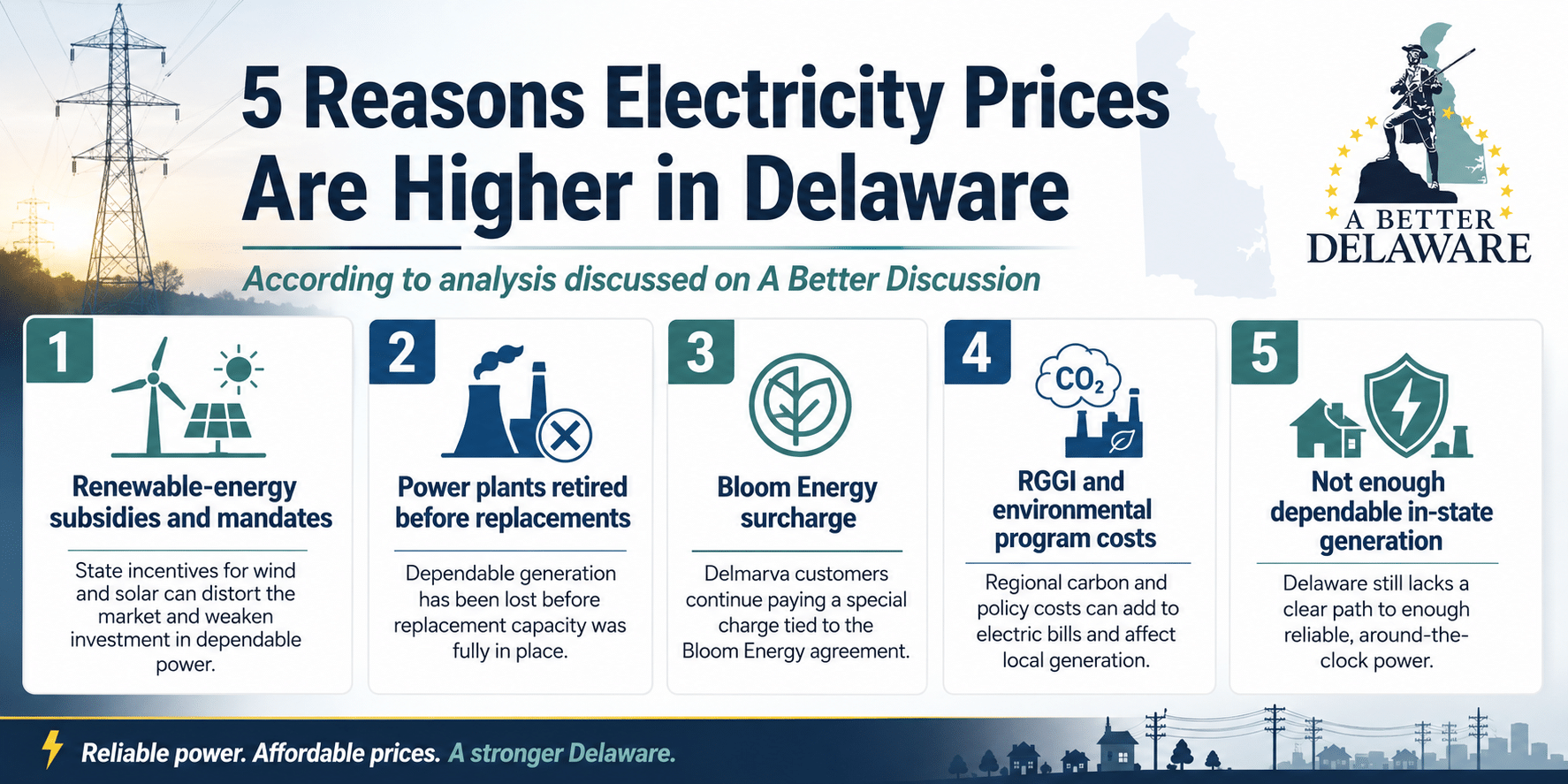
Nichols said the five factors making Delaware electricity more expensive are state support for intermittent
renewable energy, the retirement of dependable power plants before replacement generation was secured,
the continued Bloom Energy surcharge paid by Delmarva Power customers, Delaware’s participation in the
Regional Greenhouse Gas Initiative and the state’s failure to encourage additional reliable power
generation.
His broader argument is that Delaware’s rising electricity costs are not simply the result of decisions made
by Delmarva Power. They are also the accumulated consequence of state legislation and environmental agreements.
Brady opened the discussion by pointing to rising electricity prices and increasing concerns about whether
the power grid can meet demand during periods of extreme heat or cold.
John declared five major reasons that Delaware’s electricity prices are high!
-
Renewable-energy policies
Nichols’ first argument was that Delaware policies subsidizing wind and solar power have distorted the
regional electricity market and weakened the financial case for building dependable power plants.
Wind and solar generators can offer electricity into the wholesale market at zero or, in some cases, negative
prices because they receive tax credits and other subsidies, Nichols said.
PJM generally dispatches the lowest-priced electricity first. That allows renewable resources to reduce the
number of hours that natural-gas, nuclear and other generators operate and earn revenue.
Nichols said the result is that dependable generating facilities may not produce enough electricity or
receive enough revenue to finance construction and continued operation.
“You can’t compete at zero,” Nichols said while explaining the challenge facing generators that must pay for
fuel, employees and other operating expenses.
He said consumers may receive lower wholesale energy prices during some periods but pay for the
subsidies through taxes and other charges. He also argued that the loss of dependable generation
contributes to higher capacity prices and reliability costs.
Supporters of renewable-energy policies argue that wind and solar reduce fuel costs, air pollution and
greenhouse-gas emissions and can help diversify the regional electricity supply. Nichols disputed whether
those benefits outweigh the costs imposed on the broader power system. -
Power plants retired before replacements were ready
Nichols said Delaware also allowed dependable generating capacity to disappear before replacement power
was secured.
He pointed to the retirement of units at the Indian River power plant near Millsboro. Market conditions
made the plant financially difficult to operate, but PJM later determined that some of the generation was
still needed to maintain reliability.
PJM issued a reliability-must-run agreement that temporarily kept the plant available while transmission
improvements were constructed to bring additional electricity into the region.
Nichols estimated that the plant’s retirement, the temporary reliability agreement and related transmission
work cost nearly $400 million. He said Delaware remains a supply-constrained area that depends heavily on
electricity generated in other states.
A different state policy, Nichols said, would have required dependable replacement generation to be
available before existing plants were retired.
The closure was not simply ordered by the state, he said. Rather, it resulted from market conditions in which
the plant was not earning enough money through either PJM’s capacity auction or the market for electricity
it generated. -
The Bloom Energy surcharge
Nichols identified Delaware’s long-term agreement supporting Bloom Energy as a third contributor to
higher customer bills.
Under the arrangement, Delmarva Power customers pay the difference between the revenue Bloom
receives from selling electricity and the amount the company is entitled to receive under the state-approved
program.
Nichols said Delmarva customers have paid more than $430 million through the agreement and continue to
pay approximately $30 million annually.
The charge appears on Delmarva Power bills as the Qualified Fuel Cell Provider tariff, commonly identified
as the QFCP charge.
Only Delmarva Power customers pay the surcharge, Nichols said.
The Bloom agreement was approved during former Gov. Jack Markell’s administration as an economic
development initiative intended to create manufacturing jobs and attract related suppliers.
Nichols said the economic benefits did not materialize at the scale promised, while the ratepayer obligation
remains.
Bloom Energy has previously defended its Delaware operation as a source of jobs, cleaner energy and
dependable electricity. Nichols and Brady focused on whether those benefits have justified the continuing
cost to customers. -
Regional greenhouse-gas costs
Delaware’s participation in the Regional Greenhouse Gas Initiative was the fourth policy questioned during
the discussion.
RGGI is a cooperative program through which participating states require certain power plants to purchase
allowances for their carbon dioxide emissions. Proceeds are generally used for energy-efficiency,
renewable-energy and consumer-assistance programs.
Nichols said the program adds to the operating costs of fossil-fuel generators located within participating
states.
Because power plants outside the RGGI region may not face the same charge, he said, PJM can sometimes
select out-of-state generation instead of electricity produced in Delaware or another participating state.
That can reduce the competitiveness of local generation without eliminating the emissions, Nichols said.
“We’re paying the RGGI tax to get the lower cost,” Nichols said, questioning whether the apparent savings
from importing electricity account for the environmental charges paid by customers.
Brady also questioned whether RGGI revenue has created an incentive for state government to continue
collecting the money and use it to support additional environmental initiatives.
Program supporters contend that RGGI has reduced emissions while generating money for energy
efficiency programs and other investments that can lower long-term energy use. -
Lack of dependable in-state generation
Nichols said the fifth problem is Delaware’s failure to develop a clear strategy for obtaining more
dependable generation.
Delmarva Power generally does not own traditional electricity-generating facilities because Delaware
separated electricity generation from utility distribution under deregulation.
The state therefore relies heavily on PJM’s regional market to attract private investment in new plants.
Nichols said that system is failing to produce enough dependable generation, even though PJM capacity
auction prices have reached record levels.
PJM’s capacity market is designed to pay generators for committing to be available in future years. High
prices should encourage new plants to be built, but Nichols said developers remain reluctant because they
cannot be certain the plants will operate enough hours in the separate energy market to recover their costs.
“The prices are screaming ‘build,’” Nichols said, but the construction is not occurring.
The shortage has become more urgent as data centers and other large electricity users add demand to the
grid.
Nichols cited a shortfall of more than 6,000 megawatts in a recent PJM auction. He said data centers did not
create all of the system’s problems but exposed weaknesses that had been developing for years.
PJM and federal regulators are considering programs that would connect new generating facilities with data
centers through long-term contracts.
Nichols said Delaware could pursue similar agreements with existing generators to secure electricity during
peak-demand periods. He said he recommended that Delmarva Power explore a contract with a company
such as Dominion Energy, which owns generating facilities elsewhere in the region.
Nichols said he later learned that PJM had made a similar recommendation to Delaware regulators.
He also called for greater consideration of natural-gas generation in the near term and proven nuclear
power designs as a longer-term option.
Questions over batteries
Although battery storage was not listed as a separate category, Nichols criticized proposals to use large
battery installations to compensate for the intermittent nature of wind and solar power.
Batteries can store electricity when supply is plentiful and discharge it when demand rises, but they must
first be charged and do not generate electricity themselves.
Nichols said four-hour battery systems would not be able to cover longer periods when electricity demand
is high and renewable generation is limited.
“You’re never going to bridge the reliability gap,” Nichols said.
He also questioned the cost of a Delaware battery proposal that he said could require about $3.3 billion in
investment, with much of the spending going to equipment and suppliers outside the state.
Debate over responsibility
Nichols said lawmakers have increasingly blamed Delmarva Power for rising bills, but he argued that the
utility is often passing through expenses created by state mandates and regional power-market costs.
He also criticized Delmarva Power for not challenging those policies more aggressively when they were
adopted. Nichols said the utility may have believed it could simply recover the added costs from customers, but the cumulative effect has now made the company the focus of public frustration. The podcast presented a sharply critical view of Delaware’s energy and environmental policies. Many of
John’s Conclusion
Nichols’ conclusions — particularly his assessment of renewable-energy subsidies, RGGI and the economic
benefits of the Bloom agreement — are disputed by environmental advocates and supporters of the
programs.
Nichols said the central question should be whether Delaware’s policies provide dependable electricity at a price households and businesses can afford. His conclusion was that electricity prices could be lower if the state placed greater emphasis on reliable
generation, reconsidered costly mandates and required data centers and other large new users to bear
more of the expenses created by their demand.
“Until we decide we’re going to build reliable thermal generation, perhaps in-state, again, if we were to re
regulate our grid, nothing’s going to change,” Nichols said
Delaware LIVE collaborates with a network of professional journalists to cover a diverse range of stories across various fields. Staff Writers include experienced journalists and young professionals. If you have questions, please feel free to contact [email protected] or our publisher, George D. Rotsch, at [email protected]