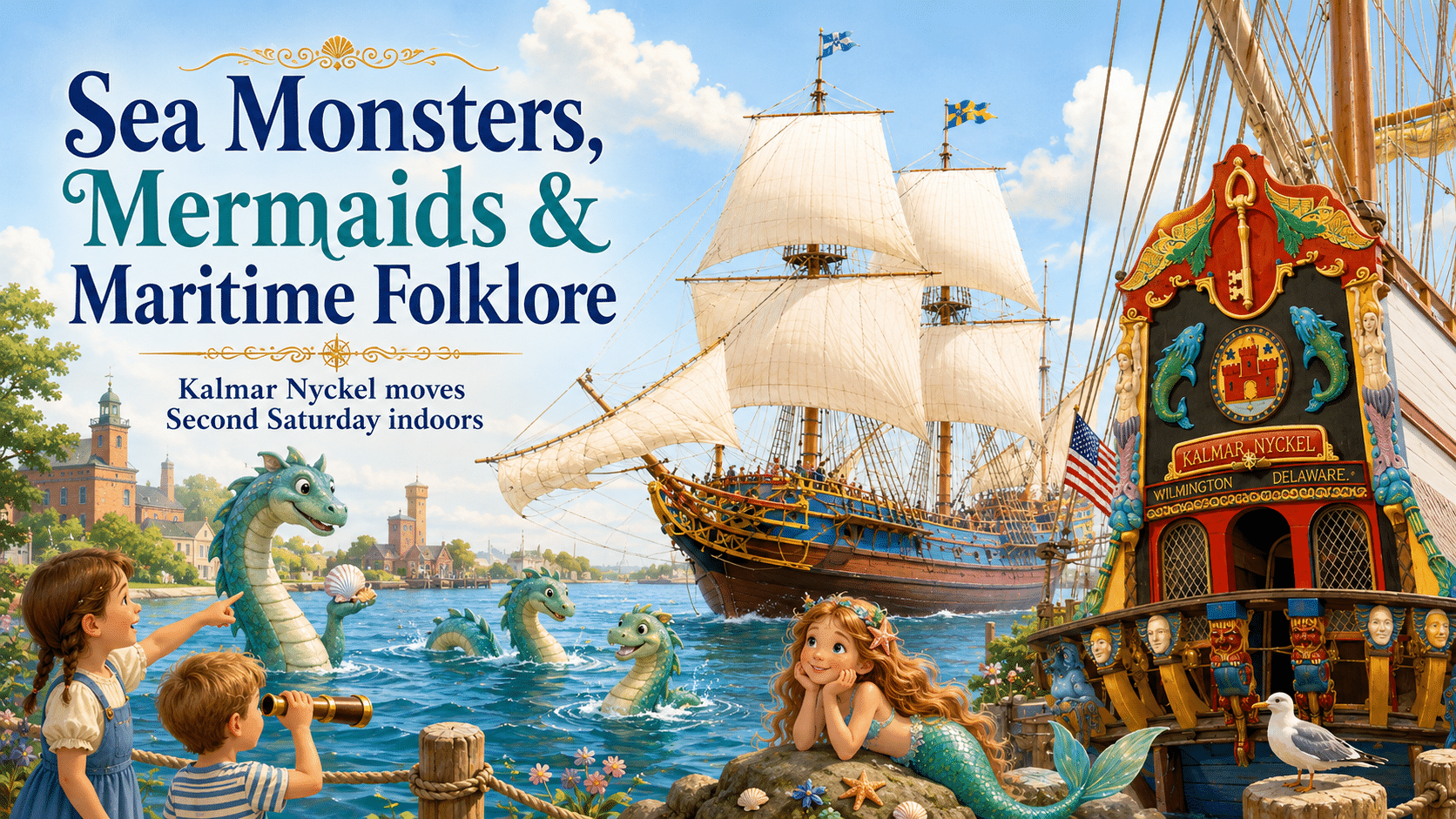
Because of expected rain and potentially poor weather, the Kalmar Nyckel Foundation is moving its Aug. 8 Second Saturday program from Fort Christina Park indoors to the Copeland Maritime Center at the Kalmar Nyckel Shipyard in Wilmington. Image created with AI on 8/7
Rain is moving “Lions, Sea Serpents & Mermaids, Oh My!” inside the Copeland Maritime Center, where families can explore the creatures and legends that once filled sailors’ imaginations.
WILMINGTON, Del. — Mermaids, sea serpents and other legendary creatures will be taking shelter from the rain Saturday.
Because of expected rain and potentially poor weather, the Kalmar Nyckel Foundation is moving its Aug. 8 Second Saturday program from Fort Christina Park indoors to the Copeland Maritime Center at the Kalmar Nyckel Shipyard in Wilmington.
The free family program, “Lions, Sea Serpents & Mermaids, Oh My!,” runs from 1 to 4 p.m. and explores the monsters, mythical creatures and maritime folklore that accompanied sailors across largely unknown oceans for centuries.
Visitors will learn about mermaids, sea serpents, lions and other creatures that appeared in sailors’ stories and as decorations aboard sailing ships. Children also can create their own sea serpents as part of the hands-on program.
Sea Monsters Filled an Unknown World
Long before satellites, sonar and modern ocean science, sailors ventured into waters they could barely understand.
Enormous whales, giant squid, unusual fish, violent currents, strange sounds and sudden storms could all become the foundation for stories about something more frightening lurking below.
Across different cultures, those fears produced an extraordinary collection of sea monsters.
Greek mythology told of Scylla, a multiheaded monster that attacked passing sailors, and Charybdis, a deadly whirlpool capable of swallowing ships.
Norse and Scandinavian stories helped create the legend of the kraken, an enormous tentacled creature said to be capable of pulling ships beneath the waves.
Sea serpents appeared repeatedly in sailors’ accounts, with mariners describing enormous snake-like creatures rising from the water or swimming alongside their vessels.
Some sightings may have been whales, giant squid, oarfish or other real animals viewed under difficult conditions.
But when sailors could not explain what they saw, folklore could.
Mermaids Brought Beauty to the Danger
Mermaids became especially enduring because they represented something different from the traditional monster.
They were mysterious and potentially dangerous, but also beautiful and human.
Stories of beings combining human and aquatic features date back thousands of years. Over time, the familiar image emerged of a woman above the waist and a fish below.
For sailors months from home, the mermaid became a powerful combination of attraction and danger — much like the sea itself.
Even explorers reported seeing them. Christopher Columbus recorded a mermaid sighting in the Caribbean in 1493, although historians generally believe he probably saw manatees.
The account shows how sailors often interpreted unfamiliar things through stories they already knew.
When Monsters Appeared on Maps and Ships
Maritime monsters were not limited to stories.
Historic maps sometimes filled unknown waters with enormous fish, serpents and fantastic creatures, visually warning travelers that they were entering places humans did not fully understand.
Mythical creatures also appeared aboard ships as carvings and figureheads.
Lions might symbolize strength and courage, while women, gods and fantastic creatures could represent protection, identity or good fortune.
Saturday’s program uses those traditions to introduce families to a time when superstition and seamanship frequently traveled together.
Why Sea Monsters Still Fascinate Us
Science has explained many of the creatures and natural forces that once frightened sailors, but sea monsters never disappeared.
The kraken, sea serpent and mermaid remain familiar characters in books, movies, television and popular culture.
Part of their appeal may come from the same mystery that fascinated sailors centuries ago.
Humans know far more about the oceans today, but the deepest waters remain difficult to explore and new marine species continue to be identified.
We know legendary krakens probably were not pulling sailing ships underwater, but giant squid are real.
There is no evidence mermaids exist, but sailors genuinely reported seeing them.
And some ancient stories about frightening waters appear to have been inspired by very real maritime hazards.
That mixture of fact, fear and imagination is what keeps sea-monster folklore alive.
A Delaware Maritime Connection
The setting adds another layer to Saturday’s program.
Today’s Kalmar Nyckel is a full-scale replica of the Swedish colonial ship associated with the establishment of New Sweden in the Delaware Valley in 1638. It will be in Historic New Castle tomorrow. The replica was built at the Wilmington shipyard and today serves as a floating classroom and ambassador for Delaware maritime history.
A 3/4 size replica of the ship is inside the Copeland Maritime Center and is available to explore on Saturday.
Saturday’s event explores another part of that history — not simply how sailors crossed the ocean, but what they imagined might be traveling beneath them.
And while mermaids may still get much of the attention, they were only one creature in a much larger and stranger world of maritime folklore.
To Go Box
- What: Second Saturday — “Lions, Sea Serpents & Mermaids, Oh My!”
- When: Saturday, Aug. 8, 1-4 p.m.
- Change of plans: Because of anticipated rain and poor weather, activities are moving indoors from Fort Christina Park.
- Where: Copeland Maritime Center at the Kalmar Nyckel Shipyard, 1124 E. Seventh St., Wilmington.
- What to expect: Sea monsters, mermaids, sea serpents, maritime folklore, ship symbolism and hands-on family activities.
- Cost: Free.
- Who: Families and visitors of all ages interested in maritime history and folklore.
- Learn more: Visit the Kalmar Nyckel Foundation website for current program information.
Delaware LIVE collaborates with a network of professional journalists to cover a diverse range of stories across various fields. Staff Writers include experienced journalists and young professionals. If you have questions, please feel free to contact [email protected] or our publisher, George D. Rotsch, at [email protected]