Uzbekistan is preparing to build a second nuclear power plant as the country seeks to expand electricity generation and guarantee stable energy supplies for its growing economy, President Shavkat Mirziyoyev has announced.
According to Fergana news agency. Mirziyoyev disclosed the plans during a ceremony launching investment projects in the Khorezm region on August 17.
“We will soon begin major preparations for the second [nuclear] power plant,” the president said.
The location, capacity and timetable for the new project have not yet been announced.
Mirziyoyev linked Uzbekistan’s energy expansion directly to its ability to attract investment. He said businesses need guarantees of reliable electricity supplies and predictable energy prices before committing capital to the country.
“Why do investors come here? What is their first question? ‘I will bring my investment, but what will the price of electricity be? What guarantees will there be?’” he said.
According to Mirziyoyev, Uzbekistan needs to implement its energy strategy through 2030, ensure reliable power supplies and reduce electricity production costs if it wants to remain attractive to investors.
Nuclear capacity to reach 4 GW by 2040
Uzbekistan has already included a major expansion of nuclear power in its long-term energy strategy.
The government expects nuclear generation capacity to reach 0.3 GW by 2030, increase to 2 GW by 2035 and reach 4 GW by 2040. At that level, nuclear power would surpass coal in terms of installed generating capacity.
Uzatom head Azim Akhmedkhazhayev previously said the site of Uzbekistan’s first nuclear power project has enough space to accommodate as many as four large reactors, although no decision has yet been made to expand the project to that scale.
First nuclear plant under construction
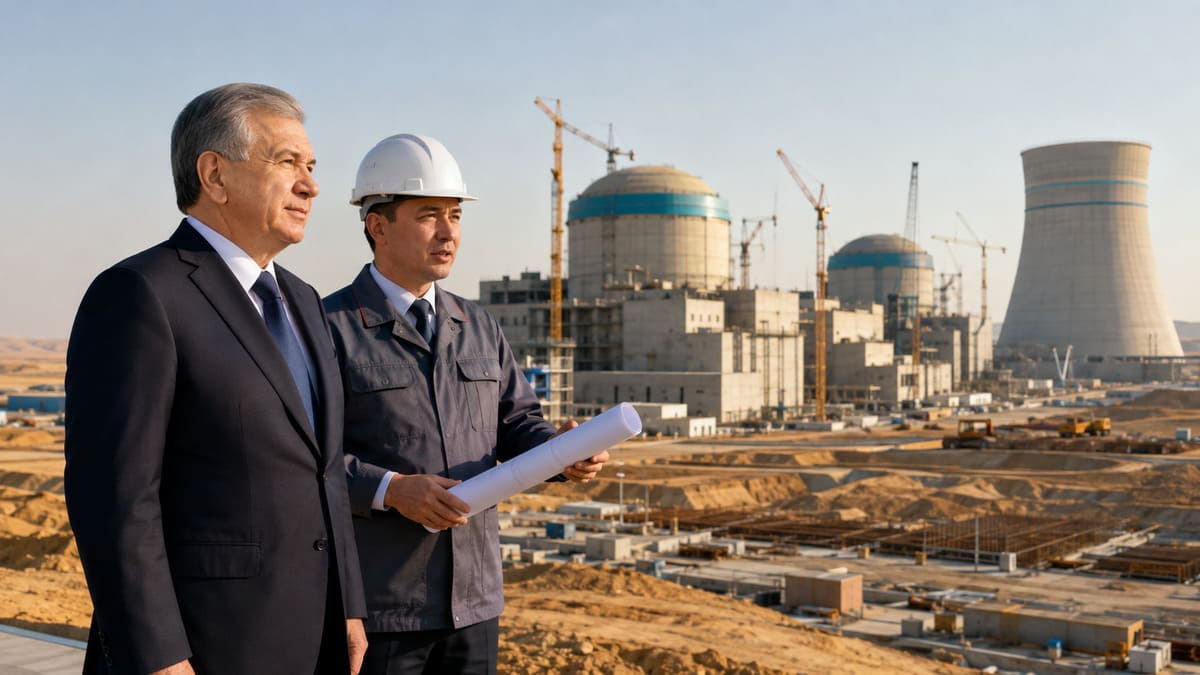
Uzbekistan’s first nuclear power complex is being built on a site of about 525 hectares near Lake Tuzkan in the Farish district of Jizzakh region with the participation of Russia’s state nuclear corporation Rosatom.
Under the latest configuration, the project will include two small RITM-200N reactor units with a capacity of 55 MW each and two larger VVER-1000 units.
The complex will have a total generating capacity of about 2.1 GW, with the reactors expected to enter operation between 2029 and 2035.
By 2035, the plant is expected to generate around 15.2 billion kWh of electricity annually — equivalent to roughly 15% of Uzbekistan’s current electricity consumption.
Uzbekistan and Russia first signed an agreement on cooperation in nuclear energy in 2017. Additional agreements concluded in 2024 and 2025 subsequently revised the configuration of the project.
Construction of the first power unit was formally launched on June 4, 2026, with the participation of Mirziyoyev and Russian President Vladimir Putin.
Nuclear plans spark debate
Uzbekistan’s nuclear energy program has also prompted public debate.
Supporters argue that nuclear power will provide the country with reliable generating capacity, support industrial growth and accelerate technological development. Critics have raised concerns over environmental safety, project costs and the risks associated with managing such large infrastructure projects.
Public hearings on the first nuclear power plant were held in Farish District in December 2025, with Uzatom later describing their outcome as satisfactory.
With preparations for a second plant now announced, nuclear energy is set to play an increasingly important role in Uzbekistan’s plans to meet rising electricity demand and support future investment.