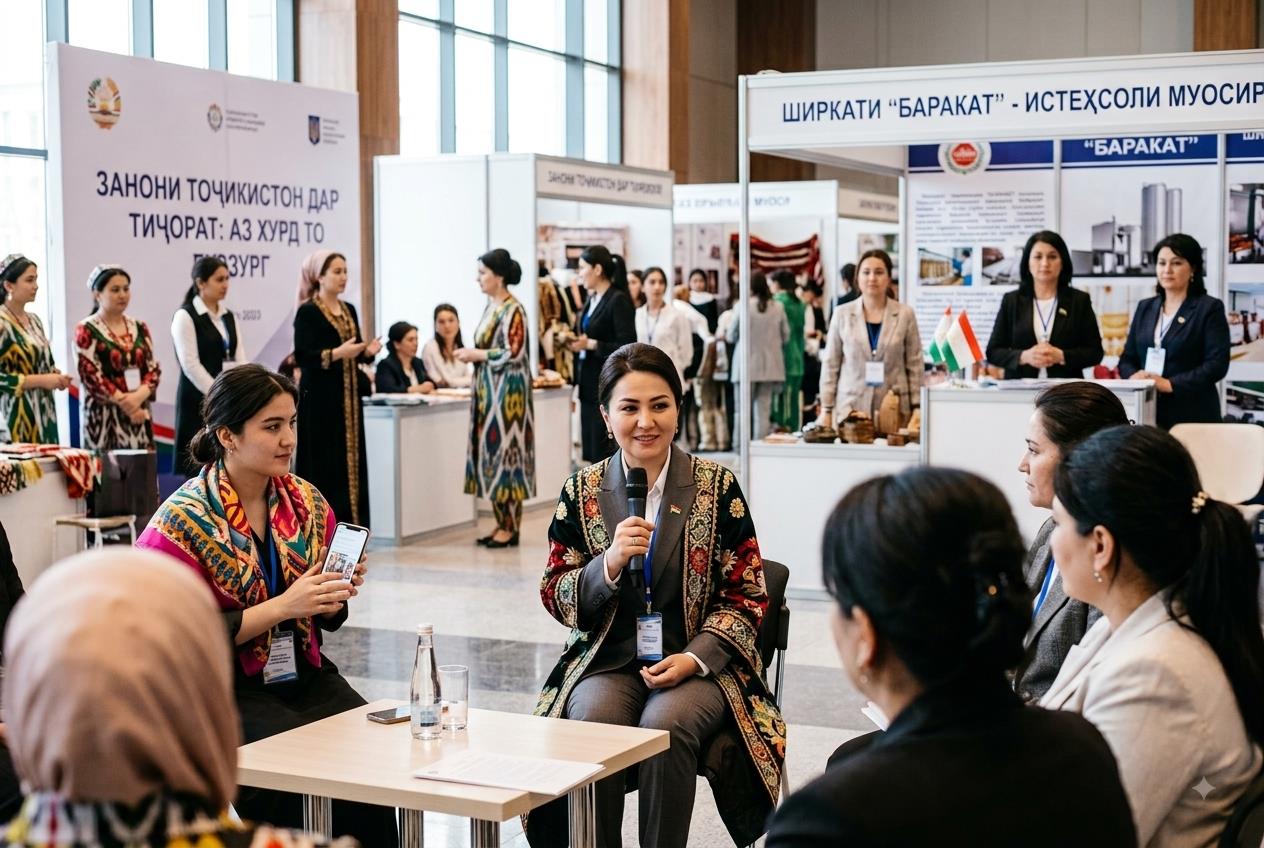
Tajikistan plans to increase the number of women entrepreneurs to 112,000 in 2027 and raise lending to women and women-owned businesses to 7.5 billion somoni. A total of 195.6 million somoni has been allocated for the government’s 2026–2027 plan of actions on women’s entrepreneurship.
The aim is not simply to increase the number of women in business, but also to improve their access to finance, help them expand their companies and open the way to new markets.
The action plan, adopted under the State Program for Women’s Entrepreneurship Development through 2027, sets out measures ranging from loans and grants to training, consulting and new business-support infrastructure.
Nearly 200 million somoni for women’s entrepreneurship
A total of 195.6 million somoni is expected to finance the plan. Of this, 153 million somoni is to come from development partners, 38.4 million from the state budget and 4.2 million from the private sector.
The funding will support targeted credit lines, grants, training programs, consulting and other measures designed to help women develop their businesses.
Presidential grants will also continue, alongside support for projects selected on the basis of their economic potential and prospects for growth.
From starting a business to expanding one
A key goal of the program is to create support for women at different stages of entrepreneurship — from developing an initial business idea to expanding an existing company.
The government plans to develop entrepreneurship training centers, consulting programs and specialized online resources. A network of business incubators, accelerators and technology parks is also envisaged to provide women with training, advice and practical support.
Special attention will be given to women from low-income families. The program aims to provide entrepreneurship training to up to 70% of women in this group, helping them acquire skills to start businesses and earn an independent income.
Women in rural areas are another priority. Those managing dehqon farms are expected to receive training in modern business management and assistance in accessing finance.
The authorities also want to increase women’s participation in agricultural processing, production chains and the manufacture of goods for export.
What holds women-owned businesses back?
As of July 1, 2026, Tajikistan had 108,700 women entrepreneurs, according to the State Committee on Investment and State-owned Property Management. Most, however, remain concentrated in small and medium-sized businesses, particularly trade and services, while large industrial enterprises led by women remain rare.
Among the main barriers are limited startup capital, lack of collateral, difficulties obtaining loans and insufficient financial, legal and digital skills. Access to new markets, professional networks and business advice can also be more difficult, particularly outside major cities.
Social factors remain important as well, including household responsibilities, limited time and persistent attitudes that associate large-scale business primarily with men.
The government says it intends to address these barriers through financing, grants and training, as well as through Tajikistan’s participation in the international WE Finance Code.
Six financial institutions have already committed to expanding financing opportunities for women-owned businesses. A dedicated information platform is also expected to provide banks and government agencies with more reliable data on lending, collateral and businesses led by women.
Separate international programs are being developed in parallel. Under a World Bank project, 3,200 women are expected to receive entrepreneurship and financial-literacy training, while 1,600 participants will be eligible for individual or group grants.
Financial institutions are also introducing products specifically aimed at women entrepreneurs. In July 2026, the European Bank for Reconstruction and Development allocated up to $3 million to Bank Eskhata under its Women in Business program.
What should change in 2027?
The program sets several measurable targets.
The number of women entrepreneurs is expected to reach 112,000 in 2027, up from a baseline of 81,000 in 2023.
More recent figures, however, show that Tajikistan is already close to meeting that target. As of July 1, 2026, the country had 108,700 women entrepreneurs.This means the more important question may be not how many women enter business, but how much their businesses grow.
The government aims to increase the contribution of women’s entrepreneurship to GDP from 1.5% in 2023 to 3.5% by 2027. Exports by women entrepreneurs are expected to rise from 16 million to 35 million somoni.
Another target is to increase lending to women and women-owned businesses from 4.5 billion somoni in 2023 to 7.5 billion somoni in 2027.
More financial and digital skills
The program also places emphasis on financial and digital literacy.
Seminars and information campaigns will cover the use of financial services, electronic payments and protection against fraud. The government also plans to expand access to banking and public services through digital tools and develop additional consulting services for women entrepreneurs.
This is particularly important in rural areas, where access to financial institutions, business advice and professional networks remains more limited.
The State Committee on Investment and State-owned Property Management will coordinate implementation of the plan. Government agencies will report regularly on progress, while the committee will submit annual results to the government.
With the number of women entrepreneurs already approaching the 2027 target, the main test will be whether the program can help more women move beyond microbusinesses, secure financing, create jobs and gain access to larger and more profitable markets.