In the 2014–2015 Islamic Education textbook for fourth graders, two boys are playing with a ball on the grass while a young girl with pigtails skips rope between them. In this year’s edition, the two boys, the ball, and the grass remain, but the girl has disappeared. The image requires no subtle interpretation; a nine-year-old child absorbs its message without a lesson: the playground belongs to the boys.
Journalist Mohammed Al-Saloum published comparisons between old and new editions of Syrian textbooks, after verifying the changes against the original copies. The fact-checking platform Verify-Sy examined a sample of these books and confirmed the discrepancies. On October 26, the Ministry of Education responded with a statement claiming that the only revision made since the liberation occurred in 2025, aimed at removing symbols of the former regime and “correcting images and related content” to “reflect the diversity of Syrian society.” The statement mentioned “inaccurate information” without specifying a single error. It remains for us to understand what exactly was “corrected,” and why the girl was deemed the mistake.
In August 2025, a decree established the Supreme Council for Education, chaired by the President of the Republic. Among its ten named members are the Minister of Religious Endowments and the Head of the Advisory Office for Religious Affairs, with not a single woman among those designated. Meanwhile, the names of the four appointed experts were never disclosed. The ministry referred the national curriculum standards to this council for approval. A body lacking female representation will thus lay down the foundation upon which our children’s textbooks will be written for years to come. What we see today is merely an early glimpse of what is to follow.
The most direct form of alteration is deletion. In a third-grade lesson titled “The Virtue of Cooperation,” a girl was originally pictured digging with a shovel alongside her peers as they planted saplings. In the new edition, her peers remain, the pile of dirt stays in place, but the girl has been removed from the illustration. This is what is known as “symbolic annihilation”: what is excluded from representation teaches the recipient that it is either non-existent or irrelevant.
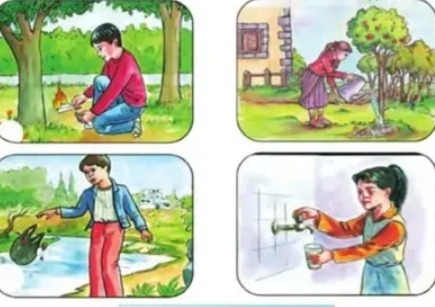
In other instances, a boy replaces the girl. The two young girls greeting each other at the door in a lesson on hospitality have been turned into two boys, and the tree previously watered by a girl in an environmental lesson is now watered by a boy. Generosity and stewardship of the land remain in the book, but they are now performed exclusively by male figures. Space and ownership are redistributed: children learn that when the household opens up to the outside world, it becomes a male domain, and that a girl’s proper place is behind the door. Furthermore, the twelfth-grade Islamic Education textbook added that a woman’s status “grows” sequentially from daughter to wife to mother.
Then comes the hijab. The presence of veiled women in textbooks is natural, as they are an integral part of a diverse Syrian society. What is new, however, is the addition of the hijab to women and young girls who were depicted unveiled in a previous temporary edition. The head of the female doctor explaining vaccines to first-grade students was covered, and a veiled girl drinking water replaced a young girl filling her cup from the tap—an age at which the hijab is not required. The textbook assumes an unseen foreign eye monitoring the female body wherever it goes, teaching the young girl to cover herself before she even understands why.
A lesson titled “Etiquette of Dress in Islam” for fourth graders previously featured a veiled girl, an unveiled girl, and two boys standing together. It has now been replaced by two men wearing short robes, skullcaps, and beards, alongside two women in full-face veils (niqab), each pair depicted in a separate frame. This attire is worn by a tiny minority in Syria. The issue here is that the state is monopolizing the definition of the “proper Muslim woman” and erasing the non-veiled Syrian Muslim woman from a textbook intended for all pupils.
Moreover, the male attire presented does not belong to traditional Syrian dress: the ankle-length robe and skullcap resemble neither the rural sirwal, the urban qumbaz, nor the dishdasha of the Jezira region. The textbook presents the attire of a specific religious faction to Syrian children as the standard dress of a Muslim, while shifting the stated purpose of clothing from “out of love for adornment” to “seeking modesty and adornment.”
This editorial effort was not even applied consistently. The same female doctor remained unveiled on the preceding page, and the schoolgirls around her in the vaccination illustration retained their pigtails. Whomever modified the images corrected whatever caught their eye and missed the rest.
These alterations also extended to historical women. Queen Elissa, depicted in sixth-grade Social Studies riding her horse into battle with a bow in hand, was reduced to a stationary, covered head. In the twelfth-grade history textbook, the text praising Lalla Fatma N’Soumer and Djamila Bouhired for their resistance against French colonialism remained, but their photographs were removed. If the removal was due to Bouhired’s association with the Assad regime, Lalla Fatma’s image would have been preserved. The textbook accepts female heroism as a narrative, but deletes it as a face with which a young girl can identify and emulate.
This is not to say that the Assad regime’s curricula warrant nostalgia. The 2017–2018 edition of the ninth-grade Islamic Education textbook stipulated that a working woman must not “cause unemployment among men” and must balance her job with her “primary duty” as a mother. The twelfth-grade textbook taught marital obedience for wives and revoked financial support if a wife was deemed disobedient (nashiz). These lessons were transferred into the new edition entirely intact.
The Ba’athist state displayed unveiled women in illustrations as proof of its modernity, while the current authority displays covered women as proof of its authenticity. The signifier has changed, but the logic remains: the female body is a screen upon which power projects its identity. Women, in the words of Nira Yuval-Davis, act as “symbolic border guards” of the community, used to delineate who belongs and who does not.
In the 2014 illustration of the planting lesson, the children wore the neckerchiefs of the “Vanguards” youth organization. The neckerchiefs were removed, the color of the school uniform was changed, and the girl was deleted. With a single stroke, de-Ba’athification became a cover for the erasure of the girl.
The ministry’s statement claims that the curricula aim to “consolidate the values of citizenship.” Yet, a lesson in the seventh-grade Arabic language textbook stating that the constitution guarantees equality between men and women in rights and duties—and that Syrian women have held the right to vote since 1949—was removed. Syria acceded to the CEDAW convention in 2003 without reservations on Article 10, which obligates states to revise textbooks to eliminate stereotypical concepts of male and female roles. This obligation rests upon the state itself and does not expire when the ruling authority changes.
The statement notes that the implementation of the new curricula will begin incrementally. Prior to that, the national framework and standards must be published for public debate and subjected to an independent review examining how men and women and their respective roles are portrayed, alongside verifying the list of announced modifications against what was actually changed in the books. It is also imperative to announce the names of the four experts, include female specialists in the Supreme Council and authoring committees, and consult female and male teachers as well as parents.
Years from now, a young girl will stand in a school courtyard, jump rope in hand, watching boys kick a ball. She will not remember the fourth-grade lesson, nor will anyone tell her that the playground is not hers. She will know it on her own, as though she were born knowing it; she will wind up her rope and walk away.
This article was translated and edited by The Syrian Observer. The Syrian Observer has not verified the content of this story. Responsibility for the information and views set out in this article lies entirely with the author.