
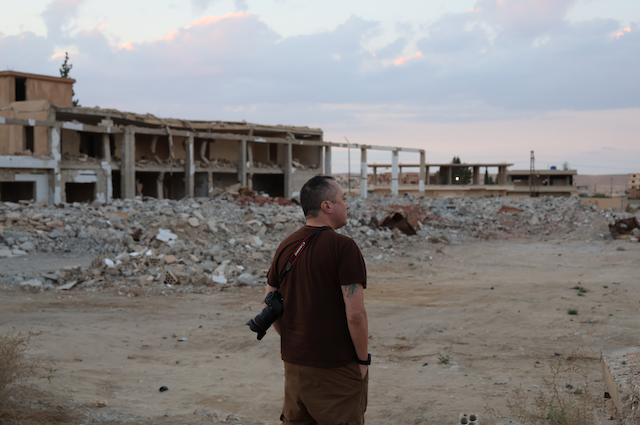
In October 2026, Sara Khan and Kevin Patrick Dawes returned to Damascus looking for answers. Sara’s brother, Abbas, a British doctor from south London, had died in Syrian regime custody.
Dawes was imprisoned alongside him and survived the ordeal, albeit with lasting injuries, including the loss of part of his right foot. While the two men had little in common apart from their language and their desire to deliver aid to Syrians suffering under the Assad regime, Dawes believes that Khan helped save his life. According to Dawes, it was Khan who passed information about his whereabouts to the outside world, eventually reaching US authorities. Now Dawes has returned not only to look for answers but also to help gather evidence against alleged perpetrators who remain at large.
Their visit comes as Syria attempts to confront the legacy of Assad’s torture and detention system, with former regime officials, including members of the Assad family, living in Moscow and elsewhere in exile, while survivors seek accountability at home and abroad. For Khan and Dawes, this is not just about closure. It is about establishing what happened inside the prisons and determining whether the surviving evidence can help bring those responsible to justice. Dawes’s American citizenship could open another avenue for accountability, potentially allowing US investigators to pursue former Syrian security officials suspected of crimes against him.
In 2012, Dr. Abbas Khan, moved by the plight of Syrians suffering under Assad’s repression, decided to enter Syria from the north. He had already been working on the Turkish border, helping the stream of Syrian refugees who had arrived brutalized by the war. Khan would return to the UK for short periods, where he worked as a doctor while raising money to deliver medical aid inside Syria. What Khan did not do was tell his mother, Fatima, that he would be entering Syria. Fatima had warned him that she would ‘break his legs’ if she found out.
Read more: Rushed justice won’t bury Syria’s past
Sara Khan is in the lobby of Cham Hotel in Damascus, Syria. 09/10/2026 (Photo: Fared Al-Mahlool)
By the end of 2012, the Assad regime was targeting hospitals, compelling many doctors, including prominent surgeons such as Dr. David Nott, to enter the country without permission from the Assad regime to provide medical assistance. As with Nott’s work, there was no suggestion that Khan had done anything other than humanitarian work, as a British inquest found.
Khan was captured at a checkpoint in northern Aleppo shortly after arriving in Syria and ended up in the notorious Branch 235, known as the Palestine Branch. He was interrogated, tortured, brought before a military court on terrorism charges and later transferred to Adra prison on the outskirts of Damascus.
Dawes’s story was similar. “In 2012, I traveled to Syria with a cargo of medical supplies. I was captured on October 3rd, shortly after crossing the border.” Being an American citizen did not shield him from torture and abuse. “I was drowned, beaten, mutilated, I am missing a large part of my right foot.”
“I was drowned, beaten, mutilated, I am missing a large part of my right foot.”
Prison conditions were brutal, Dawes said. “I was stripped of all my blankets and held in a freezing cell. I was left chained to bars for a week longer, perhaps less, long enough to lose track of time … my feet were beaten … they starved me down nearly to 80 pounds. For a long time, the size of the rations we were given was very small, and grew smaller and smaller.”
But there was some hope. Dawes discovered that a British doctor was also being held in the underground cells. He could hear Khan being beaten and tortured with scalding liquids.
“Abbas Khan, a doctor from the United Kingdom, was captured and held in a cell near mine. We were able to speak by yelling under the door. We made a pact: whoever reached the West first must return news of the other’s survival. Abbas was able to do so by way of his mother, who had found him in Syria.”
“We made a pact: whoever reached the West first must return news of the other’s survival.”
Abbas’s mother began searching for her son as soon as she learned that he was missing in Syria. She reached out to the Foreign Office, the prime minister’s office and her local member of Parliament to secure his release. The family considered the response from all three inadequate. However, Tobias Ellwood, then a Foreign Office minister, addressed Dr. Abbas Khan’s death in a statement concerning the inquest: “The Foreign Office consistently sought access and pressed for his detention to be reviewed, including through ministers and international partners. The Syrian regime ignored these approaches.”
Curiously, an offer of help came from Nick Griffin, the leader of the far-right British National Party (BNP), who, according to the family’s account, said he could probably secure Abbas’s release if he admitted to being an extremist. Fatima decided that such an admission was too high a price to pay. She traveled to Lebanon and succeeded in obtaining a Syrian visa in Beirut. By July 2013, she was in Damascus, where, according to Sara, she located her son “within three weeks,” before British authorities had managed to do so.
The regime later transferred him from the Palestine Branch to Adra prison, where, according to the family’s account, the torture and abuse stopped. “My Abbas,” Sara said, “was writing letters to us, and my mother would take the letters and take pictures of them and send them to us.”
But such efforts came at a cost. Fatima, who became known as al-Hindiya—the Indian—because of her saris, learned how to navigate the ministries, courts and prisons. She spent six months in Damascus and more than $27,000 in bribes, eventually securing assurances that her son would be released. Abbas was looking forward to coming home.
Back in the UK, public pressure was also mounting. Fatima had gone to the press, publicizing the letters Abbas had written. In early December, she was reportedly told that there was good news and that her son would be released imminently. But when she approached the Syrian authorities, expecting to secure her son’s release, a security official told her that Abbas had committed suicide.
Remnants in one of Assad’s prisons. 05/01/2025 (Photo: Tam Hussein)
A British inquest subsequently concluded that Abbas had been unlawfully killed. Fatima was devastated. The embalming of his body complicated efforts to determine the precise medical cause of death. No one has been brought to justice for the doctor’s death.
Although the Khan family criticized the British authorities for their response while Abbas was alive, British officials assisted with the repatriation of his body following his death. Then-Foreign Secretary William Hague and others called for his body to be returned. “The British Embassy,” Sara said, “helped to fly Abbas’s body back to London, and Abbas is buried there.”
Dawes’s case followed a different diplomatic course. After more than three years in Syrian detention, he was released through efforts involving Russian officials and returned to the United States. Dawes believes Khan’s actions helped American authorities establish his whereabouts.
Dawes said Syrian authorities handed him over to Russian Spetsnaz special forces. “I was continuously hooded and blindfolded. My hands were cuffed, and I eventually arrived in Moscow, Russia. I remember being taken from the van [and] ushered into the Russian Foreign Ministry. At this point, I thought that I was still in Syria, that I was about to be given my reception beating at a prison like Sednaya or Adra or some other place where they send people to die. Instead, agents of my own government arrived, retrieved me, took me to the U.S. Embassy, treated my immediate medical conditions, and flew me from there to an army base in Germany. After that, I was returned to the United States.”
Sara Khan and Dawes returned to Syria hoping to identify those responsible for Abbas’s death and the abuses Dawes witnessed. The two cases also reveal how differently Britain and the United States handled the detention of their nationals. Neither case has established who was responsible for the abuses the men suffered.
“They tortured two children to death in front of me, ten perhaps eight [years old], young children. Their voices hadn’t changed yet.”
The experiences of Khan and Dawes reveal something of the brutality of Assad’s prisons, where countless Syrians experienced torture and death. Dawes recalled that “hundreds, if not thousands of Syrians passed into their graves. To the point that they even ran out of places to put the bodies, stacking them on the roof of one of the buildings in a great pile of garbage bags.” He added: “They tortured two children to death in front of me, ten perhaps eight [years old], young children. Their voices hadn’t changed yet.” Dawes said he later recognized one of the children in the Caesar photographs. Dawes’s testimony could be valuable to investigators. His recollection of the layout of the prison could help identify the perpetrators and corroborate accounts of abuses.
The Syrian Emergency Task Force (SETF), which is working with Dawes, says it is gathering evidence that could assist American investigators pursuing former Syrian security officials. Dawes’s American citizenship could provide a legal basis for US prosecutors to investigate certain crimes committed against him, even if the alleged perpetrators have fled Syria.
Prosecutions abroad can help bring former Syrian officials to justice, but much depends on whether evidence gathered inside Syria can be preserved and made available to foreign investigators and used in future prosecutions.
Sara Khan and Dawes both say that the new Syrian government has been forthcoming and helpful in trying to establish what happened. But their search is complicated by the Assad regime destroying records en masse, claims that Turkish authorities hold some files and the fact that suspected perpetrators have fled abroad. Establishing the full extent of abuses committed against Syrians and foreign detainees such as Khan could take generations.
More than a decade after the two prisoners made their pact, its legacy lives on not only in Dawes’s survival, but also in his return to Damascus alongside Abbas’s sister to help identify those responsible for the abuses suffered by countless Syrians in Assad’s dungeons.
