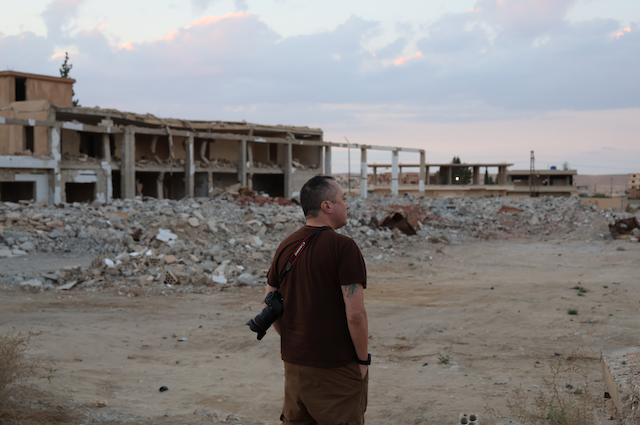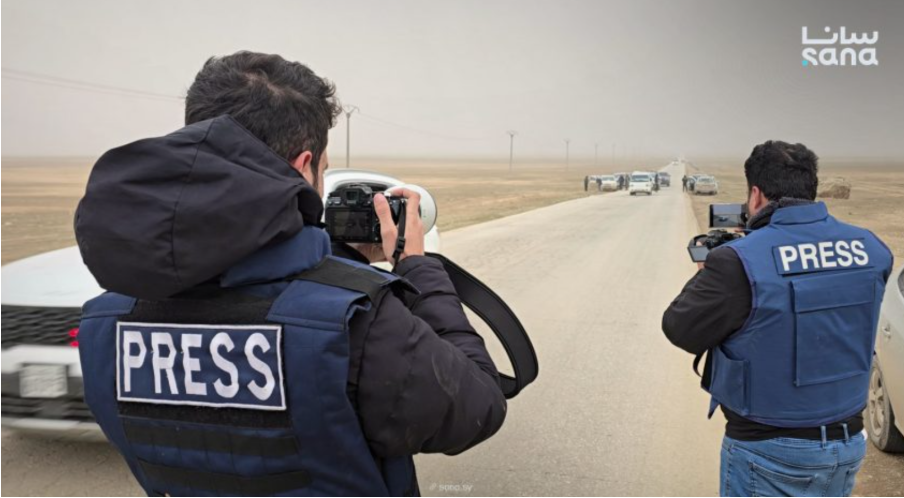
Climbing 36 places on the World Press Freedom Index in a single year is no small feat for any country. Granted, having started from the bottom of the barrel (177th out of 180 countries last year), Syria was able to improve significantly just by allowing the most basic freedoms. So far, it seems the authorities are learning on the job; while their decisions are at times confusing, and although one step forward is occasionally followed by two steps back, there is reason to hope that Syrians can build on most of the positive changes.
When Ahmad al-Sharaa entered Damascus in December 2024, the military operation that liberated Syria from the Assad regime immediately segued into a charm offensive, and the media team was an active element of his entourage. Every one of his steps was studied, choreographed and polished for widespread media consumption. Popular engagement was expected and encouraged, and a massive audience of stunned Syrians, whose tongues had been loosened since the start of the revolution, reveled in the novelty.
The Baathist regime of the Assad years had stringently controlled speech and media, harshly punishing those who crossed the countless red lines. For decades, authorities dictated, state media disseminated, and people deciphered and digested the communication that came down a narrow one-way street.
Under al-Sharaa, two-way traffic has been flowing on wider roads, but with calculated ambiguity. The government has developed a limited communication mechanism of varying efficiency. The population has retained its hard-earned revolutionary ability to speak out and talk back. Now unrestrained by the prohibitions of the Assad era, people openly comment on every government decision and share every rumor.
“The state is not silencing critics, but its loud echo chambers do try to move public opinion in times of pressure; it worked for a while.”
With no official spokespeople for the presidency or for most ministries, and no prime minister to fulfill the task of representing the interim government’s remit and performance, numerous loyal influencers have adopted the role of announcers and defenders. They have flooded social media networks with justifications for unpopular actions, occasionally accusing critics of being loyal to enemies of the new Syria. The state is not silencing critics, but its loud echo chambers do try to move public opinion in times of pressure; it worked for a while.
A glitch in this inadequate system appeared in June 2026, creating a commotion that showcased governmental inexperience and indecision. In the midst of his social media campaign exposing figures who had not delivered on pledges made during reconstruction drives, filmmaker Hassan Akkad was arrested and jailed for several days. It later emerged that he had been accused of slander and defamation by journalist Moussa Omar, one of those who had made pledges. However, Akkad had merely quoted information published by the authorities in his exposure of Omar and in that of Muhammad Hamsho, the Assad-era businessman whose opaque rehabilitation by the government has angered many Syrians.
After a few days of radio silence, the Syrian Ministry of Information issued a short video abruptly announcing new speech and media prohibitions, namely the vaguely defined transgressions of offending public morals, spreading fake news and rumors (without defining these terms), violating privacy, defamation, hate speech, offending religions and revealing state secrets. Apart from the needed control of hate speech, the decision seemed to signal a partial return to Assad-style restraints and control. Since then, people have continued to speak and write freely, but the government’s resurrection of this media and cybercrime legislation has been badly received.
This incident and others like it have fueled complaints about the government’s cryptic communication habits and its lack of transparency and professionalism. On many occasions, even for appointments to several chargé d’affaires diplomatic posts earlier this year, it was through the usual influencers that decisions and names were first heard. Often, these same influencers signal the release of important news before ministries or state media do. And while the official Syrian media agency has relaunched in its new and slightly improved form, it has limited exposure. Meanwhile, the name Syria TV suggests a state broadcaster, although the channel is privately owned and operates independently of the Syrian state, creating further confusion.
These issues matter when Syria as a whole, and the government in particular, are subject to massive disinformation campaigns on traditional and social media platforms. While fake news reports use inflammatory AI-generated images and images from other (or past) conflicts to allege rampant, systematic killings and dispossession of numerous Syrian communities on a daily basis, there is no concerted national effort to counter propaganda that targets the country and keeps Syrians constantly on the defensive with limited means.
“Clips and quotes from his numerous meetings do not compensate for an absence of personal outreach.”
There is a sense in official and influencer circles, it seems, that President al-Sharaa’s personal appearances are sufficient to offset all this noncommunication and win over skeptics. For this to happen, he would need to communicate regularly, directly and plainly with the Syrian population, even in colloquial Arabic. Clips and quotes from his numerous meetings do not compensate for an absence of personal outreach, and when several Syrian localities protested a big increase in fuel prices in September, with a marked outpouring of anger on social media and across the country, he should have reduced tensions by connecting with the people.
When these protests died down, he issued instructions for spending cuts. This followed months of ostentatious displays of expenditure, with fancy official car fleets and luxury projects, accompanied by pervasive government branding, riling up a society in survival mode, struggling to make ends meet. A personal address would have been much better received by people asking to be seen and heard after so much suffering.
People have resented the government’s handling of issues of national interest, such as the pardon and rehabilitation of Hamsho, the inconsequential People’s Assembly, the stalled reconstruction and the Syrian Sovereign Fund, about which very little has been divulged. An official spokesperson would at least partly resolve many of these communication deficiencies and would address the popular demand for immediacy and transparency.
Read more: Sanctioned Syrian tycoon Hamsho eyes a ‘new chapter’ after financial settlement
“An official spokesperson would at least partly resolve many of these communication deficiencies and would address the popular demand for immediacy and transparency.”
The al-Sharaa team’s overreliance on his personal charisma to extend a hand when needed is also a flawed strategy. For his recent appearance at an Atlantic Council event in New York, despite the availability of more suitable—and certainly more neutral—media and think tank figures, former Obama official Brett McGurk was chosen to moderate; surprisingly, his forceful (but expected) line of questioning caught al-Sharaa off guard.
These experiences on both domestic and foreign fronts should be pushing the government to adopt a more consistent approach to public engagement, demonstrating its understanding of communication and its acceptance of a media that is free to question and hold the government to account. Nearly two years into the transition, the government’s reliance on unofficial channels to communicate with the public has blurred the distinction between official policy and political messaging. President al-Sharaa can easily improve on current practices while guaranteeing free speech and the independence of media in the new Syria—moves that will enhance trust and uphold the goodwill of the people.
The views expressed in this article belong to the author and do not necessarily reflect the editorial policy of Syria Direct