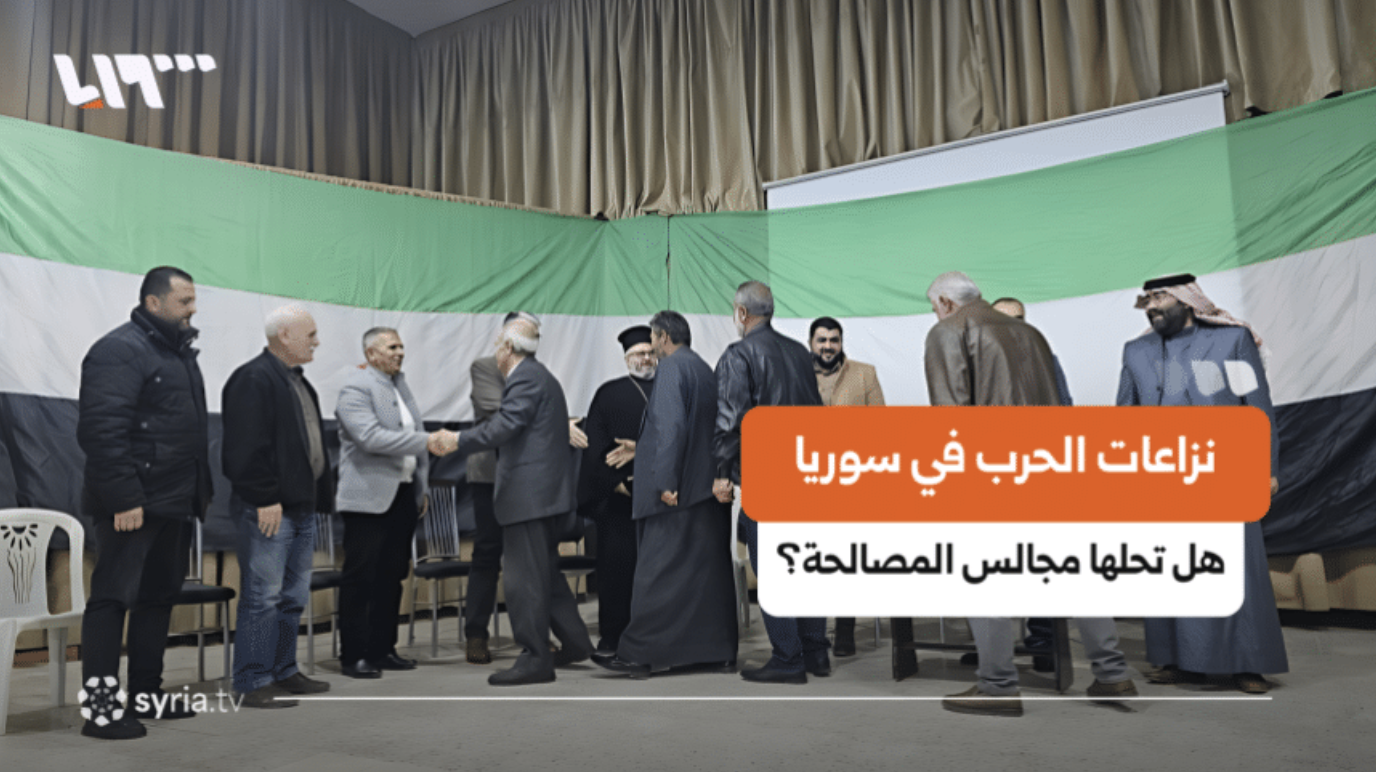
Local reconciliation councils are expanding in several parts of Syria to address social, financial and property disputes that have accumulated since the war years. They are filling a gap left by weak courts and slow procedures. The lack of a legal framework for these councils, and the limited legal expertise of those running them, raise questions about their role and the limits of their authority in the period ahead.
Researcher and journalist Natasha Danon said in a report published by the Malcolm H. Kerr Carnegie Middle East Center that reconciliation councils are appearing in different parts of the country to mediate disputes within local communities, especially those left behind by the war years, while the transitional justice process still faces major challenges.
According to the report, the disputes these councils handle include property, financial and personal status cases, as well as blood feuds and revenge-related disputes. They do not hear security cases or crimes that fall under serious criminal penalties.
More than 7,000 volunteers
The report said that after the fall of the Assad regime in December 2024, reconciliation councils were extended to the governorate level, along with local committees in villages, to address the war’s impact at the community level.
More than 7,000 volunteers take part in these councils and committees across Syria. The exception is the General Reconciliation Council, based in Idlib, whose staff receive government salaries, according to the report.
The councils’ roots go back to the early years of the Syrian revolution, when tribal and local councils emerged in areas outside the control of the ousted regime. They aimed to fill the vacuum left by state institutions, deal with local disputes and provide some services.
In Idlib, a growing number of displaced people and a heavy court caseload led to the creation of a general reconciliation council in 2019. Its work then expanded from tribal cases to disputes involving residents of both cities and rural areas.
A fast alternative to the courts
The report links demand for reconciliation councils to the state of Syria’s judiciary, which suffers from a shortage of staff and a heavy caseload. Several courthouses were damaged, and judicial records were lost or destroyed during the war.
The dismissal of hundreds of judges tied to the ousted regime worsened the shortage of judicial staff, while the authorities work to appoint new judges and rehabilitate judicial institutions.
Mohammad Khattab, head of the General Reconciliation Council’s office, said demand for the councils stems from their speed and accessibility. He noted that most cases are completed within three days, and that handling a case usually takes no more than a month.
He added that the councils’ services are free, unlike going to court and the costs that come with it, which gives them added importance as economic conditions deteriorate.
A mechanism based on mutual consent
In Raqqa, the head of the reconciliation council, Khaled al-Hajj, said that going to the council requires the consent of both parties to the dispute, and that any settlement needs both of them to agree.
“Both parties enter the process by mutual consent, and outcomes require their agreement. If either party rejects the proposed settlement, the case is referred to the judiciary,” he said.
According to the report, since its founding the Raqqa council has handled cases that are mostly financial disputes, followed by brawls, property disputes, civil status cases and killings.
Of 432 cases brought before the council, only 16 were referred to the judiciary because the parties could not reach a settlement.
Although reconciliation councils do not yet have official status or a clear legal basis, they coordinate with the courts. In some cases, the judiciary can enforce financial settlements reached through these councils if one party fails to meet its obligations.
Concerns over lack of legal expertise
Some legal professionals, however, criticize the makeup of these councils.
Cases are usually heard by a panel of three arbitrators: a religious sheikh and two people who are supposed to provide the legal side. But Du’a al-Khadr, a lawyer from Raqqa, said some mediators lack legal expertise, and that no judges or lawyers take part in the local committees there.
“In Raqqa, these mediators lack an understanding of the law, particularly regarding property disputes, and they often rush to resolve cases, which can lead some plaintiffs to lose part of their rights in the name of speed,” al-Khadr said.
The report points to other concerns regarding the representation of women, as women are absent from the mediation committees in Raqqa, although officials say there are women mediators in other parts of the country.
Al-Khadr believes the absence of women can be a problem in sensitive cases, where some women find it difficult to speak in front of men, especially in matters of harassment and sexual assault.
Temporary councils awaiting a transitional justice framework
The head of the Raqqa reconciliation council considers the councils’ current role not a final substitute for transitional justice, but a temporary means of reducing tensions and handling disputes until the legal framework is completed.
“Our role is to calm tensions, not to resolve them permanently. We are ultimately a temporary solution, and we handle cases until a legal framework for transitional justice is put in place,” al-Hajj said.
The Raqqa council currently refers cases involving enforced disappearance and war crimes attributed to the Islamic State group and the Syrian Democratic Forces to the National Commission for Transitional Justice, which was formed in 2025 and is working on drafting legislation due to be presented to the People’s Assembly.
The report suggests that giving reconciliation councils a legal framework could allow them to help rebuild trust among members of society, open channels of dialogue and settle local disputes. It notes that the councils are currently seeking legal recognition and integration into the anticipated transitional justice framework.
At the same time, the report warns that expanding the role of councils that lack legal expertise, at the expense of rebuilding the formal judiciary, could entrench forms of mediation based on Sharia and custom rather than the civil legal system. This makes defining their relationship to the courts and their legal authority one of the key issues to be settled in the next phase.
This article was translated and edited by The Syrian Observer. The Syrian Observer has not verified the content of this story. Responsibility for the information and views set out in this article lies entirely with the author.