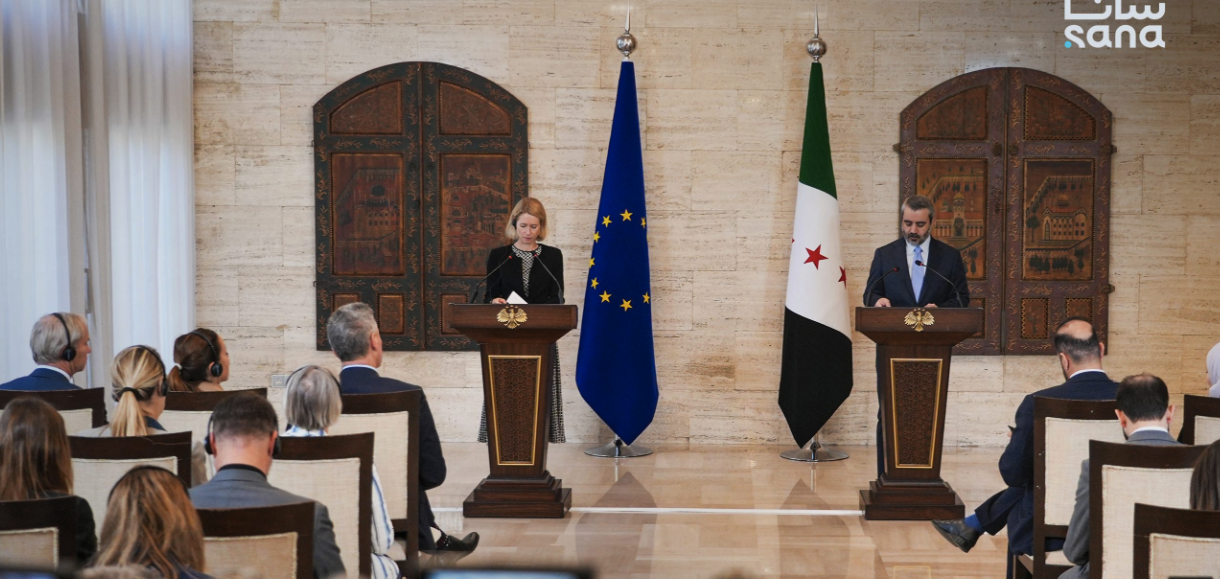
Kaja Kallas, the European Union’s High Representative for Foreign Affairs and Security Policy, arrived in Damascus on Tuesday. The visit moves the Syrian-European rapprochement from the diplomatic arrangements of recent months, which moved at a rapid pace, to direct meetings on expanding cooperation between the two sides.
Foreign Minister Assaad al-Shibani received Kallas at Tishreen Palace in Damascus, after she met Minister of Social Affairs and Labor Hind Kabawat. Their talks covered cooperation on social protection, sustainable development, economic empowerment, the reintegration of returnees, and the role of civil society in delivering services and strengthening social cohesion.
The visit draws its significance from its timing and the content of its meetings. It comes weeks after the appointment of the first EU ambassador to Syria in 14 years, at a stage in which the relationship has moved from restoring contact after the fall of the toppled regime to the lifting of sanctions, the return of the European mission to Damascus, and the reactivation of the cooperation agreement, and now to discussions on a new partnership agreement between the two sides.
From Restoring Contact to Supporting Economic Recovery and Reconstruction
After the fall of the toppled regime, the European Union began reopening channels of communication with Damascus, following years in which its mission accredited to Syria operated mainly from outside the country.
The European External Action Service says the Union has “substantially strengthened” its presence and engagement in Damascus since December 2024, before its mission moved permanently to the Syrian capital in November 2025, with the aim of broadening dialogue and cooperation with the Syrian authorities.
In the early phase, the European position was cautious, and the Union tied the expansion of relations to the political transition, stability, and respect for rights. Over the course of 2025, however, the process gradually moved from political contacts to practical measures, including the easing of restrictions and then the lifting of economic sanctions.
On May 28, 2025, the European Union lifted the economic sanctions imposed on Syria, with the exception of measures tied to security considerations and sanctions targeting figures and entities linked to the toppled regime.
The decision marked a fundamental shift in the nature of the relationship, as European policy moved from managing the Syrian crisis and providing humanitarian aid to supporting economic recovery and reconstruction and reintegrating Syria into the regional and international economic system.
The Commission and the European Council in Damascus: A New Chapter in Relations
On January 9, 2026, the extent of the shift became clearer when European Commission President Ursula von der Leyen and European Council President António Costa visited Damascus and met President Ahmad al-Sharaa.
Announcing the visit, the European Commission presented it as the opening of a “new chapter” in relations with Syria and set out three main tracks for the new relationship:
- A political partnership to support the transition, stability, and regional reintegration.
- Expanded trade, economic cooperation, and investment.
- A financial support package of roughly 620 million euros for 2026 and 2027, covering humanitarian aid, early recovery, and bilateral support.
Accordingly, the European-Syrian relationship was no longer limited to humanitarian cooperation or political contacts, and began to turn into a broader framework covering the economy, trade, reconstruction, and institution building.
First High-Level Political Dialogue
On May 11, 2026, the relationship reached a new institutional level with the first high-level political dialogue between the European Union and Syria, held at the Union’s headquarters in Brussels.
Kallas chaired the meeting on the European side, while Foreign Minister al-Shibani chaired it on the Syrian side. Also taking part were EU Commissioner for the Mediterranean Dubravka Šuica and Commissioner for Preparedness and Crisis Management Hadja Lahbib.
The European Council said at the time that the dialogue offered an opportunity to make progress toward normalizing relations between the European Union and Syria, and addressed two main tracks: bilateral relations, regional issues, security, and stability; and support for Syria’s transition, economic recovery, and reconstruction.
The meeting coincided with a political and legal decision by which the Council of the European Union ended the partial suspension of the cooperation agreement between Syria and the European Economic Community, in place since 2011, and restored the agreement in full.
The agreement, originally concluded in 1977, was the legal framework for economic and trade relations between the two sides, before parts of it were suspended in response to violations committed by the toppled Assad regime.
In its statement after the meeting, the European Union described the reactivation of the agreement as a “clear political signal” of its commitment to re-engaging with Syria and supporting its economic recovery.
First Ambassador in 14 Years
The latest and clearest step came on September 6, when Michael Ohnmacht presented his credentials to President al-Sharaa as the European Union’s ambassador to Syria.
The European External Action Service said the step restored the Union’s representation at ambassador level for the first time since 2012, ending a 14-year gap in full diplomatic relations between the two sides.
In presenting his credentials, Ohnmacht pointed to what he called “remarkable progress” in relations over the past 18 months and announced his intention to work with the Syrian government toward a new “partnership agreement” that would set a broader framework for Syrian-European relations.
Three days earlier, on receiving a copy of the ambassador’s credentials, al-Shibani had affirmed Syria’s wish to move quickly to negotiations on the partnership agreement, describing the European Union as a “distinguished partner” of Syria.
These developments indicate that the current relationship between the two sides now rests, in practice, on a resident European mission in Damascus, an accredited ambassador, a high-level political dialogue, and a reactivated economic cooperation agreement, in addition to preliminary talks on a new partnership agreement.
It is in this context that Kallas’s visit comes, weeks after Ohnmacht’s accreditation and four months after she chaired the first high-level political dialogue with Syria in Brussels, as part of a European path toward broader political and economic cooperation with Damascus.
A Political Return Accompanied by a Security Umbrella
The European Union’s return to Damascus is not limited to the political and diplomatic dimension. Intelligence Online said the Union is currently working behind the scenes to significantly strengthen its security presence in Syria, in step with Kallas’s visit.
In April 2025, Intelligence Online had reported that the European Union was preparing to hire a Lebanese security company to protect European diplomatic missions heading to the Syrian capital, adding that the company is run by a former Lebanese intelligence official.
About a month later, European contracting documents showed that the Union’s External Action Service had awarded the Lebanese company Prosec Professional Security SAL a contract to provide security services to the European Union mission in Syria. The award was announced on May 21, 2025.
According to data available from open sources, the contract was titled “Security Services for the European Union Mission in Syria – One-Year Interim Contract” and stipulated that the company would provide the human and material resources needed to protect the persons and property under the European Union’s responsibility.
The services explicitly named in the contract included security guards, close personal protection, and active tracking systems using GPS and GPRS technologies, reflecting a scope that goes beyond guarding a diplomatic premises to include protecting people and their movements and vehicles.
According to the published contract data, implementation began on April 27, 2025, and ran for 12 months, until April 27, 2026, at a listed value of roughly $3.56 million.
The External Action Service’s documents also show that Prosec was not new to the European Union, having previously won security contracts for the European mission in Lebanon, including one worth more than 1.1 million euros in earlier contracting records.
The Syria contract was concluded through a negotiated procedure without an open call for competition, and the Union described it as an “interim contract,” at a stage when the European presence inside Syria was still being rebuilt.
By May 2025, the conditions under which the contract was concluded had changed considerably. The company’s main declared role was tied to securing the missions and visits of European diplomats to Damascus, while the European Union mission itself moved permanently to the Syrian capital in November of the same year, before Michael Ohnmacht became a formally accredited ambassador in September 2026.
The Intelligence Online report opens the file on the European security presence in Syria, stating that the European Union is now seeking to significantly raise its security presence in Syria, without the nature of the new arrangements or the party that will carry them out having been fully clarified.
Among the keywords tied to the report are the names of international and local security and risk firms, along with the names of Syrian companies, which suggests that the current European expansion may be accompanied by a reshuffling of the network of firms and contractors tasked with protecting the mission and European delegations.
In conclusion, it is certain that Europe’s return to Syria is no longer merely a political return. The mission’s shift from temporary visits to a permanent diplomatic presence has been accompanied by the building of a security and protection apparatus that expands in parallel with the relationship itself.
This article was translated and edited by The Syrian Observer. The Syrian Observer has not verified the content of this story. Responsibility for the information and views set out in this article lies entirely with the author.