By Abdikarim H. Abdi Buh
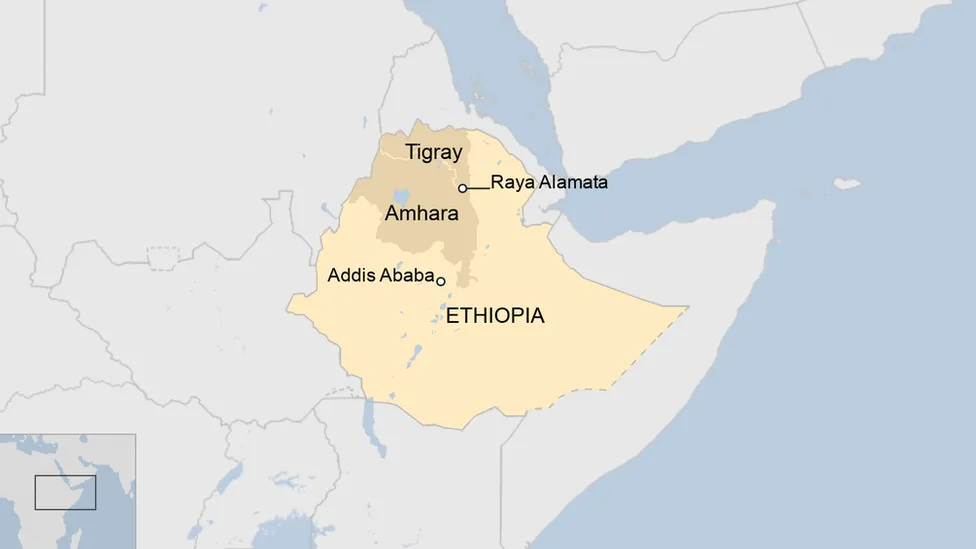
A dangerous new chapter may be opening in the Horn of Africa. Renewed tensions between Ethiopia’s federal government and the Tigray People’s Liberation Front (TPLF) are raising fears of another major conflict in northern Ethiopia—one that could extend far beyond Tigray and potentially reshape the security architecture of neighboring Somalia.
For Somalia, the question is particularly consequential: what happens if Ethiopia suddenly needs thousands of troops that are currently deployed across the border? That possibility is no longer merely an abstract strategic concern.
Tensions between Addis Ababa and the TPLF have intensified following the TPLF’s return to political dominance in Tigray and the weakening of the transitional administration supported by the federal government. The developments have further strained the fragile political understanding created by the 2022 Pretoria peace agreement, which ended two years of devastating war.
New clashes in western Tigray have added to concerns that the peace agreement is under its most serious pressure since it was signed. A return to full-scale war would be disastrous for Ethiopia. But its consequences could also be felt across the wider region—including in Somalia, where Ethiopian troops remain a critical component of the country’s security architecture.
The Somalia Question
Ethiopia has maintained a substantial military presence in Somalia for years, including forces operating along the two countries’ border and troops participating in the African Union Support and Stabilization Mission in Somalia, AUSSOM. Those forces have become an important part of the regional security equation.
Somalia remains heavily dependent on international security assistance while its own security forces continue the difficult process of assuming responsibility for national security. AUSSOM remains a key component of that transition. This creates an uncomfortable strategic reality.
If fighting in Tigray escalates to the point where Addis Ababa requires additional troops at home, Ethiopian commanders may face difficult choices about force deployments outside the country. Some Ethiopian troops currently serving in Somalia could potentially be reassigned to domestic priorities.
There is, however, no confirmed evidence that Ethiopia has decided to withdraw its forces from Somalia because of the Tigray crisis. Any large-scale redeployment should therefore be treated as a potential scenario rather than an established policy. But in geopolitics, possibilities can be consequential long before they become official decisions.
A reduction in Ethiopian forces could create additional pressure on Somalia’s already fragile security transition—particularly at a time when the future financing and international support structure surrounding AUSSOM remains uncertain.
A Regional Crisis Waiting to Connect
The Tigray crisis cannot be viewed in isolation. One of the most worrying dimensions is the rapidly deteriorating relationship between Ethiopia and Eritrea.
The two countries were once close military partners during the 2020–2022 Tigray war, when Eritrean forces fought alongside Ethiopian federal forces against the TPLF. That alliance has since collapsed.
Relations between Addis Ababa and Asmara have deteriorated sharply, with disputes involving Eritrean troops in Ethiopian territory, border questions, and Ethiopia’s increasingly explicit interest in securing reliable access to the Red Sea.
For Eritrea, Ethiopia’s ambitions on the Red Sea are not simply an economic question. They touch directly on sovereignty and national security. Ethiopia has been landlocked since Eritrea became independent, making reliable access to a Red Sea port strategically important to Addis Ababa.
Asmara, meanwhile, has every reason to be wary of an increasingly powerful neighbor seeking a permanent maritime foothold. That makes the Tigray crisis particularly dangerous.
A confrontation between Addis Ababa and the TPLF could create opportunities for Eritrea to exert pressure on Ethiopia indirectly—or potentially become involved more directly if its security interests are threatened. The result could be a regional equation in which former enemies become temporary partners because their interests happen to converge.
The Enemy of My Enemy?
The irony is striking. Eritrea and the TPLF spent decades as bitter enemies. Their confrontation culminated in the devastating 1998–2000 Ethiopia-Eritrea war and later the Tigray conflict. Yet today’s geopolitical landscape is radically different.
The principal strategic relationship is no longer simply Eritrea versus TPLF. It is increasingly Eritrea versus an Ethiopian government whose regional ambitions have become a source of concern in Asmara. That distinction matters.
TPLF’s political and military resurgence, combined with worsening Ethiopia-Eritrea relations, could create an unexpected convergence of interests—even if no formal alliance exists between the parties.
Ethiopian Prime Minister Abiy Ahmed has repeatedly warned about external and internal forces seeking to destabilize his government, with Tigray and Eritrea featuring prominently in the government’s security calculations.
Meanwhile, reports and assessments have pointed to renewed military mobilization inside Tigray, adding to fears that the Pretoria agreement could be approaching a critical breaking point.
Sudan Adds Another Layer of Danger
Then there is Sudan. The Horn of Africa’s security crises increasingly overlap. Tigray, Eritrea and Sudan sit within a strategic triangle connecting the Nile Basin, the Red Sea and the wider Horn of Africa. A renewed Ethiopian conflict could therefore interact with Sudan’s devastating civil war and produce consequences that are difficult to contain.
A new war in Tigray could generate additional displacement, disrupt cross-border trade, increase arms flows and create new opportunities for armed groups operating across porous borders. What begins as an Ethiopian domestic conflict could rapidly acquire regional characteristics. That is precisely what makes the current situation so alarming.
For Somalia, the first and most immediate concern would be security. If Ethiopia were forced to move substantial numbers of troops from Somalia back toward Tigray or other vulnerable areas, Somalia could face a reduction in one of the most significant external military contingents supporting its security environment. That would happen at a particularly difficult moment.
Somalia is still confronting Al-Shabaab, while its security institutions remain heavily dependent on international assistance, training, intelligence and logistical support. A sudden reduction in Ethiopian forces could therefore create security gaps in areas where Somali forces are not yet capable of independently replacing them.
It could also complicate AUSSOM’s broader transition strategy. The mission is already operating in an environment where questions about financing, troop contributions and long-term international support remain unresolved. A major Ethiopian redeployment would add another layer of uncertainty.
The Bigger Horn of Africa Picture
The implications extend beyond troop numbers. Ethiopia is one of the most powerful states in the Horn of Africa. Eritrea controls a strategically important stretch of Red Sea coastline. Sudan is engulfed in a devastating civil war. Somalia sits beside the Gulf of Aden and the Bab el-Mandeb, one of the world’s most important maritime corridors.
Together, these countries form a geopolitical chain linking East Africa, the Red Sea, the Arabian Peninsula and the Indian Ocean. A major conflict in one part of that chain rarely remains isolated for long.
For Somalia, the danger is particularly acute because the country is still rebuilding its security institutions while simultaneously confronting a persistent insurgency.
The last thing Mogadishu needs is a sudden deterioration in the regional security environment or a significant reduction in the foreign forces currently helping to contain militant threats. No War Yet—but the Warning Signs Are Growing. It would be premature to declare that Ethiopia is heading inevitably toward another full-scale Tigray war.
The federal government retains substantial military capabilities, and political and diplomatic mechanisms remain available to prevent further escalation. But the warning signs are difficult to ignore.
The return of TPLF political influence in Tigray, renewed clashes, reported military mobilization, worsening relations between Addis Ababa and Asmara, and the unresolved question of Ethiopia’s Red Sea ambitions have combined to create one of the most volatile strategic environments in the Horn of Africa in years.
The Pretoria agreement was supposed to close the chapter on Ethiopia’s devastating internal war. Instead, the region is now watching to see whether its fragile peace can survive a new generation of political and military confrontation. For Somalia, the stakes could hardly be higher.
A renewed Ethiopian conflict could alter the deployment of Ethiopian forces, reshape AUSSOM’s security calculations, strengthen regional rivalries and create new opportunities for Al-Shabaab to exploit security gaps.
The lesson for Mogadishu is therefore sobering. Somalia cannot afford to build its security strategy on the assumption that Ethiopia will always have enough troops to protect its own borders and simultaneously carry the burden of security beyond them.
If war returns to Tigray, Somalia may discover that a conflict hundreds of kilometers away can suddenly become a crisis on its own doorstep. And in the Horn of Africa, that distance can disappear remarkably quickly.
Abdikarim H. Abdi Buh
Email: abdikarimshak@gmail.com