Russia slams U.N. watchdog for reporting on North Korean nuclear facility
IAEA can’t verify DPRK’s nuclear program, Moscow argued, after agency identified another enrichment facility in Yongbyon
Russia has brushed off a U.N. nuclear watchdog’s report on North Korea’s nuclear program that included findings on a newly built uranium enrichment facility, citing insufficient evidence attributed to the agency’s lack of access to the country.
A Russian representative to the International Atomic Energy Agency (IAEA) in a statement in Vienna on Wednesday noted the watchdog had not conducted inspections in the DPRK since 2009, arguing that it was “unable to draw any reliable conclusions regarding the state of the country’s nuclear infrastructure.”
“The Secretariat’s assessments, based solely on satellite imagery and information from open sources, have no added value, create a misleading impression and give rise to additional risks,” the representative said, while calling on the IAEA to stop issuing reports on North Korea’s nuclear program.
The remarks followed an Aug. 28 report by IAEA Director General Rafael Grossi titled “Application of Safeguards in the Democratic People’s Republic of Korea,” which detailed recent developments in the country’s nuclear program.
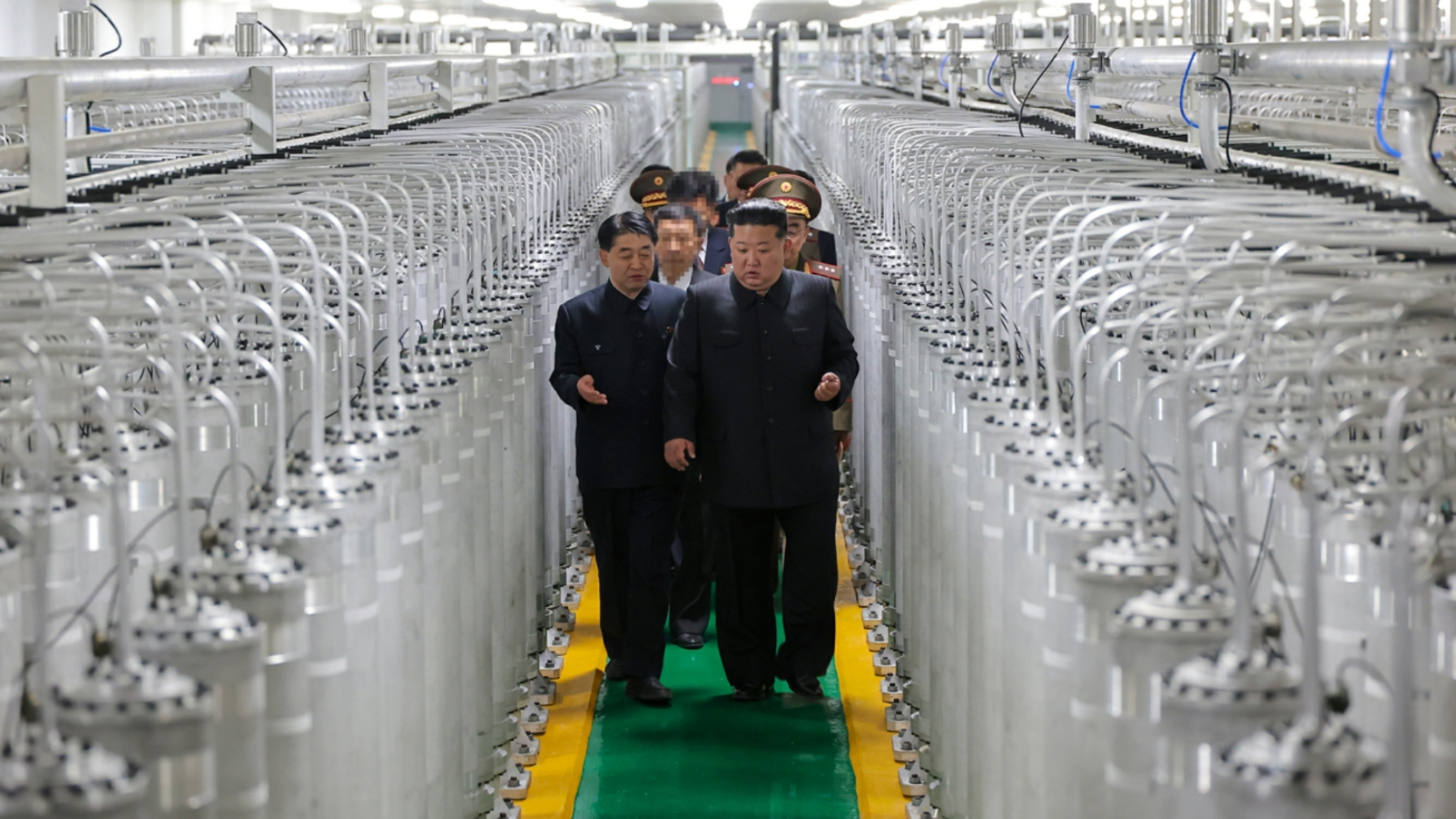
The report included updates on a new uranium enrichment facility completed between Dec. 2024 and March 2026 at Yongbyon, a nuclear complex about 50 miles north of Pyongyang. Grossi previously linked the new “nuclear material production plant” to DPRK leader Kim Jong Un’s June 3 visit and expressed serious concern over its operations.
The August report identified the site Kim visited as a new two-story building at Yongbyon by comparing state media photographs with commercially available satellite imagery taken during construction. The agency referred to the site as Yongbyon Uranium Enrichment Facility 2 (Yongbyon UEF2).
“The photographs from the visit indicate that gas centrifuge cascades are installed on both the upper and lower floors of the main building,” the report said. “This building could accommodate up to 28 of the cascades depicted in the photographs.”
The capacity estimate is consistent with an earlier assessment by nonproliferation expert Jeffrey Lewis, who assessed that the building could house 28 cascades, or roughly 4,600 centrifuges.
The IAEA report said the centrifuges visible in the state media photographs appeared to be of the same type as those at Kangson and Yongbyon’s older enrichment facility, which the agency referred to as Yongbyon UEF1.
“Installation of at least one of the cascades depicted in the photographs was incomplete,” the report said, noting that “at least one of the cascades” seen in the state media images appeared to “have a different configuration from the cascades comprised of 344 centrifuges shown in the earlier photographs of Kangson UEF and Yongbyon UEF1.”
The report described the continued development of North Korea’s nuclear program as “deeply troubling” while providing updates on other facilities.
The IAEA noted signs of ongoing activity at the Kangson uranium enrichment facility a few miles southwest of Pyongyang, where an annex was added in 2024.
“Beginning in Jan. 2026, there were also indications that operations had commenced within its annex,” the report said. The agency also observed indications of continuous operation at Yongbyon UEF1.
Cooling-water discharges and other indicators suggested that Yongbyon’s 5 MW(e) Experimental Nuclear Power Plant “continued to operate in its seventh operational cycle throughout the reporting period,” with “occasional shutdowns of one or two days’ duration.”
The agency also reported indications that Yongbyon’s Light Water Reactor (LWR) was in stable operation from early Dec. 2025 to mid-March, followed by a shutdown until the end of April. It then operated through the end of the reporting period, apart from a shutdown lasting a few days in mid-May.
“Overall, the Agency has observed that the LWR was operating for approximately two-thirds of the reporting period,” the report said.
Grossi’s report pointed to the apparent completion of a campaign at Yongbyon’s Radiochemical Laboratory to reprocess irradiated fuel from the 5 MW(e) reactor’s sixth operating cycle, with intermittent operation of its supporting steam plant between April and July suggesting subsequent waste treatment or maintenance.
The report noted “expanded mining, milling and concentration activities at the Pyongsan Uranium Mine and the Pyongsan Uranium Concentrate Plant” and “ongoing activity at the Wolbisan Uranium Mine.”
The IAEA did not observe “indications of significant activity” at the nuclear test site at Punggye-ri but stressed that the facility “remains capable of supporting a nuclear test.”
North Korea has conducted six nuclear tests, most recently on Sept. 3, 2017.
The IAEA “continues to maintain readiness to carry out its verification role should it regain access to North Korea’s nuclear facilities, which halted after the DPRK ceased cooperation,” the report concluded.
Edited by David Choi