- From April 20 to May 1, 2026, Indigenous delegates from around the world will gather at the United Nation Permanent Forum on Indigenous Issues in New York City to discuss the latest issues Indigenous peoples are facing and provide expert advice and recommendations in the U.N. system.
- This year’s forum is focused on the topic of survival in the midst of war, with its official theme “Ensuring Indigenous Peoples’ health, including in the context of conflict.”
- Experts emphasize that Indigenous peoples already face health inequities from colonialism and climate change, and these harms are compounded by armed conflicts, unsustainable extraction for the AI boom and biodiversity conservation policies that risk ecological degradation and further displacement of Indigenous peoples from their lands.
- Indigenous delegates planning to attend the forum shared their thoughts and plans for the forum.
See All Key Ideas
This story is republished through the Indigenous News Alliance.
Hundreds of delegates are arriving at the United Nations this week for the world’s largest gathering of Indigenous peoples. But they arrive against an increasingly hostilechallenging global backdrop, facing an artificial intelligence boom driving new extraction on ancestral lands, a U.S. administration that has made it increasingly difficult for Global South delegates to secure visas to attend, and the twin challenges of climate change and green energy projects that have frequently run afoul of Indigenous land rights.
This year’s United Nations Permanent Forum on Indigenous Issues is focused on the grim topic of survival in the midst of war, with its official theme “Ensuring Indigenous Peoples’ health, including in the context of conflict.”
Experts emphasize that Indigenous peoples already face health inequities from colonialism and climate change, and these harms are compounded by armed conflicts and militarization that risk ecological degradation and further displacement of Indigenous peoples from their lands. Experts say that health for Indigenous peoples is directly tied to the environment, land, and sovereignty, and can’t be siloed into clinical discussions about medicine or public health. Warfare isn’t the only concern — advocates are seeing the extraction of critical minerals for the greenenergy transition drive Indigenous rights violations, and are echoing a long-standing call to make climate financing directly available to their communities, instead of through state or foreign intermediaries.
But before diplomatic conversations can begin, many delegates must confront the practical barrier of visa restrictions put in place by the Trump Administration. Mariana Kiimi Ortiz Flores, who is Na Ñuu Savi from Mexico and works as an advocacy assistant at Cultural Survival, said last year, her organization prepared Indigenous representatives from Africa to attend the forum, but their visa applications were denied, and this year, one of their Indigenous staff members from South America was denied her visa as well.
Newly elected UNPFII Chairperson Aluki Kotierk during the United Nations Permanent Forum on Indigenous Issues at the United Nations Headquarters in New York on April 21, 2025. Image by Taylor Irvine.
“It’s getting harder and harder to access the United States, not only because of the visa [issues],” said Flores. “People from the Global South, especially Indigenous peoples that have a certain look like brown skin and certain characteristics, we feel threatened because of the general climate of insecurity and hate speech against Latin people and Indigenous peoples.”
Under the Trump administration, the U.S. State Department, which manages the visa process, is following high standards of national and public security while it examines visas on a case-by-case basis.
Last year, Flores’ organization helped Indigenous leaders from Bolivia attend the forum to protest mining in their traditional lands. They left the forum after being harassed by the leader of a political party in Bolivia, and, coupled with health issues, have decided not to return. “The forum is meant to be for Indigenous peoples, but we really felt that that’s not what’s happening anymore and that at the end of the day the states are the ones who have more power over our lives,” Flores said. “This struggle of defending their land against this extractive industry is really affecting them not only physically but also mentally, spiritually.”
That comprehensive toll is one of the central focuses of a key report by Geoffrey Roth, a Standing Rock Sioux descendant, former vice chair of the Permanent Forum, and board chair of the Indigenous Determinants of Health Alliance, an international Indigenous health advocacy nonprofit.
“You can’t separate human health from the health of the environment, or our culture, or our language,” Roth said. “Indigenous people view health from a holistic perspective.”
Deforestation and mining using toxic mercury in Cinta Larga territory, 2017. Image by Amazônia Real via Flickr (CC BY-NC-ND 4.0).
In his report, Roth outlines the Indigenous determinants of health, ranging from land tenure and governance authority that strengthen Indigenous well-being to risk indicators like land dispossession and exclusion from decision-making. Roth argues that fragmented approaches to Indigenous health frequently embraced by the U.N. system and state governments fail to adequately address health problems and underlying causes.
For example, biodiversity policies that ignore Indigenous rights miss opportunities to restore Indigenous land tenure that can both improve ecosystem outcomes and strengthen access to traditional foods. Mental health interventions that ignore state-sanctioned Indigenous language erasure overlook the potential to improve Indigenous mental well-being through language revitalization. “Indigenous health is not just about healthcare, it’s about land, culture, food systems, and community,” Roth said.
The Coquille Indian Tribe in Oregon adopted the Indigenous determinants of health by ordinance last year, and Roth has been working with them as chairman of their executive health board to incorporate the determinants of health across their agencies. “They understand that when they take elders out on a monthly basis to do fishing activities, that is health for those elders,” he said. “It’s continuing their tradition as Coquille people, and it improves the mental health, behavioral health of those elders that are able to participate in that, let alone the food they catch.”
Roth also calls on the U.N. to recognize the value of Indigenous midwifery, which has been frequently banned in favor of Western practices, forcing Indigenous women into conventional institutions where they often face racism and “obstetric violence,” such as procedures performed without their consent. “Indigenous people have been doing this for thousands of years, not only midwifery, but also caring for the environment and caring for our culture and preserving these food systems,” he said.
Matilde Amador, a midwife in the Ngäbe-Buglé comarca, Panama, holds a plant known as the “regulator” that is used during childbirth and labor. Image by Adam Williams.
AI, ‘a double-edged sword’
In another report to UNPFII, former Permanent Forum chair Hindou Oumarou Ibrahim, who is Indigenous Mbororo from Chad, warns that AI acts as a double-edged sword for Indigenous communities. While she urges governments to help Indigenous peoples develop AI tools to revitalize endangered languages and monitor their territories, she also warns of a looming era of digital extractivism as generative AI systems and tech companies actively scrape cultural content, such as medicinal knowledge, traditional stories, and even genetic data.
Lydia Jennings, citizen of the Pascua Yaqui Tribe (Yoeme) and Huichol (Wixáritari), is an assistant professor of environmental studies at Dartmouth College. She said her advocacy for Indigenous data sovereignty — the movement ensuring communities retain the right to own and control their own data — began after a troubling discovery. She noticed a mining company had pulled information about Indigenous cultural practices from an environmental impact statement and was using it on its website to promote a mining project. “That was very alarming to me,” she said. “How much information do we share in efforts to protect our sacred homelands? And what are the ways that we can govern how and who uses that data?”
Like Ibrahim, she says AI can be an opportunity for tribes, noting some might be interested in hosting data centers or using AI to help with language preservation or synthesizing information. However, she remains wary of how much Indigenous data AI systems may be co-opting without consent, as well as the severe risks that massive data centers pose to tribal lands and water resources. “Who has the power and how do we redistribute that power?” she asked. “It can be a tool to power and a tool to harm, but how do we choose to wield it?”
Jennings said there’s a growing movement to incorporate best practices of Indigenous data sovereignty on multiple levels, ranging from academic research to national and international policies.
Former UNPFII chairperson Hindou Oumarou Ibrahim during the United Nations Permanent Forum on Indigenous Issues at the United Nations Headquarters in New York on April 22, 2025. Image by Taylor Irvine.
Calls to favor mobility for nomadic peoples
Another focus of this year’s Permanent Forum is the climate crisis. In a February report focusing on nomadic peoples, experts warned that rigid state borders and exclusionary “fortress conservation” models are curbing the traditional mobility of pastoralists, hunter-gatherers, and seafarers, even as they deal with the fallout of both climate change and increasing lack of access to ancestral lands and waters.
The authors argue that mobility is a deliberate, knowledge-based climate adaptation strategy that state policymakers are actively erasing, citing an example of the Tuareg people in the Sahara Desert.
“While the desert knows no borders, contemporary militarized frontiers increasingly restrict ancestral routes and undermine pastoral systems and access to services, rendering these lived realities of Indigenous Peoples invisible in official data and policy frameworks,” the authors describe.
That echoes sentiments expressed by Samante Anne, who is Indigenous Maasai from Kenya and recently spoke at a virtual panel on pastoralists’ legal rights on behalf of the Mainyoito Pastoralists Integrated Development Organization. Anne said although 60% percent of land in Kenya is considered communal, land is increasingly being subdivided for developments and claimed for carbon offset projects that limit pastoralists’ access to land and movement.
A Maasai cattle herder in Ngorongoro Conservation Area. Image by Albert Herbigneaux via Flickr (CC BY-NC-ND 2.0).
“Mobility has everything to do with us adapting to climate change,” Anne said. “Mobility has everything to do with ensuring our livelihoods are secure, our food security is good.”
Calls to distinguish Indigenous peoples from local communities
Making progress on Indigenous health, artificial intelligence, and territorial rights is complicated by a persistent trend within the U.N.: lumping Indigenous peoples together with “local communities.”
In official policies and initiatives, the two groups are frequently merged under the acronym “IPLCs”—Indigenous Peoples and Local Communities. But while local communities represent a broad category of stakeholders, Indigenous peoples hold distinct, legally recognized rights under international law. Roth from the Indigenous Determinants of Health Alliance said he recently confronted this issue at the World Health Organization when the agency categorized an Indigenous initiative merely as an “equity” issue.
“This is not an equity issue,” Roth said he told the agency. “We are not just another one of your minority populations. We are rights holders, and this needs to be approached from a rights-based approach.”
“Conflating us with other populations really diminishes our rights and diminishes our ability to maintain our health in our communities,” Roth said. This grouping also actively hinders participation, Roth said, pointing to the U.N. Convention on Biological Diversity’s IPLC working group as an example.
“I’ve tried to participate in that group several times, and as an Indigenous person, I don’t feel welcome and I’m not able to participate,” he said. “These (IPLC) institutions are a way to lessen or dilute the voice of Indigenous peoples in these global mechanisms, and that, to me, is unacceptable.”
According to the Secretariat of the Convention on Biological Diversity, upholding the contributions and rights of Indigenous peoples and local communities — as custodians of a large portion of the planet’s biodiversity — is a crosscutting consideration in all areas of work under the Convention on Biological Diversity (CBD) and its Protocols.
Indigenous delegates at the COP16 U.N. biodiversity conference’s last plenary on Nov. 1. Image by UN biodiversity via Flickr (CC BY 2.0)
“Having a dedicated [body] considering issues related to Indigenous peoples and local communities is a first for the United Nations system and a welcome step towards more participatory decision-making, in the words of the COP 16 President, Ms. Irene Vélez Torres (Colombia),” a spokesperson told Mongabay.
Roth is far from the only Indigenous delegate critical of the institutions or efforts that merge Indigenous peoples and local communities together. In 2023, the U.N.’s three top Indigenous rights bodies — the Permanent Forum, the Special Rapporteur on the Rights of Indigenous Peoples, and the Expert Mechanism on the Rights of Indigenous Peoples — issued a joint statement demanding that U.N. environmental treaties stop using the IPLC acronym entirely.
“Indigenous Peoples should not be grouped with an undefined set of communities that may have very different rights and interests,” they wrote.
For advocates on the ground, that debate is just one part of a growing disillusionment with the U.N. system itself. Cultural Survival’s Mariana Kiimi Ortiz Flores said that the institution has suffered from a willingness by member states to simply disregard its laws.
“The United Nations as an international institution has been losing its influence and its power,” said Flores. But despite its bureaucratic hurdles, visa denials, and geopolitical hostility, she said she’s among the many Indigenous peoples determined to show up this week.
“If we as Indigenous peoples don’t do it,” said Flores, “No one else will speak for us and defend us.”
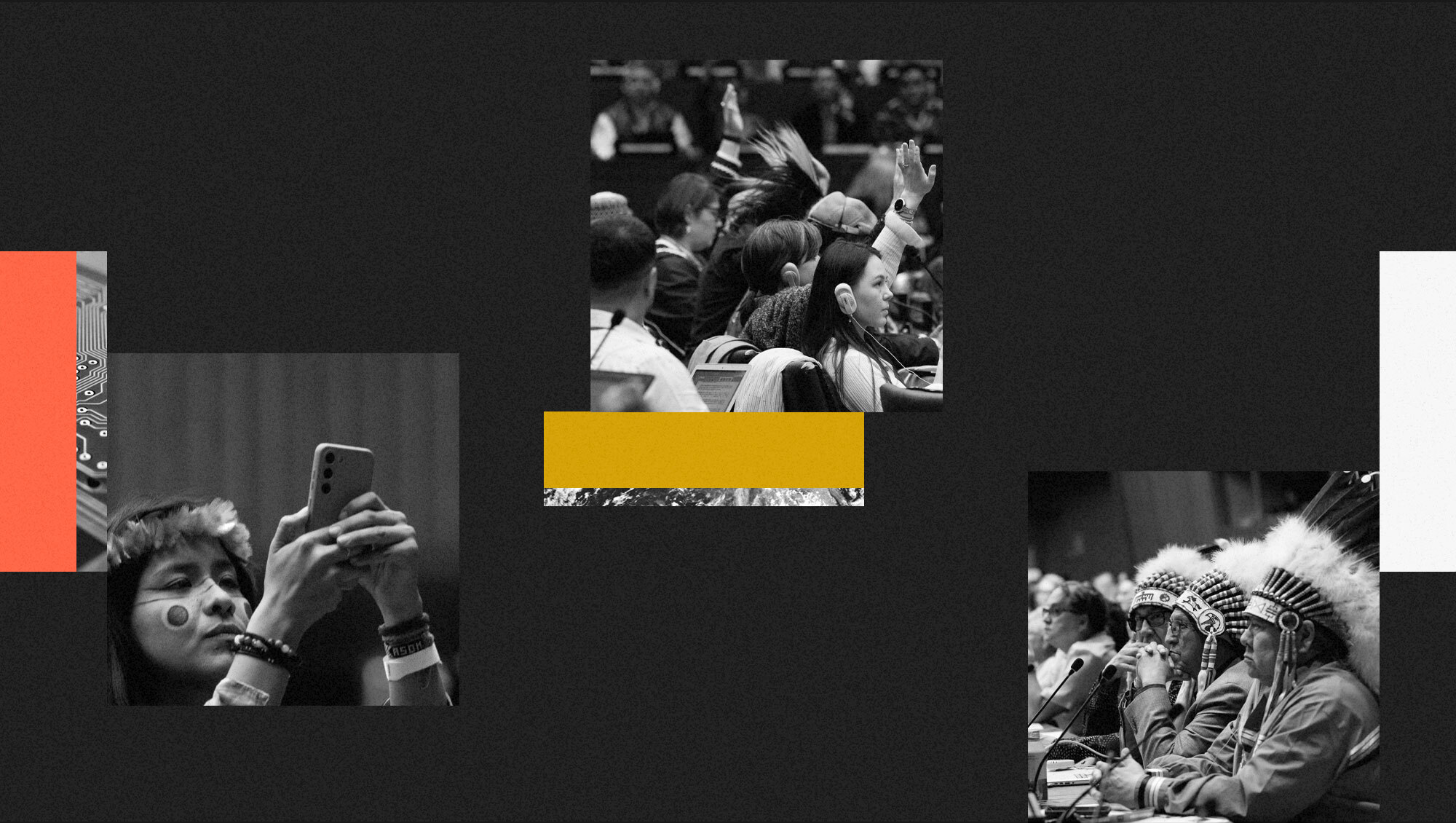
Banner image: Art by Grist / Taylar Irvine.
FEEDBACK: Use this form to send a message to the author of this post. If you want to post a public comment, you can do that at the bottom of the page.