- Independent testing of the Salween River began in September 2005 after researchers found alarming levels of toxic contaminants in the nearby Kok, Sai and Ruak rivers in Thailand, much of it linked to unregulated mining in Myanmar.
- Rare earth mines exporting crucial minerals needed for artificial intelligence, mobile phones, electric vehicles, renewable energy technologies and other uses have been blamed, but the mining of gold and various critical minerals also continues largely in secrecy across river basins in Myanmar.
- Most suspected mines were found upstream in the Salween’s basin, notably in Shan state, where various factions such as the United Wa State Army and the Myanmar National Democratic Alliance Army, as well as the Myanmar military, are fighting for territory.
- A working group was formed to address the growing issue of contamination across Thailand’s rivers, including the Salween, and tests showed arsenic levels at every monitoring point were more than double safety levels; news of the contamination has put local fishers and communities on alert.
See All Key Ideas
MAE HONG SON, Thailand — Saw Si Paw Rak Salween guns the wooden fishing boat’s engine and steers along the river that inspired his family name.
He is ethnic Karen — his parents migrated from Myanmar’s side of the Salween River to the Thai side. When he acquired Thai citizenship, Saw Si Paw had to select his own family name, a convention not followed in much of Myanmar. He settled on Rak Salween, which translates to “Love the Salween River.”
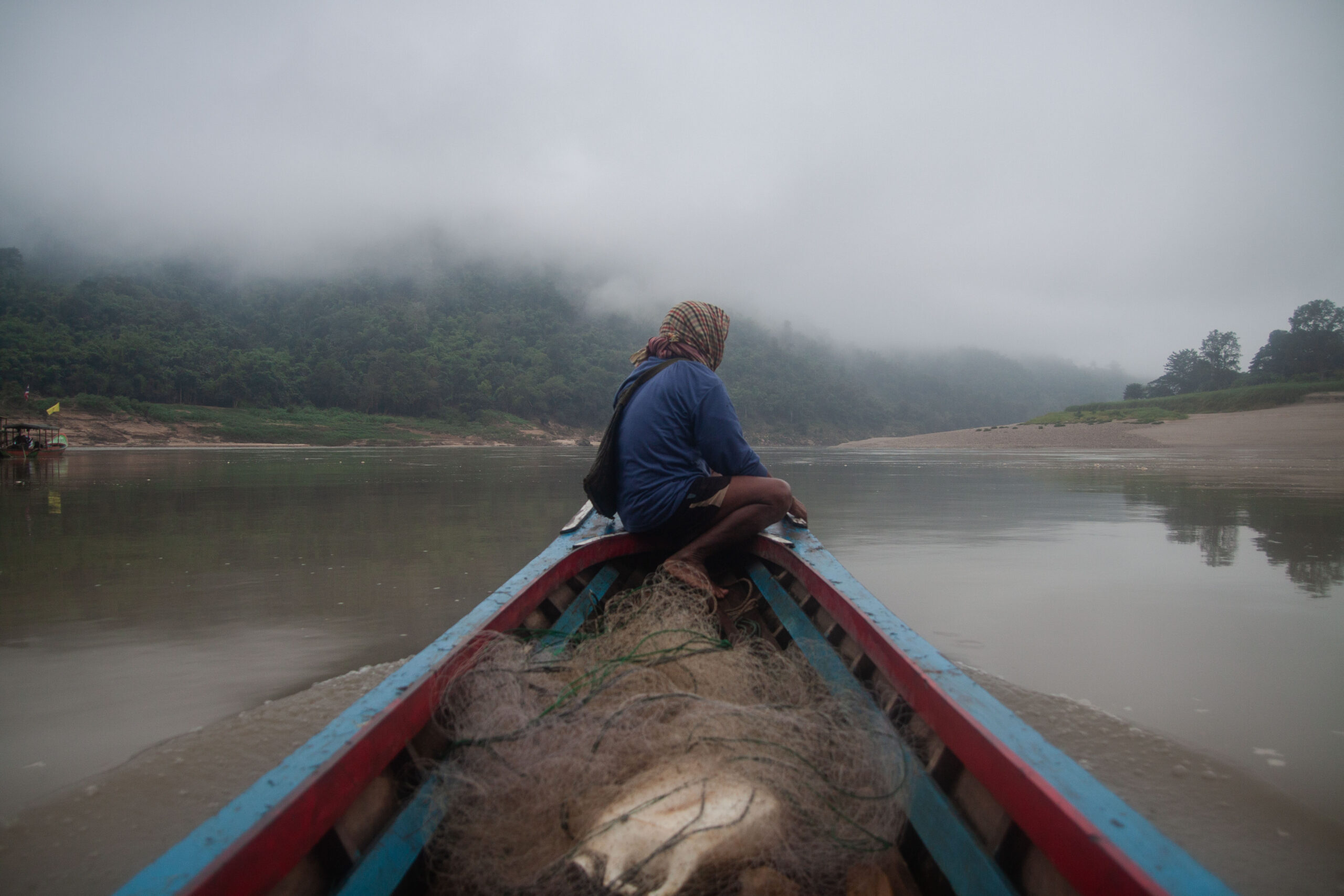
Saw Si Paw’s love for the wild, free-flowing waterway extends beyond his chosen name. Together with his father, he guides the boat to his family’s 8-meter (26-foot) fishing nets left overnight on the Myanmar side of the river. Fishing is all he’s ever known, having learned the trade from his father and plied it on the Salween his entire life.
So, it was especially jarring for him to hear about toxic chemicals recently found in the Salween.
Independent testing of the Salween River began in September 2025, when researchers from Thailand’s Institute of Health Sciences Research at Chiang Mai University found alarming levels of contamination detected in the nearby Kok, Sai and Ruak rivers in Chiang Mai and Chiang Rai in Thailand, much of which has been linked to unregulated mining in Myanmar.
In particular, rare earth mines exporting crucial minerals — needed for artificial intelligence, mobile phones, laptops, electric vehicles and renewable energy technologies, among other things — have been blamed. But the mining of gold and various critical minerals also continues largely in secrecy across river basins in Myanmar.
Drone shot of a mining site in Myanmar. Image courtesy of Ecological Alert and Recovery–Thailand.
Given the proximity of many of these mines to the Salween River Basin, researchers turned their attention to Thailand’s Mae Hong Son province, where the Salween serves as the Myanmar border. Saw Si Paw lives in the province’s small village of Ban Sob Moei, tucked along the waterway.
Using satellite imagery analysis, the Stimson Center, a U.S.-based think tank, identified 127 suspected mines operating within the Salween River Basin between 2016 and 2026.
Exactly what minerals are being extracted is unclear. Across northern Myanmar, where much of this mining is concentrated, the ethnic factions controlling these territories have not made details public.
Among 28 mines that opened since 2023, five have been identified as in situ leaching mines, typical of rare earth extraction. In situ leaching mines pump water and chemicals below the Earth’s surface to dissolve and extract valuable minerals.
Most suspected mines were found upstream in the Salween’s basin, notably in Shan state, where various factions such as the United Wa State Army and the Myanmar National Democratic Alliance Army, as well as the Myanmar military, are fighting for territory, according to maps updated by analyst Thomas van Linge on April 10, 2026.
Mongabay reached out to U Nyi Rang, spokesperson for the United Wa State Army, as well as a spokesperson for their allies in the Myanmar National Democratic Alliance Army, but to date neither have replied.
Mining operations extracting critical and rare earth minerals upstream in Myanmar have been detected through satellite analysis by U.S.-based think tank the Stimson Center. Image by Andrés Alegría/Mongabay.
It’s these mines that are thought to be the source of the Salween’s troubles.
“The first time I heard about the problem was in December [2025],” said Saw Si Paw. For now, he discounts concerns.
“I don’t feel any fear, I still live as normal, just like before,” said Saw Si Paw. “There was a lot of sediment after the heavy rain, and that made our skin itchy, but that’s normal when the water’s muddy.”
His father, who moved to Thailand about 60 years ago, sits in front of the boat, periodically hauling up nets to inspect their catch. Together, they do this twice a day.
“We tend to catch more in the afternoon,” said Saw Si Paw from the back of the boat. “The fish are more active once they’ve had time to warm up.”
Yet authorities are warning Thais to avoid fish from the Salween, and other locals are heeding that advice.
Despite confirmation of arsenic contamination in the Salween River, many riverine communities have no choice but to keep eating the fish. Photo by Gerald Flynn/Mongabay.
‘The worst thing that could happen’
Originating in the snowmelts of Tibet and running south through China and Myanmar, where it briefly serves as the border with Thailand, the Salween flows undammed and untamed through some 3,300 kilometers (2,050 miles) before joining the Andaman Sea in the Indian Ocean.
It is Asia’s longest free-flowing river and a lifeline for communities as well as a biodiversity hotspot, so researchers were alarmed when their tests of the Salween found arsenic five times over the 0.01 milligram per liter safety standard set by the World Health Organization.
“For me, personally, I still hoped that the Salween was the most pristine river system, because we’ve protected it from hydropower dams, the water diversion project and those kinds of large-scale destructive infrastructures,” said Pianporn Deetes, veteran environmentalist and executive director of Rivers and Rights. “So, when the water test results came out, it was hard to describe. It was beyond my imagination, the destruction — the worst thing that could happen.”
Thailand’s Pollution Control Department, a bureau under the Ministry of Natural Resources and Environment, conducted their own testing on the Salween Nov. 5-6 but found arsenic levels at or below the 0.01 mg/l safety limits. They said September’s high water levels explained the discrepancy between results from independent researchers.
For many riverine communities along the Salween, the river provides fish, drinking water and irrigation for crops. All of this is now at risk due to heavy metal contamination. Photo by Gerald Flynn/Mongabay.
Nevertheless, on Nov. 13, Natural Resources and Environment Minister Suchart Chomklin ordered the formation of a working group to address the growing issue of contamination across Thailand’s rivers, including the Salween.
The working group established 13 sampling points along the Salween. Tests conducted in mid-November showed arsenic levels at every monitoring point were more than double safety levels, according to the Pollution Control Department.
But for fishers like Saw Si Paw, much of this information hadn’t reached the community. In January, Mongabay visited Tha Ta Feng, Mae Sam Laep and Ban Sob Moei in Thailand as well as Thi Rotha village in Karen state, Myanmar. Residents were aware to varying degrees of the contamination. Few had been given guidance on how to live with the problem. Many had no option but to continue eating fish, drinking water and irrigating crops from the Salween.
While testing has confirmed that the Salween’s waters have been contaminated, communities feel little has been done to solve the growing crisis. Photo by Gerald Flynn/Mongabay.
‘No choice but to use the contaminated water’
Having spent 22 years among an estimated 29,000 people in the Mae La refugee camp in Thailand’s Tak province, Luh Ge moved to Tha Ta Feng village for a better life. Here, among the northernmost communities Mongabay visited along the Salween, Luh Ge has spent the last year or so farming.
But the harvest of his first crops coincided with the discovery of toxic heavy metals associated with mining operations.
“During October last year, I heard about the chemicals but I’d never heard about the Salween being contaminated before,” Luh Ge told Mongabay in a January interview outside his home. “I was told by members of the community, so I stopped using water directly from the Salween.”
His farm, which sports rice, beans and tobacco, isn’t solely reliant on the Salween for irrigation. Luh Ge is lucky enough to live nearby the Kong Ka creek, which flows through the mountains, past his farm and into the Salween.
Luh Ge didn’t think his crops had been contaminated, because he wasn’t using water from the Salween, but when the Kong Ka creek dries up in the Thai summer, he fears he will have no choice.
At the same time, tests on sediment from the Salween’s riverbed conducted by the Pollution Control Department between Jan. 26 and Jan. 30 found arsenic levels ranging from 36 mg per kilogram to 75 mg/kg across the 13 monitoring points. All exceeded safety standards. Arsenic levels of 10 mg/kg or lower in sediment are deemed safe for benthic organisms while 33 mg/kg is regarded by the authorities as “severely harmful.”
Thailand’s Pollution Control Department conducted tests on the Salween River in November 2025 and January 2026, with both times confirming dangerous levels of arsenic contamination. Image by Andrés Alegría/Mongabay.
Testing of the river’s water conducted at the same time by the department found arsenic levels ranging from 0.023 mg/l to 0.038 mg/l, nearly four times the safety limit.
About half of Tha Ta Feng’s villagers farm on the riverbank using the Salween for irrigation, but most have stopped, according to Di Padee, an ethnically Karen farmer.
“After the news of the contamination spread, people had to make a decision about the crops they’d already planted,” he said. “Not many feel it’s safe to plant new crops. For those who farm on the banks of the Salween, though, there’s really no choice but to use the contaminated water.”
The same risk applies for the vegetables and fish they consume, he said, noting that most people stopped eating both. But he acknowledged that, for those too poor to travel and purchase food at markets, there is little alternative to the Salween’s offerings.
The contamination along Thailand’s rivers was initially discovered nearly a year ago in Chiang Mai province’s Mae Ai district, where mines in Myanmar’s Shan state have contaminated more than 100,000 rai (about 16,000 hectares or 39,500 acres) of farmland with arsenic, cyanide, lead and cadmium.
Chemicals like cyanide and mercury are often used to dissolve precious metals, separating them from ore, but arsenic and cadmium can be released into ecosystems as mining byproducts. All can cause serious cardiovascular, mental, digestive and reproductive problems, especially after prolonged exposure.
Luh Ge, a Karen farmer in Tha Ta Feng village, relies on a nearby creek for water to irrigate his crops, but most other villagers rely on the Salween’s water for farming. Photo by Gerald Flynn/Mongabay.
In October 2025, a shipment of rice from Thailand to Australia was rejected by Australia’s Department of Agriculture, Fisheries and Forestry. As part of a program to monitor imported food that may pose risks, tests found arsenic contamination. It is unclear whether this was linked to mining pollution.
To reach Tha Ta Feng village, Mongabay needed to swap out a rental car for a Karen villager’s four-wheel-drive pickup truck capable of handling the 20-km (12-mi) hour-long ride through the jungle. Few villagers along the river here have the means to make regular trips back to Mae Sam Laep, the nearest market town, to purchase fresh meat and vegetables, leaving many to contend with possibly contaminated products available locally.
“From October through December last year, I had to stop fishing and go work as a laborer,” said Say Yuth, a Karen fisher who is struggling to find work amid the pollution crisis. “I was harvesting other people’s rice for them, because nobody wanted to buy our fish.”
Say Yuth’s wife, Ne Paw, often helps her husband with the fishing business by sourcing buyers while he ekes out a living on the river. In their thatched rattan home, they showed reporters fish from the Salween that they could no longer sell that would be their next meal.
“We still have to pay for fuel and use our labor to catch and prep the fish, but we can’t find buyers as easily anymore,” she lamented. “But the fish population is still much lower than this time last year, so it’s harder to catch them and harder to sell them.”
Unable to sell fish from the Salween River due to the contamination risk, Ne Paw and her husband are struggling to survive. They still eat fish from the river as they can’t afford to buy farmed fish. Photo by Gerald Flynn/Mongabay.
Desperation in Karen state
“Even in the Thai side, the circulation of information regarding the dangers of the contaminated fish was not great, but on the Myanmar side, my relatives heard absolutely nothing and were still eating the fish regularly,” Ne Paw said.
While the Thai communities Mongabay visited had all found some information online, those living across the river in Karen state, Myanmar, were left in the dark.
Na Paw, the chief of Thi Rotha village in Karen state told Mongabay he only became aware of the contamination when relatives visited from the Thai side of the Salween.
“I felt very afraid,” he said. “I’m a fisherman myself, so now I’ve quit fishing until it’s safe again. I don’t drink the water and have stopped bathing in the Salween.”
Na Paw said he was unaware of mining activity nearby but admitted that information upstream from Shan or Kachin was hard to come by. These two states are, according to local rights groups and satellite imagery analysis by the Stimson Center, Myanmar’s mining hotspots.
“At first people felt fear; everyone stopped eating the fish from the Salween. Some tried to sell what they’d caught, but now nobody goes out to catch the fish at all,” Na Paw told Mongabay. “The government here has done nothing. No tests, no information has been shared, neither the Karen National Union nor the military junta.”
The Salween serves as the border between Thailand to the east and Myanmar to the west, but the Karen communities on either side share both a culture and a strong reliance on the river. Photo by Gerald Flynn/Mongabay.
Mongabay had planned to visit surrounding villages in Myanmar. But those communities had been evacuated due to ongoing combat. The Myanmar military, which seized power in the February 2021 coup, has been fighting armed ethnic groups, which have since partnered with a resistance movement against the junta. All the factions need money in order to finance the fighting. For many, especially those in Shan and Kachin, this may well mean mining.
But for residents simply trying to make a living, the toxic chemicals are just another threat to their lives.
Noh Shi, a farmer living in Thi Rotha village, was sheltering her youngest child from the afternoon sun when she spoke with Mongabay.
“My husband caught two fish from the Salween, but they didn’t look healthy,” she said, adding that all the fish caught on that trip had the same disfigurements. “They had sores, like some sort of skin disease, so we didn’t eat the fish in the end.”
Now her husband forages for rattan and helps farm betel nuts, but Noh Shi said she is worried how long the pollution crisis will drag on. Her family is currently spending more money than they can afford on farmed fish and bottled water from across the river.
“We worry about our rice production,” said Noh Shi. “Last season, I couldn’t harvest anything because mice ate it. This year, the water is contaminated.”
There is essentially no government intervention on the Myanmar side, according to those on the ground, but even for the ethnically Karen communities along the Salween in Thailand, the trickle of information has been slow.
Sheltering from the sun, Noh Shi and her children in Karen state worry that the contamination of the Salween River will drive them deeper into the poverty. Photo by Gerald Flynn/Mongabay.
Contamination flows faster than information
In Tha Ta Feng, there are about 150 households who formally registered with the government as residents, along with some displaced people passing through the village from Myanmar, but despite their shared reliance on the Salween, few could find useful information on how to deal with the pollution.
“About 75% of villagers here can’t read Thai, so they didn’t have access to the same information that I did,” said Lamnuetor Dangdan Wiman, president of the Salween Youth Network, who goes by her nickname, Som.
A lifelong resident of Tha Ta Feng, Som was frustrated by the lack of response, both from authorities and her community, when she first learned of the arsenic contamination in early November 2025 from a network of environmental activists.
“People were numb, the villagers couldn’t believe it,” she said. “Staff from the Pollution Control Department hadn’t been here to confirm the seriousness of the situation yet.”
Her efforts to share information were more successful among young people, who rapidly adapted to the situation and began avoiding the Salween’s water and fish. Older members of her community, Som said, were less receptive to facing the problem.
Lamnuetor Dangdan Wiman, a.k.a. Som, worked to inform residents of Tha Ta Feng village about the dangers associated with eating contaminated fish and bathing in the Salween River. Photo by Gerald Flynn/Mongabay.
Mae Yuam subdistrict authorities didn’t provide information on the contamination until later in December 2025, Som said, with many among Tha Ta Feng village refusing to believe the river they had relied upon for generations could be so badly polluted.
“The Pollution Control Department has never really communicated very well with the villagers,” she said.
When local authorities relayed information to Tha Ta Feng residents, Som said they gave few details about the contamination and even less useful advice for how to protect themselves.
“They did bring in a doctor, one from a state-run hospital in Mae Sariang district, who told us to use a chemical to filter the water,” she said. “But researchers at Chulalongkorn University told me that this process wouldn’t really work to make the water safe.”
The doctors didn’t provide filtration chemicals and Som remembered feeling angry when they were told they could purchase these solutions — if they had the money.
Pa Haw, father of Saw Si Paw Rak Salween, still catches and eats fish from the river, but the fishing duo find few buyers now that news of the contamination has spread. Photo by Gerald Flynn/Mongabay.
Same problems, different response
“‘Could we still eat the fish? Can we wash in the river? Can we rely on the Salween for daily use?’ These were the questions villagers were asking me,” said Pongpipat Meebenjamart, chair of Mae Sam Laep subdistrict’s administrative organization, which sits some 20 km downstream of Tha Ta Feng.
Pongpipat recalled that when Chiang Mai University researchers did initial tests in September 2025, the results prompted him and other local authorities to coordinate with the Pollution Control Department, the Department of Water Resources and the Department of Agriculture. In November, officials from these departments then took samples of fish, shrimp, crops, sediment from the riverbanks and even blood and urine from villagers identified as high-risk due to exposure.
The Pollution Control Department said heavy metal contamination didn’t exceed safety levels but declined to share their results with Pongpipat or other officials in Mae Hong Son. Instead, the department warned against eating too much fish from the Salween or crops from its banks.
“If we continued eating the fish and our crops, would we get sick? The authorities told us to avoid using the Salween’s water, stop eating the fish and the shrimp, but that the contamination levels are safe. It didn’t make sense,” Pongpipat said. As of early January, he said, the Pollution Control Department had provided no updates.
Few knew what was safe, and clear information from the Pollution Control Department was absent, in both Thai and Karen languages.
“It’s very urgent that, even if the contamination doesn’t exceed the safety levels, the government takes swift action to identify the source of the contamination, safe water supplies for affected communities,” he added. “We can’t solve everything downstream here in Thailand. Here, few feel confident. Nobody in Mae Sam Laep has returned to fishing. Everyone is still afraid.”
Traders in Mae Sam Laep still transport products to sell to downstream communities, but few dare to eat the fish from the Salween. Photo by Gerald Flynn/Mongabay.
A spokesperson for the Pollution Control Department told Mongabay that the bureau had inspected domestic tributaries flowing into the Salween and “found no heavy metal contamination significantly exceeding the prescribed safety standards.”
When asked whether officials had linked the pollution to mining, the spokesperson added, “It is highly probable that the contamination originates from transboundary sources.”
Besides monthly monitoring that begun in March 2026, the Pollution Control Department said the government has raised the issue with Myanmar’s Ministry of Natural Resources and Environmental Conservation, alongside ongoing diplomatic and military coordination, although the department’s spokesperson did not elaborate on what this coordination entailed.
The spokesperson noted that the Pollution Control Department is collaborating with other government agencies to provide guidelines to affected communities to protect public health.
“Efforts are also underway to secure alternative water sources for the affected areas,” they said.
Mongabay also contacted the Myanmar junta’s Ministry of Natural Resources and Environmental Conservation, requesting information regarding cooperation with Thai authorities, but the ministry has not responded to emailed questions.
Government intervention in Thailand has been minimal, but across the Salween in Karen state, chief of Thi Rotha village, Na Paw, told Mongabay there has been no information and no help. Photo by Gerald Flynn/Mongabay.
While Thai authorities’ messaging on the Salween has been unclear, the Interim Executive Council of Karenni state, just north of Karen state in Myanmar, issued a public warning on Feb. 25. Their testing found arsenic levels had soared past the 0.01 mg/l set by the WHO, reaching 0.096 mg/l on the Salween’s mainstem and up to 0.554 mg/l on the Molo Creek, one of the river’s tributaries.
For Pianporn, director of Rights and Rivers, the Thai authorities’ response on the Salween has been lackluster compared with the contamination of the Kok, Sai and Ruak rivers, which flow into the Mekong.
The pollution on the Kok River was estimated to have caused 1.3 billion baht (roughly $40 million) in damage by September 2025, with losses projected to surpass $90 million if the issue goes unaddressed. The scale of the problem, with contaminated irrigation and drinking water affecting tens of thousands of people, forced authorities to act.
But along the Salween, with far fewer people, less economic output and less of a collective voice to demand government intervention, Pianporn fears the problem is easier to ignore.
“For those in Karen state, Karenni state or in Myanmar in general, the level of violence in their everyday life is much more intense compared to this water quality issue,” she said. “We’re talking about airplanes dropping bombs. But this water pollution is another form of invisible violence.”
Pianporn argued this is no longer a Myanmar or Thai problem; instead, it is the fault of global supply chains that demand rare earth and critical minerals.
“I foresee that the global demand of the critical minerals will increase tremendously, while the sources are limited to places like Myanmar, but we need to identify no-go zones,” Pianporn said. “Clearly, this is the headwater of a river system that is a vital source of life for millions of people and also significant for the ocean. How can we allow this to happen?”
Banner image: Pa Haw, father of Saw Si Paw Rak Salween, directs the boat to the father-son pair’s fishing nets that were laid on the Salween River the night before. Photo by Gerald Flynn/Mongabay.