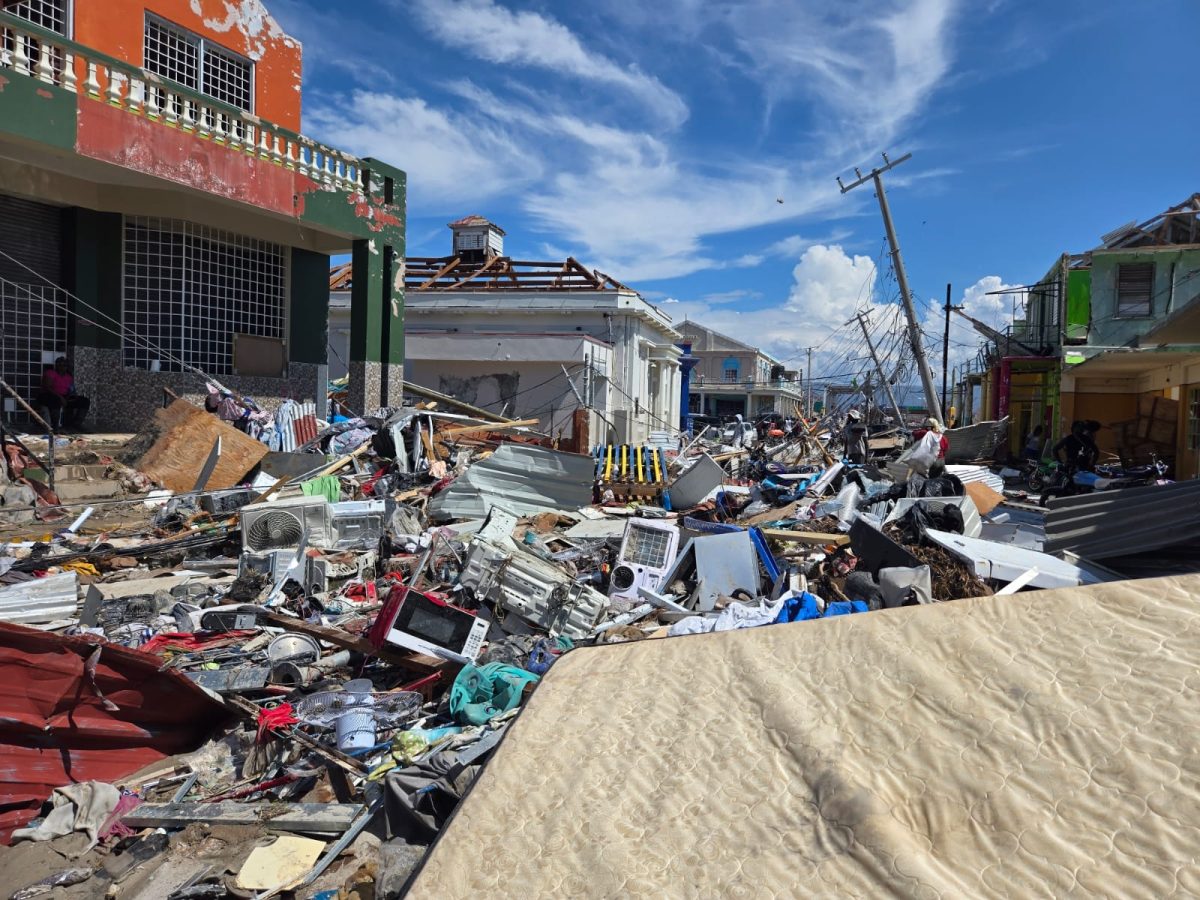
The government’s post-Hurricane Melissa recovery efforts are being hampered by the protracted use of the robust disaster financing it had secured.
That’s according to Caribbean Policy Research Institute, CAPRI, in a study titled “Higher Ground: Lessons from Hurricane Melissa for Resilience, Relief, and Recovery”.
CAPRI launched the report at the Montego Bay Cultural Centre in St. James on Wednesday.
Mahiri Stewart has that story.
The launch of CAPRI’s report coincided with the one-year anniversary of Hurricane Melissa.
According to CAPRI’s research fellow, Aleem Mahabir, the government’s fiscal discipline pre-Melissa left it in an empowered state when faced with the incoming category 5 hurricane.
CAPRI says Jamaica’s disaster financing framework supplied about one billion US dollars, or over $158 billion Jamaican after Melissa.
It notes that this was more than the US $662 million the government had expected to recover from a Category 4 or 5 storm.
However, CAPRI says there are weaknesses in how the framework’s money is used to drive the recovery and assist those impacted.
CAPRI referenced a May Auditor General report which found that months after Hurricane Melissa, the Office of Disaster Preparedness and Emergency Management, ODPEM, had only spent less than 2 percent of the $1.4 billion in relief donated to Jamaica.
CAPRI also notes that most of Jamaica’s relief spending goes to one-off initiatives including the ROOFS programme and the loan to the Jamaica Public Service Company, JPS.
The think tank says, excluding the JPS loan, twice as much money was committed to one-off relief projects as to the amount committed to the National Reconstruction and Resilience Authority, NaRRA, an entity the study labels as one responsible for infrastructure rebuilding and climate-resilient housing.
CAPRI says building out a system to manage relief spending would shorten recovery from the next disaster and lower its cost.
The institute also raised concerns about past instances of the government creating relief platforms that could have assisted in Melissa’s aftermath but didn’t because they were decommissioned.
CAPRI cited the CARE website, launched in 2020, to provide COVID-19 relief grants as a platform as a key example.
That website lapsed, meaning when Melissa struck, a brand-new platform had to be created.
CAPRI notes that a year after Melissa, Jamaica is better protected against another catastrophe than against the ordinary storm, which is far more likely to come first.
But it wants to see established real-time digital accounting, reporting, and audit protocols so that disaster funds are deployed quickly and transparently as well as to expand parametric insurance and catastrophe-bond capacity.
Meanwhile, the CAPRI report is also raising concern about the status of financial instruments aimed at providing relief in weather events less severe than Melissa.
Mahabir points to the National Disaster Fund.
He says CAPRI is recommending that the government make a minimum, mandatory contribution to the National Disaster Fund annually.
Aleem Mahabir, research fellow at CAPRI.