Migrants, the ‘others’, have always been easy political targets during periods of economic uncertainty. Rising living costs, stagnant wages, housing affordability, pressure on services, culture wars, overseas conflicts and the sway of tech barons, and disruptive impact of artificial intelligence are all amplified by social media. Grievances are harvested in algorithmic echo chambers, to fuel mistrust of governments and institutions providing populists fertile ground on which to campaign.
The interview
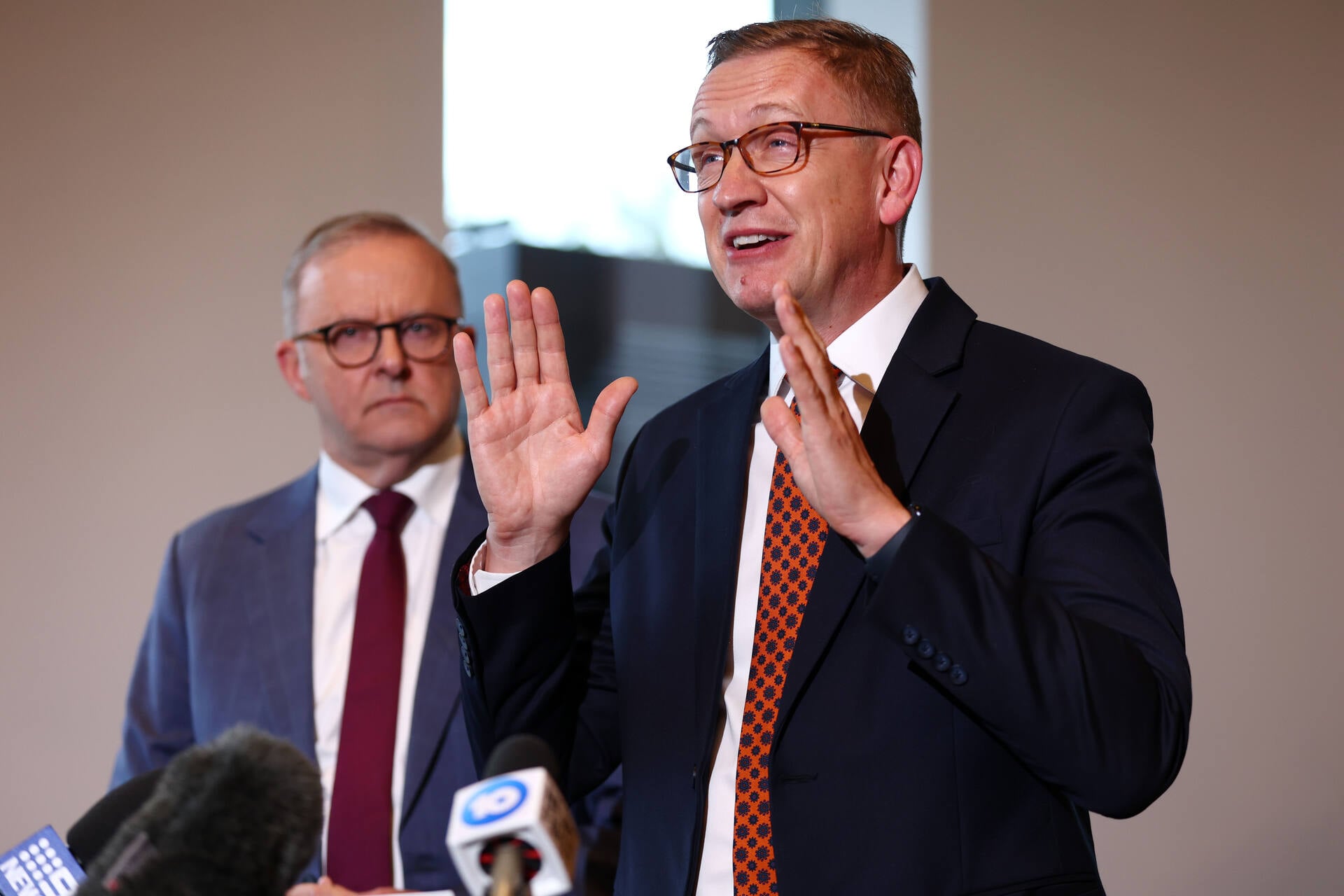
Assistant Minister for Multicultural Affairs, Citizenship and Customs Julian Hill took part in an extended television interview with Fotis Kapetopoulos of Neos Kosmos and Marco Patavino of Il Globo fascilitated by Independent Multicultural Media Australia (IMMA).
Hill is energetic, a policy wonk and adept at diversity. His own electorate of Bruce is among Victoria’s most culturally diverse seats — shaped by generations of post-war migrants, including a strong Greek presence, and enriched by newer and emerging communities from South Asia and beyond
Economic anxiety and the appeal of populism
Big ‘M’ multiculturalism, built by Labor and Liberal governments, is at its core about integrating migrants into Australia and helping people from diverse backgrounds become proud Australians. It rests on pluralism, liberal democracy, equality of opportunity rather than equality of outcome, entrepreneurship and cultural exchange. Above all, it embraces all Australians—Anglo, Celtic, European, Asian, Middle Eastern and more. It recognises First Nations peoples as the First Australians and acknowledges that everyone else came here by boat or, later, by plane. It offered everyone the opportunity to grow, contribute and thrive.
“One Nation has voted against wages, against penalty rates, against paid parental leave. They’re no friend of working Australians.” Minister Julian Hill
The Coalition seems reluctant to defend a policy it had a major role in founding as One Nation rises.
One Nation’s resurgence, and signs that sections of established migrant communities, like Greeks, and Italians are increasingly willing to consider populist parties, prompted the first major question. Hill said the shift was less about ethnicity than economics.
Juian Hill at the Greek Orthodox Anastai 2024. Photo: Supplied
“People are under pressure,” he said.
“You look around the world, and we’ve had one crisis after another—COVID, global inflation, wars in Ukraine and the Middle East. Cost of living is the number one issue for Australians regardless of their cultural background.”
He acknowledged that populist movements often identify genuine public frustrations but said they rarely provide practical solutions.
“They point to things people are worried about, but they don’t have any real answers.”
“We’ve been one of the most successful multicultural nations on Earth.” Minister Julian Hill
Hill warned those leaning towards Pauline Hanson to judge One Nation by its “parliamentary record rather than its social media.”
“One Nation has voted against wages, against penalty rates, against paid parental leave. They’re no friend of working Australians.”
Economic insecurity, migration, housing and social cohesion increasingly intersect in political debate, even where the causes of economic anxiety lie elsewhere.
“Greeks, Italians, Serbians, Vietnamese, Cambodians, Indians, Chinese… people from all over the world have come here over decades and generations. Overwhelmingly they learn English as our official language,” Hills said.
Multiculturalism as national strength
Hill rejected the argument advanced by Pauline Hanson that Australia’s cultural and linguistic diversity weakens national cohesion.
“I love our country as it really is,” he said.
“We’ve been one of the most successful multicultural nations on Earth.”
He scoffed at the call by One Nation to get rid of translators and interpreters by pointing to illegality and chaos it would cause.
“They want to get rid of everything” he laughed, “sheer chaos.”
“Literally, our justice system, court cases, and police prosecutions would collapse without professional interpreting services, because you need evidence that a judge will say, yep, that’s a proper translation, we can convict you of a crime, like serious.
Successive waves of migration, “Greeks, Italians, Macedonians, Vietnamese, Chinese and Indians…all are central to Australia and the nation’s success”
Hill here paying his respects at the Apitaphio – Greek Orthodox Good Friday. Photo: Supplied
“Australia has always evolved through migration.”
For Hill, the real question is not whether Australia is multicultural but how that diversity is managed.
“The question isn’t whether we’ll be multicultural. We’ve always been multicultural. The question is whether our diversity remains a source of national strength or whether extremists exploit it to divide us.”
For more than 50 years, governments of both political persuasions understood multiculturalism as a civic compact built on rights and responsibilities rather than identity alone. It was intended to strengthen Australia, not fragment it.
The Multicultural Framework, unfinished work
Hill was asked why the recommendations of the Multicultural Framework Review, chaired by Dr Hass Dellal AO, a grand vizier of multiculturalism since the early 1990s, had yet to emerge as a stronger public narrative from the Prime Minister. And this at a time when social cohesion faces increasing pressure.
Equally, the Coalition has forgotten that a conservative case for multiculturalism has always existed: one based on faith, family, tradition, citizenship, responsibility and belonging. Multiculturalism was never intended to be owned by the progressive left; its foundations include civic obligation and respect for institutions.
The Review undercored all that, and proposes a renewed vision of multicultural Australia anchored in citizenship, belonging and shared national purpose—ideas sometimes described as “patriotic multiculturalism”. The minister pointed to the Prime Minister’s broader language.
“The Prime Minister’s been talking about this at length repeatedly, progressive patriotism, being proud of Australia, loving Australia, and committing to Australia,” Hill said.
He said though that the Review had captured something fundamental.
“Overwhelmingly Australians are proud Australians,” he said.
Using Greek and Italian migration as examples, Hill returned to the aspirations that have driven migration for generations.
“They came here wanting a better life for their children.”
“They worked hard, paid taxes, built businesses and today their children contribute across every profession.”
Hill says multiculturalism has always involved obligations as well as rights.
“When people come here they sign up to Australia’s laws, democracy, institutions and values—including equality between men and women and mutual respect.”
Echoing Prime Minister Anthony Albanese’s “progressive patriotism”, Hill said belonging demands contribution.
“Multiculturalism isn’t only about rights. It’s also about responsibilities.”
Most importantly, Hill drew a distinction that has shaped Australian multicultural policy since its earliest years.
“We expect people to integrate—not assimilate. Australians shouldn’t have to leave their ancestral cultures at the door.”
Australian values, not assimilation
The Opposition’s repeated references to “Australian values” was raised. Hill said Australia’s civic expectations are already well defined.
“We have an Australian Values Statement. Every immigrant signs up to those values.”
Drawing on his own family background, he rejected the notion that integration requires migrants to abandon their heritage.
“Half my family is Italian.”
“I grew up with the Greeks, deeply familiar, I grew up in Melbourne, how could you not?”
He returned to a familiar story of migration shared across communities.
“People work hard, they pay taxes, they work multiple jobs, they help build the country and their kids now take their place in every part of Australian society.”
Hill suggested that parts of the Opposition risk chasing One Nation rather than defending Australia’s liberal democratic tradition.
“You can’t out-One Nation One Nation.”
Instead, he argued Australia should remain confident in both its national identity and its multicultural settlement.
“I’m not afraid of the word integrate.”
Migration remains an economic necessity
Australia’s ageing migrant population, those Greeks, Italians, that arrived post-war, is increasing demanding qualified, language-competent workers in health and aged care. Many migrant communities from the 1970s also grow older. “As people age, many lose their second language and return to the language they first learnt as children,” Hill said.
That, reinforces the need for professional interpreters across hospitals, courts and government. “It literally saves lives.”
Skilled migration remains central to Australia’s long-term economic planning, the minister said. Particularly in aged care, education, construction and other sectors facing workforce shortages. However, it should “complement, not replace, Australian workers”.
“We should train Australians first, but where genuine shortages exist, skilled migration is essential.”
He also pointed to reforms speeding up the recognition of overseas qualifications, particularly in construction, to help address the housing shortage.
Cost of living and political anxiety
Throughout the interview, Hill repeatedly returned to one theme: the cost of living.
One Nation, migration or growing dissatisfaction with politics, he said can be traced to economic insecurity that sits beneath much of today’s political volatility.
He pointed to the government’s tax cuts, Medicare investment, cheaper medicines and energy reforms as measures intended to ease financial pressure.
“When governments govern well and deal with people’s concerns, there’s less opportunity for populists to exploit frustration.”
Can the centre hold?
The rise of antisemitism following the conflict between Israel and Hamas has opened deep cracks in what has otherwise been a relatively cohesive society.
The Bondi massacre in December 2025, when two gunmen murdered 15 Jewish Australians celebrating Hanukkah, shattered assumptions about safety and belonging.
“Whether the centre holds is the most important question facing Australian politics and society,” Hill said
Julian Hill, at a commemoration of the victims of the Hanukkah Bondi attack, where two gunmen opened fire on the gathering, killing at least 15 people and injuring many others. Australian authorities described it as an antisemitic terrorist attack targeting the Jewish community. Photo: Supplied
He acknowledged that Australia faced similar pressures affecting democracies in Europe and North America, he said its institutions remained comparatively resilient.
“We’ve got compulsory voting. We’ve got an independent electoral commission. Those things have helped protect Australian democracy.”
However the minister said that Australia was “not immune from growing polarisation.”
“Whether the centre holds is the most important question facing Australian politics and society.” Minister Julian Hill
“We have the extreme right represented by One Nation and elements of conservative politics. We also have parts of the far left. But most Australians live in the centre.”
Hill rejected any suggestion that multiculturalism may have created tensions.
“Polarisation and extremism don’t stem from diversity. They stem from social distance, misinformation and malign authoritarian foreign governments seeking to interfere in democratic societies.”
Without anticipating the findings of the Royal Commission into Antisemitism and Social Cohesion, Hill pointed to the first Commonwealth Parliament in 1901, “there were four Jewish members of the Australian Parliament.”
General John Monash he added “one of Australia’s most important military commanders, and great Australian” was Jewish .
“Jewish Australians have made extraordinary contributions to this country.”
The federal government he emphasised, “is committed to confronting Antisemitism, Islamophobia and every other form of racism directed at Australia’s multicultural communities.”
Minister Hill is seated in the middle, surrounded by the board and members of Independent Multicultural Media Australia (IMMA) in Sydney, 2025. Photo:Supplied
It is a success, overall
Hill believes Australia’s multicultural settlement has succeeded. But success cannot be assumed to be permanent. Economic insecurity, geopolitical conflict, misinformation and political extremism are placing new pressures on the civic compact that has underpinned Australian multiculturalism for more than 50 years.
Hill’s answer is neither assimilation nor identity politics, but a confident multiculturalism grounded in citizenship, democratic institutions, shared civic values and mutual responsibility. For the minister, renewing that civic consensus is essential if Australia is to preserve one of its greatest democratic achievements.