Football Victoria is working with Victoria Police to investigate disturbing scenes that unfolded before and during last Saturday’s National Premier Leagues Victoria fixture between South Melbourne FC and Preston Lions FC.
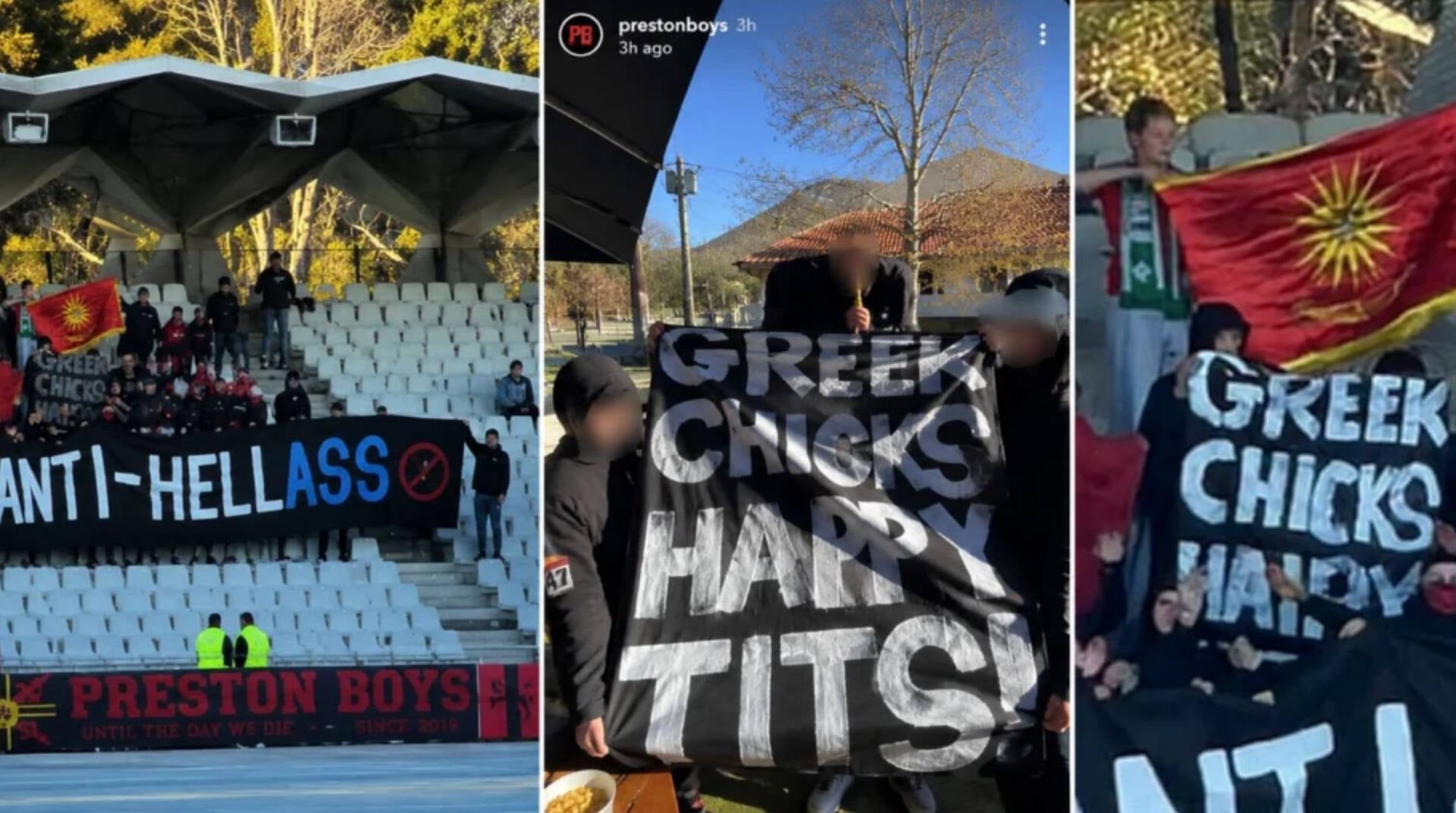
The investigation follows allegations that a small group of supporters engaged in organised acts of provocation, displayed inflammatory behaviour and chanted anti-Greek slogans during one of the competition’s marquee matches.
Authorities are now working to identify those responsible, with Football Victoria making it clear that every available disciplinary sanction will be pursued and that there will be no tolerance for behaviour that promotes hatred, intimidation or ethnic vilification.
“These people are not football supporters”
In one of its strongest public statements in recent years, Football Victoria condemned the incidents in unequivocal terms.
The governing body said that yet another showcase NPL Victoria fixture had been overshadowed by “the abhorrent actions of a small group of individuals” whose deliberate intention was to provoke, divide and inflame tensions.
According to Football Victoria, the incidents occurred both in the Preston Lions supporters’ stand and during a march by a group of supporters travelling to the venue before kick-off.
“These people are not football supporters,” the statement declared.
“Football is not a platform for hatred, intimidation or vilification. Anyone who chooses to weaponise our game in that way is attacking everything that football stands for.”
Football Victoria confirmed it is working closely with Victoria Police, both clubs and venue operators to identify those involved through CCTV footage, photographs and witness statements.
The governing body has also appealed to members of the public to provide any photographs or video footage, particularly from the Preston Lions supporters’ area and the march to the stadium, to assist investigators.
Warnings that could no longer be ignored
The latest developments come after Neos Kosmos recently warned that tensions surrounding certain fixtures were escalating to dangerous levels.
In a strongly worded editorial, the newspaper argued that unless decisive action was taken, serious violence inside or outside football grounds could become inevitable.
Over recent months, Neos Kosmos had received repeated complaints from readers and football supporters concerning the behaviour of a small group of individuals attending Preston Lions matches.
According to those complaints, the group displayed flags featuring the Vergina Sun—a historic Greek symbol—in a provocative manner while chanting anti-Greek slogans, including the offensive phrase “Hatred for Greece.”
Reports also referred to banners targeting Greeks, insults directed at Greece and Greek Australians, mockery of the word “Hellas” and the publication of similar material across social media platforms.
These actions, Neos Kosmos argued, go far beyond passionate football support. They amount to deliberate expressions of ethnic hatred.
Responsibility should not be generalised
At the same time, responsibility must not be unfairly attributed to Preston Lions FC or the overwhelming majority of its supporters.
Most Preston Lions fans attend matches to support their club and enjoy the football. They should not be judged by the actions of a small minority seeking to turn the terraces into a platform for nationalist confrontation and ethnic hostility.
That distinction, however, does not remove the responsibility of the club’s leadership to act.
Any perception that extremist behaviour is being tolerated risks damaging not only the reputation of Preston Lions but also confidence in the broader football community. Silence can be interpreted as indifference, and indifference creates space for extremism to grow.
The rules must apply equally
The investigation also represents an important test for Football Victoria.
Australian football has repeatedly declared that racism, discrimination and vilification have no place in the game. Those principles must now be upheld through firm and consistent enforcement.
Disciplinary standards cannot vary according to the club involved or the ethnic community being targeted.
Whether abuse is directed at Greeks, Italians, Croatians, Macedonians, Australians or any other community, racism and ethnic hatred must attract the same response.
Consistency is essential if football’s anti-racism policies are to retain public trust.
Self-reflection is also necessary
Neos Kosmos has consistently maintained that every community must also be prepared to examine the conduct of its own supporters.
There have been occasions when individual Greek supporters have responded to provocation with nationalist or offensive chants of their own. That behaviour is equally unacceptable.
Hatred cannot be confronted with more hatred, and one act of provocation never justifies another.
If football is to remain a place where communities come together through sport rather than conflict, extremism must be rejected regardless of where it originates.
More than a football issue
The significance of the investigation extends beyond a single match.
Australia is widely regarded as one of the world’s most successful multicultural societies, and football has long reflected that diversity. Clubs founded by migrant communities have become an important part of the country’s sporting and social history.
That history should be celebrated, not exploited to revive old national conflicts or import overseas grievances into local competitions.
The overwhelming majority of supporters from all communities attend matches peacefully and with respect for one another. They are the people football authorities and clubs have a responsibility to protect.
A defining moment
Football Victoria’s decision to work with Victoria Police is an important first step.
The real test will be whether those responsible are identified and held accountable.
Decisive action would send a clear message that racism, ethnic hatred and intimidation will not be tolerated in Victorian football.
The issue is no longer confined to offensive chants. It concerns the integrity of the competition, the safety of supporters and the multicultural values that have shaped Australian football for generations.
Football should unite communities, not divide them.
The overwhelming majority of supporters understand that. It is now up to Football Victoria, the clubs and the authorities to ensure that a small minority is no longer allowed to define the game for everyone else.