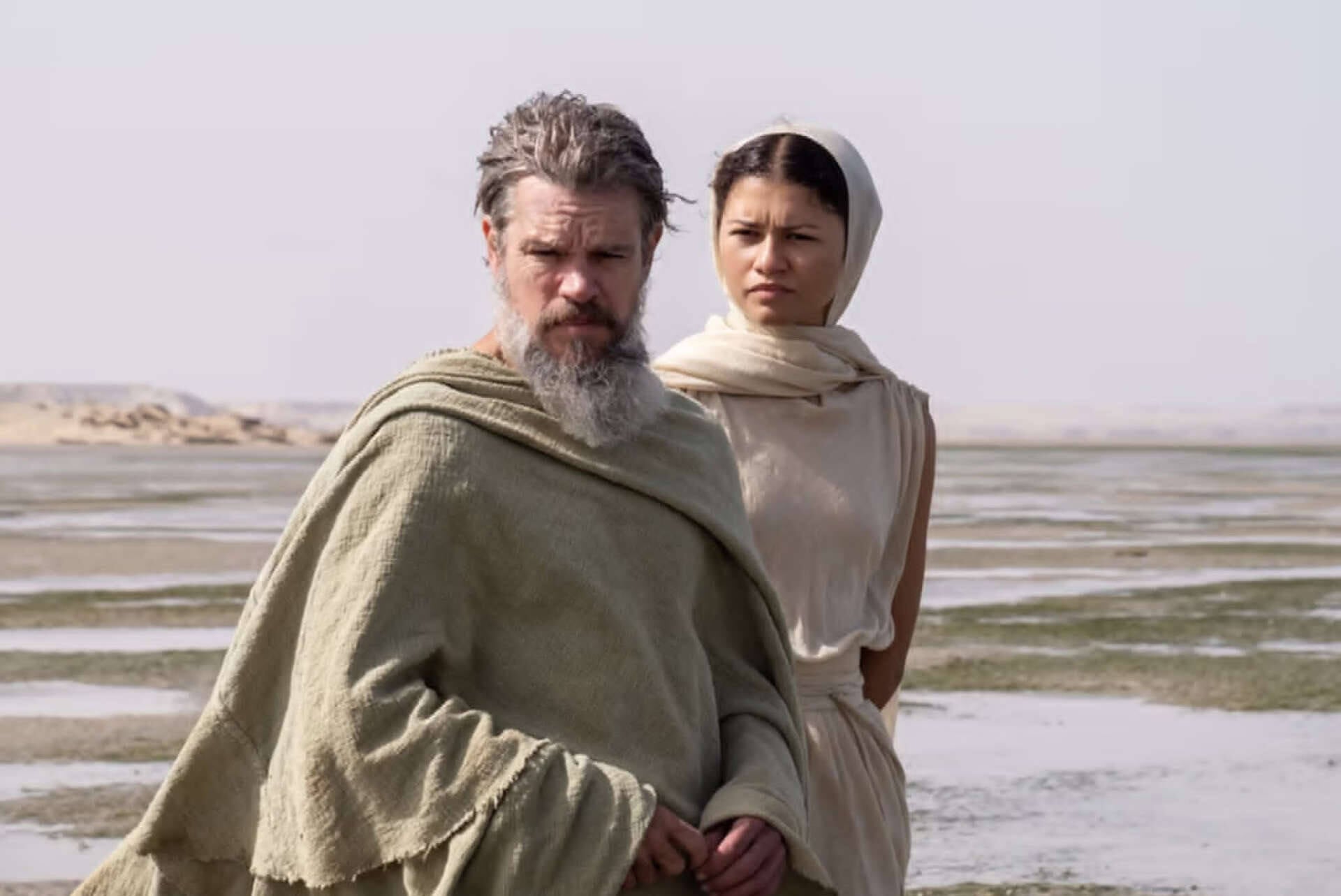
Christopher Nolan’s long-awaited adaptation of The Odyssey is already shaping up to be one of the year’s most anticipated cinematic events.
Widely regarded as one of contemporary cinema’s most accomplished directors, Nolan has built his reputation on ambitious productions and a distinctive visual language. For The Odyssey, he has embraced an epic approach, combining natural landscapes, practical sets, authentic ships and cutting-edge IMAX technology.
Everything suggests this is a production that treats Homer’s epic not simply as an action-adventure story, but as a work carrying the weight of a shared global cultural heritage.
The intention is clear: to bring one of humanity’s oldest and most influential narratives to the screen with cinematic scale worthy of its enduring significance.
Yet long before its theatrical release, the film has already sparked an international debate. Its first trailer attracted millions of views and generated widespread discussion across social media.
The conversation has extended well beyond technical aspects of the production, touching on questions of cultural representation, historical identity and the way contemporary cinema engages with the classical canon.
Some websites and television programmes claimed the trailer had attracted an unusually high number of negative reactions. Those claims, however, cannot be independently verified, as YouTube no longer makes dislike counts publicly available. At the same time, restrictions on comments under some promotional posts further fuelled online speculation.
But the real issue goes beyond internet reactions.
The more profound question is this: what happens when a contemporary filmmaker chooses to reinterpret a work that is not merely a literary masterpiece, but one of the foundations of an entire civilisation?
Homer as the foundation of Western civilisation
Nearly 2,800 years separate us from the poet who stands at the beginning of Western storytelling.
Homer was not simply a poet. He was a foundation.
Not merely a storyteller, but the progenitor of a tradition that shaped the way humanity understands narrative itself.
We call him the father of literature not out of convention, but because without him poetry, drama, epic storytelling and, ultimately, cinematic storytelling would have lacked their first great archetype.
The Iliad and The Odyssey are not simply two ancient poems. They are the wellspring of Western narrative.
In his landmark work Paideia: The Ideals of Greek Culture, the classical scholar Werner Jaeger argued that Homer was the first great educator of the Greek world. His epics transmitted more than stories of heroes and gods; they offered a way of understanding humanity, virtue, honour, responsibility and the relationship between the individual and the community.
The Homeric tradition was never merely entertainment. It was a vehicle of civilisation.
That is why every new interpretation of The Odyssey is about more than a film adaptation. It reflects the way an era chooses to engage with its own cultural roots.
Tradition is not a museum
Every discussion about adapting classical works risks falling into one of two extremes.
The first is to believe that masterpieces of the past should remain frozen in time, preserved like museum exhibits. Such an approach would transform Homer from a living creator into an archaeological relic.
The second is to treat these works simply as raw material, available for unlimited reinvention without any obligation to their original meaning.
Neither position is particularly fruitful.
Tradition is neither a prison nor a warehouse of ideas.
It is a dialogue.
As T. S. Eliot argued in his influential essay Tradition and the Individual Talent, the true artist neither rejects tradition nor submits to it unquestioningly. Instead, creativity emerges through an ongoing conversation with the works that came before.
That is the essential point.
Artistic freedom lies not in abandoning tradition, but in engaging with it creatively.
Helen and the weight of a symbol
Perhaps the most visible controversy surrounding Nolan’s film has centred on the casting of Academy Award winner Lupita Nyong’o as Helen of Troy.
It is important to be precise.
The debate is not about Nyong’o’s talent or a filmmaker’s right to choose their cast. She is an internationally acclaimed actor.
Rather, many viewers are asking a different question: what happens when a character who is more than a fictional figure—one who has shaped cultural memory for thousands of years—is fundamentally reimagined?
Helen, Homer’s beautiful Greek queen, is not simply another mythological heroine.
From the Homeric epics to Greek tragedy, from sculpture to painting, she has come to symbolise beauty, desire, fate, responsibility and the destructive power of passion.
Her story has endured for nearly three millennia not because she was merely a literary character, but because she became an archetype.
For that reason, any debate surrounding her cinematic portrayal is not merely aesthetic.
It is cultural.
When an artist works with a figure so deeply embedded in civilisation’s collective imagination, they are not simply reshaping a fictional character.
They are engaging with cultural memory.
Art, mimesis and responsibility
In Poetics, Aristotle identifies mimesis—imitation or representation—as one of art’s defining principles.
Art is not a simple copy of reality.
It is interpretation, selection and creative reimagining.
That means every great artist has the right to enter into dialogue with the past.
Had artists been confined to faithful reproduction alone, civilisation itself would have ceased to evolve. Shakespeare reworked earlier stories. Ancient Greek tragedians continually reinterpreted familiar myths. Great creators have always borrowed, transformed and renewed.
But reinterpretation does not mean erasure.
Creative freedom presupposes knowledge of what is being reinterpreted. It requires engagement with the original rather than merely appropriating its title.
Perhaps this is the defining cultural question of our time: Can everything about a work be changed while still claiming the identity of the work itself?
It is here that artistic freedom meets cultural responsibility.
When culture becomes ‘raw material’
We live in an age in which almost every cultural work can be adapted, relocated and reinvented.
That, in itself, is not a problem.
Art has always evolved through encounters between the old and the new.
The difficulty begins when great works are treated solely as material to be repurposed.
Homer’s epics, now long free from copyright restrictions, are available to inspire countless new interpretations.
But the fact that a work belongs to everyone does not mean it deserves any less respect.
Quite the opposite.
Because Homer belongs to all humanity, our responsibility towards him is even greater.
There is no legal obligation to protect the memory of a civilisation.
There is, however, a deeper moral responsibility.
The fact that the law remains silent does not mean that respect should do the same.
Cultural sensitivity cannot be selective
One of the most compelling aspects of the current debate is the differing standards often applied to cultural heritage.
Today, there is—rightly—growing awareness of how cultures, communities and the historical experiences of different peoples are represented. Artists and filmmakers are increasingly expected to approach cultural identities with knowledge, sensitivity and respect.
That is a welcome development.
But it cannot be applied selectively.
Ancient Greece is not a neutral backdrop devoid of cultural meaning. The Homeric epics are not simply old stories awaiting a contemporary retelling. They are among the foundations upon which Western thought was built.
Respect for cultural heritage should not depend on which heritage is under discussion.
Homer after Homer
Ultimately, the debate surrounding Christopher Nolan’s The Odyssey may lead us to a question that is larger than the film itself.
How do we relate to the works that shaped the world we inhabit?
Homer does not need our protection.
His poetry survived empires, wars, religious transformation and the erosion of time itself. His verses have travelled across nearly three millennia and continue to speak to readers today.
What requires protection is not Homer.
It is our own ability to recognise the weight carried by certain works.
The Odyssey is not merely the story of a man returning home. It is humanity’s timeless search for identity, memory and belonging. It is the first great narrative of homecoming and, perhaps, the first great meditation on what it means to remain human in the face of adversity.
Christopher Nolan has every right to enter into dialogue with Homer. Every great age reinterprets those that came before it.
But every artist who engages with a work of such significance also assumes a responsibility: to remember that they are not simply holding a screenplay in their hands.
They are holding a fragment of humanity’s collective memory.
Because Homer is not raw material. He is the beginning.