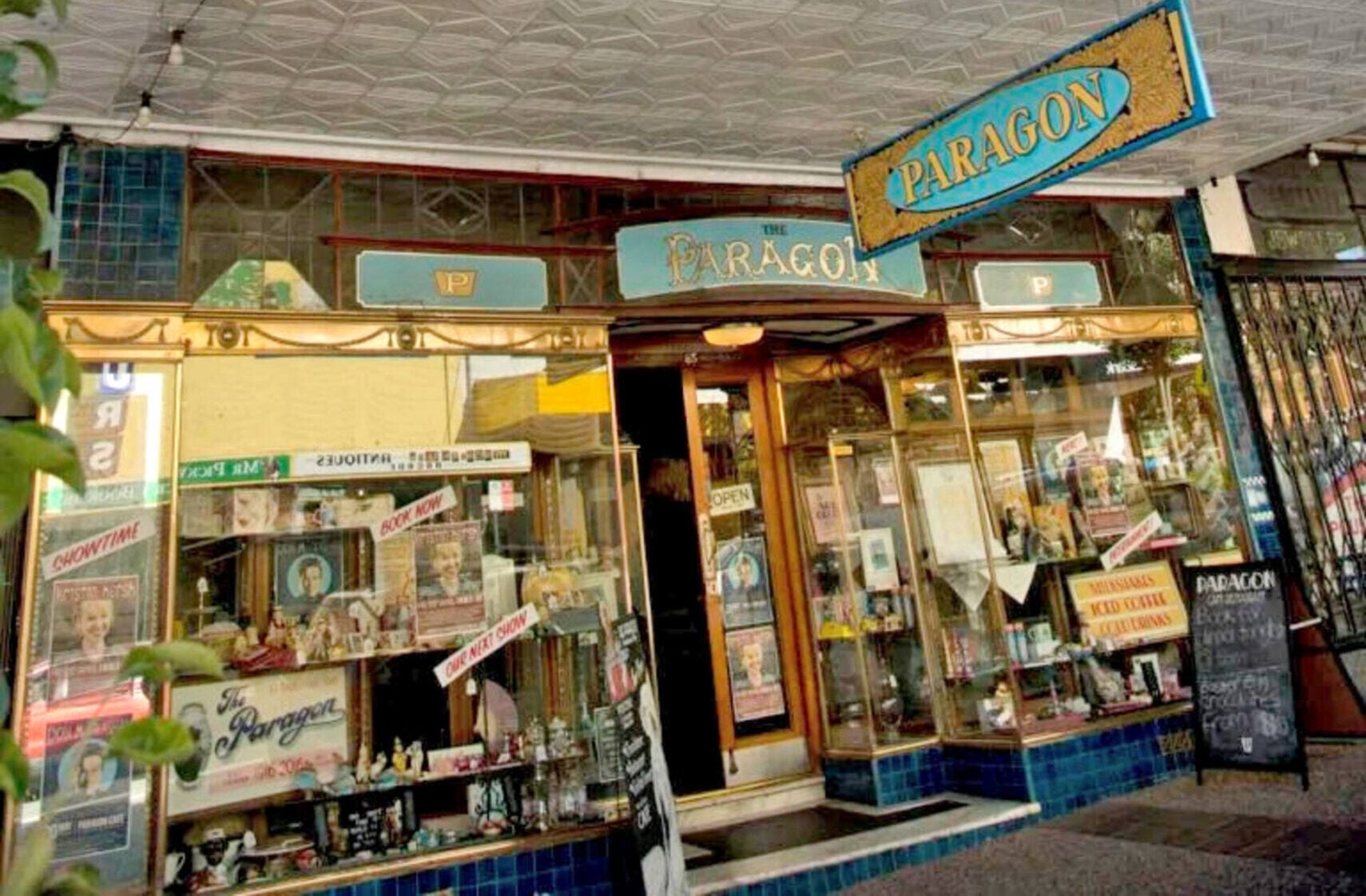
The Paragon Cafe is an architectural monument, a social document and a material expression of the way Greek migrants entered Australian society. Through the work of Effy Alexakis and Leonard Janiszewski, whose painstaking documentation of the Greek café phenomenon rescued an entire chapter of migrant history from oblivion, the Paragon has become one of the defining symbols of Greek Australia. Its significance, however, extends beyond architecture and hospitality because it exposes a revealing asymmetry in Greek-Australian memory. Our community has maintained certain inheritances with extraordinary tenacity while allowing many of the material settings in which Australian lives were fashioned to recede towards obscurity, as though the civilisation carried across the sea possessed an unquestioned historical authority denied to the places where migration assumed lived form.
Greek-Australians’ historical identity is inextricably linked to the monuments it constructs to commemorate it. Statues of Leonidas in Brunswick and Spyridon Louis in Brighton-Le-Sands testify to a historical imagination whose axis continues to point towards the eastern Mediterranean despite distance, prosperity and the passing of generations. Meanwhile the cafés whose terrazzo floors were scrubbed before dawn, the milk bars where children completed homework between customers, the fish shops, and other businesses through which families accumulated modest fortunes, learnt unfamiliar customs and gradually altered Australian society have occupied a far less secure position within communal memory. Such imbalance can easily be mistaken for indifference, although migration rarely permits explanations of such simplicity. Scholars describe the amnesia migration inevitably produces, although the term signifies a continual work of internal editing rather than simple forgetting.
The Paragon therefore occupies an uneasy position within Greek-Australian consciousness because it belongs to the Australia migrants created, or rather reacted and adapted to, rather than the Greece they carried within themselves. Communities readily commemorate battlefields, temples, and national heroes because these places arrive already invested with symbolic meaning. Workplaces acquire significance only retrospectively, once historical confidence has developed sufficiently to recognise that the deepest archives of migration frequently reside inside ordinary buildings, and of course, once the mainstream has afforded them heritage status.
Maurice Halbwachs observed that collective memory develops through social frameworks rather than private recollection: it is families, churches and associations that determine which aspects of the past deserve remembrance and that provide the interpretive language through which they are understood. Coupled with this is the need for communities to shape their memories in such a way as to appeal to the dominant group. Choosing to emphasise our ancient past rather than our immediate past, is a case in point. Given the immensity of the past it inherited, and the respect it was traditionally afforded by the ruling class, comparatively little institutional energy was devoted to recording the material history of Greek-Australia itself. The community consequently developed an exceptionally rich vocabulary for explaining where it came from and a comparatively modest one for explaining what it became, treating migration primarily as a passage between two stable identities instead of recognising it as a historical condition that generated its own places, practices and traditions.
There is a further asymmetry within this pattern of remembrance. The vernacular monuments migration produced, including cafés, milk bars and oyster saloons, overwhelmingly commemorate the petty bourgeoisie: the family that owned the counter rather than the family that worked on another person’s assembly line. The café lends itself to a narrative of advancement culminating in ownership, while the factory records wages earned under someone else’s name and offers no comparable conclusion of independence or ascent. Recovering the proletarian dimension of Greek-Australian history therefore requires an acknowledgment that the counter photographs beautifully, whereas the factory floor rarely enters the commemorative frame.
The present condition of the Paragon gives this argument particular urgency. The building has stood empty since 2018, its interior increasingly exposed to water damage, mould, graffiti and squatters, while the New South Wales government has been obliged to bring its owner before the Land and Environment Court. A place capable of embodying an entire chapter of migrant history is consequently deteriorating while questions of ownership, responsibility and intervention remain unresolved.
Australians encountered Greek hospitality long before many consciously encountered Greek culture, and commerce became one of the principal means through which migrants participated in public life while maintaining continuity within the family. That participation demanded constant adjustment. Menus accommodated Australian tastes, accents softened, Greek conversations paused when customers entered, “Greek” looking staff receded into the obscurity of the kitchen, unfamiliar ingredients disappeared, and innumerable small concessions accumulated into a disciplined performance of acceptability.
Customers and proprietors consequently remember the same rooms through fundamentally different emotional frameworks. Patrons recall polished counters, milkshakes, familiar faces and establishments whose reassuring permanence appeared effortless. Families remember relentless work. Cafés commonly operated from early morning until late at night, seven days a week, while entire households lived behind their businesses and children completed homework between serving customers. The café functioned simultaneously as workplace, home, financial gamble, social interface and instrument of intergenerational advancement, compressing almost every dimension of family existence into a single building.
Psychology further helps explain why such places have rarely become central objects of collective remembrance. Experiences dominated by exhaustion, exclusion and continual vigilance seldom become cherished memories once they have fulfilled their purpose. For many Greek migrants, the café existed precisely so that their children would never spend their own lives behind its counter. Success therefore carried an implicit desire to leave that world behind. Remembering required a return to sacrifice, fatigue and the discipline of continual adaptation, whereas forgetting allowed suffering to acquire meaning without demanding perpetual recollection. Trauma shaped collective memory by influencing which experiences could be narrated with pride, which survived through euphemism and which gradually receded from communal consciousness.
If the Paragon survives, it will retain something increasingly rare: an opportunity to encounter migration as lived experience rather than retrospective narrative. Its significance lies precisely in refusing to separate enterprise from fatigue, adaptation from continuity, or public success from private sacrifice. Few surviving places still possess that capacity.
Restoration as a living museum of Greek-Australian migration presents a practical means of conserving both the building and the history it embodies. The service of beverages could coexist with exhibitions interpreting the history of Greek cafés across Australia, while the photographic archive assembled by Effy Alexakis and Leonard Janiszewski could be presented alongside oral histories, family collections and objects rescued from establishments that have disappeared. An honest account should also include the factory floors and wage labour that produced no comparable architectural monument. Standing before the Paragon’s marble counters, decorative ceilings and Art Deco interiors, visitors could encounter the relationship between enterprise, family labour, assimilation, hospitality and belonging in physical form.
Whether such projects remain aspirations or become realities ultimately depends upon the priorities communities set for themselves. Every generation inherits institutions, resources and responsibilities created by those who came before it. The measure of historical maturity lies not simply in carrying forward what has been inherited, but in recognising when the time has come to record the history that inheritance itself produced.
Members of our community has ineffectually attempted to “save” the building before. However, the debate surrounding the proceeds from the sale of Hellenic Village at Austral gives these questions an immediacy they have never previously possessed. The community now finds itself responsible for an inheritance approaching one hundred and twenty million dollars, wealth accumulated through the very history this essay has sought to recover. Inevitably, discussion has centred upon governance, accountability and distribution. Another question nevertheless deserves a place beside them. Every inheritance carries with it an understanding of the past, whether articulated or assumed. The decisions made today will determine not only how that inheritance is spent, but what history it ultimately serves.
If Greek Australia chooses to protect the material record of its own experience, it will finally acknowledge that the Australian chapter of its history deserves to stand alongside the civilisational inheritance that preceded it. The question is no longer whether the community possesses the means to do so. It is whether it possesses the historical confidence to do justice to that history in all its complexity, resisting the temptation to remember only those parts that flatter it while allowing the rest to disappear.