Photos by Nike
By Nike
HAVANA TIMES – For some time now, I have been struck by how my people have managed to survive the chaos here. It is thanks to the ingenuity of so many Cubans who have found ways to adapt and improve their living conditions. To make a living, they have been converting and adapting their gasoline-powered vehicles to run on electricity, since gasoline and diesel are either unavailable or extremely expensive in the country’s very limited market.
I have a friend who returned from the United States a few months ago. He had to come back because he was unable to obtain legal status there after entering through the border. Rather than wait to be deported, he decided to return voluntarily. He prepared himself to survive in Cuba with his family and try to give his children a better life.
When he arrived in Cuba, he brought some savings to try to live as comfortably as possible. He bought a battery and solar panel system for the home where his wife and children live so they wouldn’t have to suffer through the blackouts.
To earn a living, he bought an electric tricycle. Before leaving Cuba, he had worked as a taxi driver in his Soviet-made Moskvich, which he sold to pay for his overland journey to the United States border.
With so many power outages, he became determined to install a solar panel on his tricycle because he couldn’t charge its batteries during the few hours a day of electricity allotted to residents. And that’s exactly what he did.
Now he drives around working with his invention, a solar panel mounted on the roof of his tricycle. Thanks to that Cuban ingenuity, he hasn’t had to stop working. His setup includes a 3,000-watt Yuyang King controller and a 35 Ah battery. The tricycle has a range of 40 kilometers at full throttle and up to 60 kilometers when driven more gently, since it is a large tricycle.
But there’s more. The other day, I was browsing Facebook when I came across a group called “Motorcycles for Enthusiasts.” I was amazed by the work they had done on a Polish-made Fiat. They fitted it with an electric motor, and the result was excellent, especially considering how small the car is.
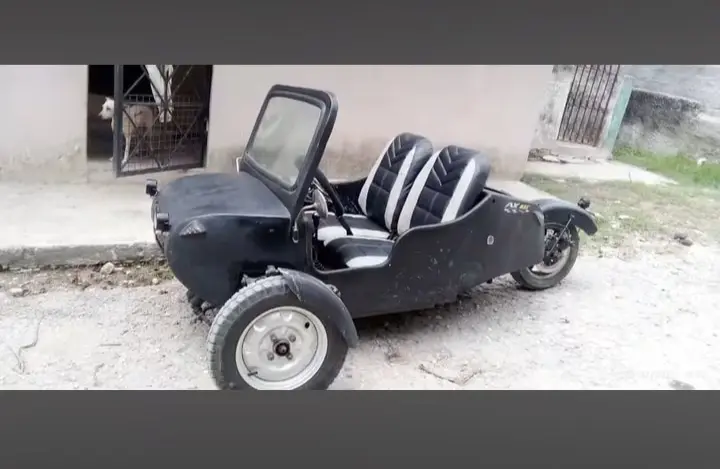
The group’s pride and joy is a converted little Polish Fiat, known in Cuba as a polaquito. They changed its design, and it turned out brilliantly. They call it the “Host Jeep,” the famous “Polaris of Guanabacoa.” You can see it in the photos.
While looking into these inventors, I also came across a very young man, Alexis Gonzalez Fuentes, from Santiago de Cuba, who built his own electric Jeep from scratch. It can reach a speed of 60 km/h and has a solar panel on its roof. The truth is that Cubans are hardworking and entrepreneurial by nature, even though attempts have been made to clip their wings.
The young men in this Facebook group offer advice to any member who wants to convert a gasoline-powered vehicle to electricity and has the means to do so. They share their knowledge and put their ideas to the test.
Mechanics, engineers, and motorcycle and automobile enthusiasts all participate in the group’s electric vehicle conversions.
What kind of electric motor do they use? What role does the gearbox play? What advantages can this combination offer?
It isn’t easy, but it isn’t impossible either.
The first challenge is coupling the electric motor to the gearbox. The second is regulating the revolutions per minute (RPM) when shifting gears.
Compared with many projects that use a differential and chain drive, this configuration offers several advantages. First, it improves the motor’s performance and extends its lifespan because the motor operates at a lower temperature while delivering greater torque.
Second, it helps regulate RPM and provides better control when starting the vehicle.
Third, it increases the driving range and extends battery life. These are the most notable advantages of this configuration.
Some of the inventors shared their opinions:
“The gearbox helps a lot.”
“I did that a long time ago with a 1,500-watt tricycle motor, and it works very well in my Polish Fiat.”
“I made that conversion using a gearbox from a Volga 24.” (A Soviet-made car.)
Many Cubans dream of converting their cars and motorcycles to electric power, and some are succeeding thanks to their ability to survive these difficult times that have been imposed on them.
Some receive help from relatives and friends abroad, while others do it entirely through their own efforts, or a pulmón, as we say here. They sell something, save up the money, and gradually make their projects a reality so they can work and get around the city. In the end, what they are doing is also helping the economy.
(Some of the photos were taken from the Facebook group.)
I invite you to take a look at and enjoy these ingenious examples of Cuban engineering in these difficult times, accomplished with the very limited resources available.
Bravo to these enterprising young people!
Vea más fotorreportajes aquí en Havana Times.