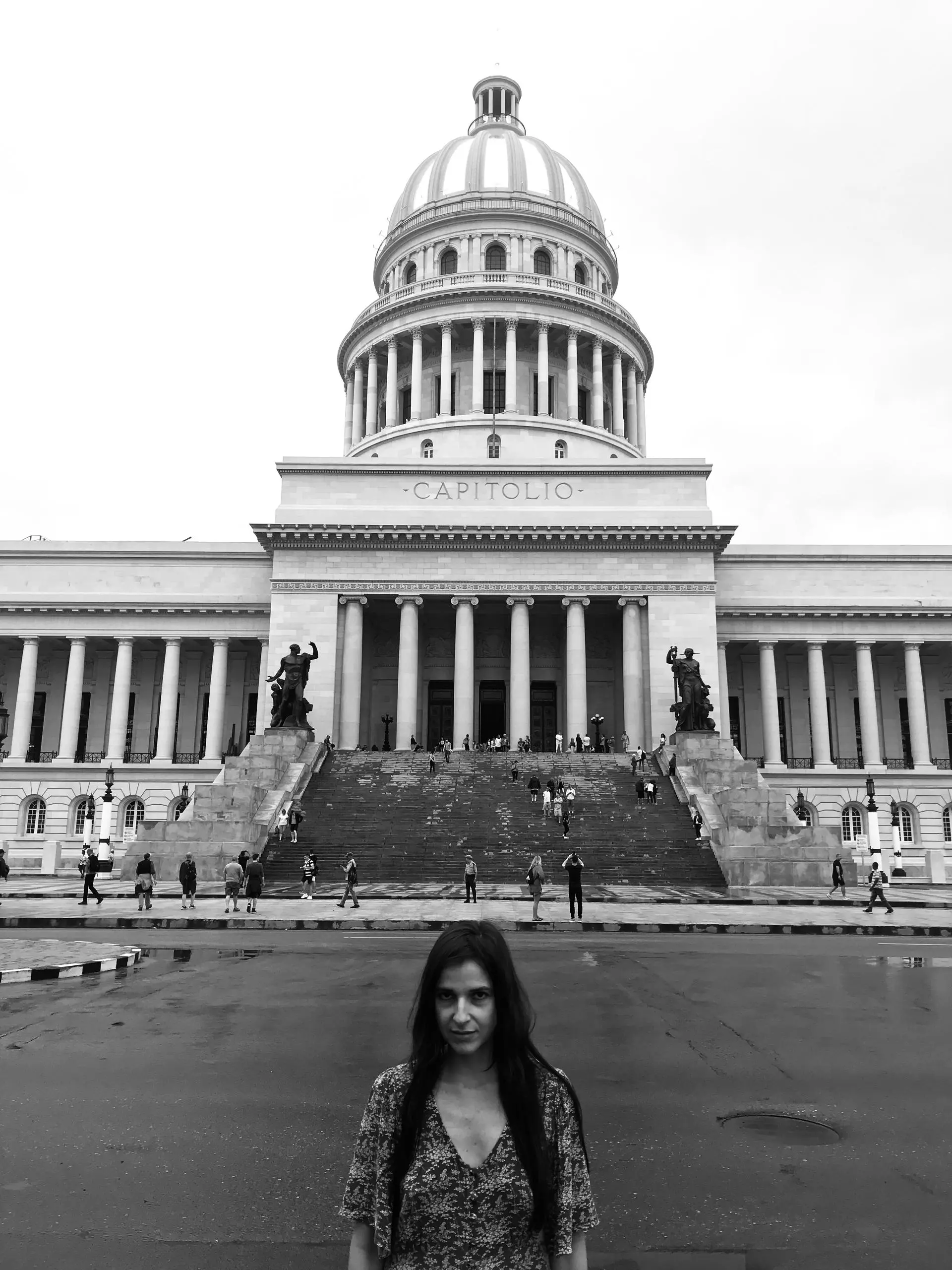
Havana’s Capitolio Building
By Lynn Cruz
HAVANA TIMES – In Cuba, television was not merely a tool for informing the public about the Revolution. It became a stage on which the Revolution could be performed, explained, and obtain public endorsement of its decisions.
In July 1959, during the July 26 celebrations in Santiago de Cuba, the arrival of thousands of peasants from the Sierra Maestra was organized. Cuban filmmaker and writer Fausto Canel recounts this in Ni tiempo para pedir auxilio (Not Even Time to Call for Help). Those peasants were not there simply to celebrate: their presence created an image of popular support that the new government needed to display.
The city became the setting for political performance. Days earlier, on July 17, Fidel Castro had staged another decisive episode. He announced his resignation as prime minister and turned his conflict with President Manuel Urrutia into a televised event. For hours, he accused Urrutia of obstructing the Revolution. Political pressure and popular mobilization ultimately forced Urrutia’s resignation. That maneuver consolidated Castro’s leadership.
Historian Lillian Guerra has studied precisely this dimension of Cuban politics: the television screen as a space for participation, persuasion, and the construction of authority. I do not mean to suggest that every political image is propaganda or that all popular participation is fictitious. But millions of Cubans were sharing the same experience.
I am reminded of The War of the Worlds, Orson Welles’s radio adaptation in which the fictional account of an alien invasion caused part of the audience to react as though they were listening to real news. In Cuba’s case, what interests me is what happens when those in power succeed in making the representation of an event replace the possibility of examining it. The viewer may end up participating in a reality whose script has already been written.
The story of those Martians has become a reference point for the media’s ability to create an experience of reality. Today, the Martians may go by other names. But the decisive transformation occurs when a cause ceases to be an idea open to debate and becomes an identity that must be defended.
In the documentary Nadie (Nobody), poet Rafael Alcides offers an image I have never been able to forget: Fidel created the Revolution, an entity that was supposedly meant to be greater than himself; but he ended up embracing it, suffocating it, until the Revolution and Fidel became one and the same. Questioning the Revolution came to mean siding with the enemy. Exceptionalism thus found a way to perpetuate itself: it stopped being presented as an extraordinary measure and became a permanent condition for survival.
Spectators of History
There is something about the Cuban experience that troubles me. When Donald Trump turns an international conflict into a political narrative aimed at a United States audience, I am interested in looking beyond his statements.
I am not suggesting that Cuba and the United States are equivalent. Their institutions, histories, and the consequences of their respective political systems are profoundly different. What interests me is comparing how those in power invoke a threat to claim extraordinary authority.
Can we recognize the same political temptation in different contexts: the belief that one’s own cause is so just that the limits placed upon it can be postponed indefinitely?
I also want to examine the narrative operation: how a complex event is transformed into a story with a protagonist, a threat, an enemy, and a promise of victory.
In this portrayal, Iran may now occupy the role of the adversary challenging the protagonist. Foreign policy also becomes a production of images, phrases, and emotions intended for domestic consumption. As though war were a work of fiction.
And that is precisely the problem: although we watch these events through a screen, war has material consequences, victims, and economic repercussions that do not disappear when the screen is turned off. War could end up becoming a spectacle. Not only for US Americans, but for everyone who follows the news.
And Trump did not invent political spectacle, just as he did not invent United States exceptionalism. The idea that the United States occupies a unique place in history, with its own mission and values, is part of a much older tradition.
At different times, that exceptionalism has served to portray the country as a model, but also to justify interventions and policies presented as necessary precisely because the United States is supposedly different from everyone else. The conviction of having a special mission can thus become the conviction of being exempt from obligations imposed on others.
Marco Rubio and the Logic of Exceptionalism
At this point, Marco Rubio occupies an important place in my reflections. Not only because of his role in US policy toward Cuba, but because he represents a connection between two political histories that are usually studied separately: that of the Cuban Revolution and that of United States exceptionalism.
Rubio speaks from a political tradition shaped by the experience of Cuban exile, anticommunism, and the promise of freedom for Cuba. That history carries real weight. It cannot be reduced to an electoral strategy or dismissed as though all its motivations were identical.
But precisely for that reason, it deserves rigorous examination. What happens when the defense of freedom is pursued through mechanisms of pressure that affect entire populations? What happens when national security becomes an argument for expanding the executive branch’s freedom of action? Where does the defense of a principle end, and where does the justification of any measure in the name of that same principle begin?
In January 2026, Trump declared a national emergency related to Cuba and established a mechanism of economic pressure also targeting countries that supplied oil to the island. The order gave the secretary of state a central role in evaluating and recommending possible tariffs. For the first time, a Cuban American held the position of secretary of state.
The image alone carries enormous symbolic weight. At the time, I wondered whether that Republican rise also contained the seeds of the end of Cuban political dominance in Miami. Ten months later, deportations, housing prices, and the Democratic Party’s electoral prospects in the midterm elections compel me to revisit that question. At the time, I expressed my concerns on social media.
The consequences of those measures are already being felt in Cuba. And the worst part is that we cannot even begin to measure the damage. All we can do is swallow it and carry on.
In May, a new executive order expanded sanctions on the regime. In August, Rubio explained the logic behind that policy to Axios with a phrase worth stopping to consider: “What we’re trying to teach them is that there are no escape valves.” He added that whenever Cuba finds a way out of the stranglehold, the United States closes it off.
The expression “no escape valves” seems to embody a conception of power that goes beyond a sanctions policy.
What does it mean to govern when the stated objective is to leave an adversary with no way out? What separates fighting an authoritarian system from adopting a logic of pressure that leaves no room for negotiation?
Rubio also appears on the Iranian stage. While Trump threatens new attacks, the secretary of state declares that the president has not yet made a decision and that diplomacy remains an option. Meanwhile, the war has contributed to rising energy costs and has put pressure on one of Trump’s most frequently repeated economic promises: lowering gasoline prices.
The Machine Also Manufactures Reality
There is another dimension I do not want to leave out: artificial intelligence. As we try to understand a technology capable of altering our relationship with information, images, and trust, we are witnessing its incorporation into political communication.
An artificially generated image can depict a situation that never occurred. A manipulated image can attribute nonexistent behavior to an adversary. A scene can be designed to provoke fear before viewers have time to ask whether it is real.
What is disturbing is not simply that a machine can produce false images. It is that those images can become part of a political machinery that no longer considers it essential to respect certain ethical boundaries.
Technology does not create that culture on its own. It makes it faster, cheaper, and sometimes harder to detect. What happened recently in Florida’s 16th Congressional District, where Republican candidate Sydney Gruters used AI-generated images to produce propaganda against her Democratic opponent, Kelly Kirschner, confronts us with a problem that is not exclusively technological.
We are facing a political question: what kind of relationship with the truth is becoming normalized? What happens to public trust when appearances can be manufactured at will and circulated as quickly as a documented event?
An algorithm can turn a decision into a procedure. It can amplify a narrative, distribute it, and make it seem omnipresent. But responsibility does not disappear inside the algorithm. It remains with those who decide what to produce, what to disseminate, and what consequences they are willing to accept.
Beyond Good and Evil
I wonder whether the deepest danger lies precisely there: in a society eventually accepting that justice can be suspended in order to save it, that freedom can be restricted in order to defend it, and that truth can be manipulated in order to protect it.
I think of the lyrics of a patriotic march sung in Cuba during the 1960s: “Long live unity, long live peace, long live the struggle for freedom!”
As in the theater of the absurd, when the words struggle, peace, and freedom are brought together in a single phrase, they seem to lose their meaning.
Exceptionalism promises an escape from limitations, but a society without limits on power does not become exceptional: it becomes vulnerable to arbitrary rule.
Because totalitarianism does not begin when one man succeeds in making everyone obey him. That seems, rather, to be the consequence of enough people believing that, because of the exceptional nature of his cause, he no longer needs to obey the same rules as everyone else.
The enemy may change names: counterrevolutionary, communist, terrorist, immigrant, foreigner, enemy of the nation, radical, dangerous. These categories are not equivalent, especially because the people placed in them do not experience the same realities. But we can examine how the image of a threat is constructed and how that image is used to determine who deserves protection, who deserves suspicion, and who can be excluded.
Read more from the diary of Lynn Cruz here on Havana Times.