and the art of not listening to each other
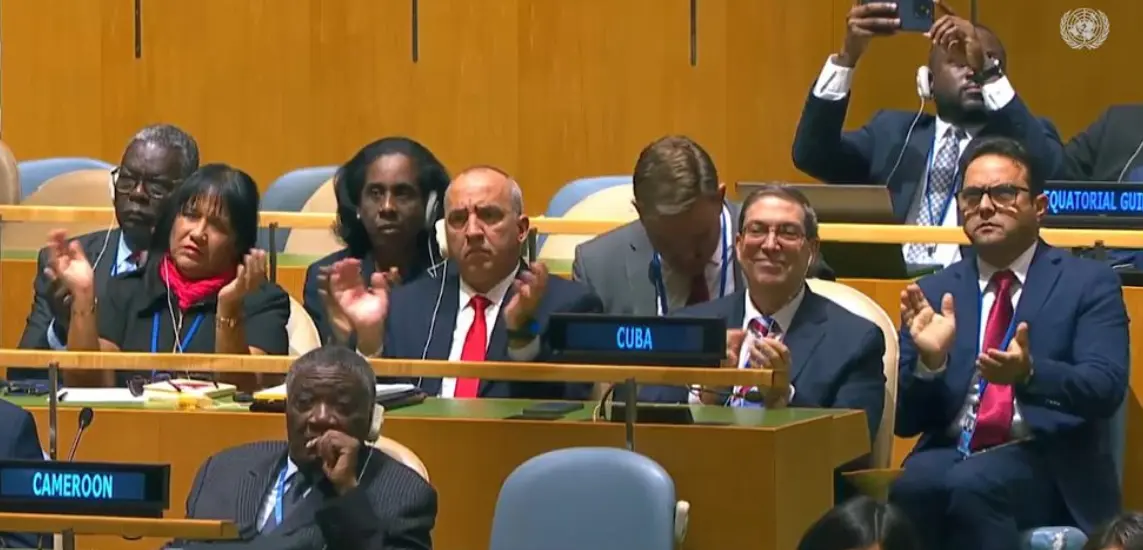
The Cuban delegation celebrates after a vote at the United Nations General Assembly took place in support of lifting the US embargo against Cuba. Photo: United Nations
By Francisco Acevedo
HAVANA TIMES – At the United Nations, diplomacy is usually presented as a sophisticated choreography of words: solemn speeches, calls for dialogue, references to international law, and every now and then, an accusation delivered with all the delicacy of a thrown rock.
However, last week’s confrontation between Cuban Foreign Minister Bruno Rodriguez and US representative Mike Waltz hardly belongs to that tradition.
The scene has something of classical theater about it, although with simultaneous translation, headphones, and plenty of blue folders. Cuba accuses the United States of maintaining an economic, commercial, and financial blockade that strangles its economy and punishes its population. Washington responds that its policy is not a blockade but a series of sanctions and restrictions aimed at the Cuban government, while holding Havana’s authorities responsible for the country’s internal crisis, lack of political freedoms, and economic problems.
Each side portrays the other as the unquestionable villain in a movie. But in this case, evidence was being presented about corruption among the upper echelons of the Cuban dictatorship, and the island’s representatives kept interrupting, often in less-than-civil ways.
Luxury watches, dream apartments in Havana or Varadero, the Castro’s private island of Cayo Piedra, Mediterranean vacations, and the latest-model vehicles. All while the Cuban people live in misery and darkness, and thousands of citizens have lost their lives trying to leave the island. That is where the money the Cuban people lack has gone, Waltz was trying to explain to the visibly nervous Cuban delegation.
The official Cuban discourse, which has so often achieved political success at the UN, is usually built around one central accusation: the so-called “blockade” constitutes a unilateral, illegal, and extraterritorial policy that seriously damages the island’s economy.
Every year, when the General Assembly debates the resolution against the embargo, the result is usually an overwhelming majority in Cuba’s favor, leaving Washington with only a handful of allies or abstentions. That is because the rest of the world forgets the underlying arguments and focuses on condemning unilateral sanctions, which are hardly popular, without considering the broader issues.
Before the world, the Cuban government presents the embargo as an almost universal explanation for all the country’s problems, without addressing internal failures such as low productivity, excessive centralization, lack of incentives, bureaucracy, dependence on imports, and reforms implemented at the speed of a snail that has submitted a written request for permission.
The United States maintains, as Waltz also stated from the podium while naming specific individuals, that its measures are a response to the lack of political freedoms, persecution of opponents, absence of multiparty elections, and human rights violations in Cuba.
From that perspective, lifting all restrictions without political changes would amount to rewarding an authoritarian government that cannot blame Washington for all its problems while simultaneously denying responsibility for repression, the lack of pluralism, and the weakness of its institutions.
Sovereignty should not serve as a shield against any international scrutiny of human rights. A state does not acquire a license to restrict freedoms simply because another state acts with hostility toward it.
The recent confrontation at the UN is not merely a dispute over economics or human rights; it is a battle of narratives. Cuba wants the world to see a small nation subjected to the most powerful country on the planet, while the United States wants the world to see an authoritarian regime attempting to turn its own internal failures into a crisis for which someone else is responsible.
Cuba is indeed a small country that has endured a prolonged, unilateral US policy, but it is also a state whose government severely restricts political competition and has responded to social protests with repression.
The problem is that the UN functions as a giant echo chamber, and governments generally do not go there to reconsider their positions but to proclaim them under better lighting.
The result is a kind of diplomatic tennis match in which nobody is really trying to win: it is enough to return the ball and make sure the cameras are rolling, while millions of people caught in the middle continue to suffer.
On the other hand, diplomatic support for Cuba does not always amount to an endorsement of its political system. Many governments vote against the embargo while also expressing reservations about the human rights situation on the island, because international diplomacy is full of nuances, even if official statements do everything possible to eliminate them.
In reality, nobody knows how to help the Cuban people: whether by lifting the blockade or removing the ruling clique by force, since they are not going to relinquish power voluntarily.
What is certain is that, for Havana, the external conflict serves domestic purposes. It helps reinforce the narrative of resistance and explain failures, and resolving the dispute would mean giving up a useful political tool.
In the grand theater of international politics, where every phrase is measured more carefully than a spoonful of sugar during times of scarcity, we witness an exchange in which each side defends its country’s position with such unwavering conviction that one might think geopolitics could be resolved simply by piling up forceful adjectives.
Waltz seems to prefer the hammer: less beating around the bush, more impact, and, if possible, a phrase that fits comfortably into a television headline.
In his remarks, he urged representatives of other countries to stop being accomplices to this annual discourse, which the island’s elite then uses to tell Cuban citizens that the world supports them, while nothing changes about the food on their plates or the medicine they cannot find.
Rodríguez and Waltz could continue trading accusations for years, each convinced that history will ultimately vindicate him, while the truth, that uncomfortable creature rarely invited to official gatherings, lies somewhere in between, far from the microphones and slogans.
In short, when the vote was held, the dictatorship won once again, this time with 130 votes in favor, 17 against, and 25 abstentions. But although the margin remains substantial, the number of countries supporting the resolution has been declining each year (in 2025, for example, there were 165 votes in favor, seven against, and 12 abstentions).
I cannot say for certain that the world is beginning to lose faith in Havana’s narrative, but if that is the case, it is happening far too slowly.
Read more from Cuba here on Havana Times.