Synopsis: Analysts challenge international media narratives linking the grounded Villa Vie Odyssey to online scams, praising the country’s humanitarian response and urging tangible anti-scam results as the ship sails to Singapore.
The departure of the Villa Vie Odyssey sans passengers from Cambodia brought a new dimension to the controversy surrounding the stranded residential cruise ship, with analysts questioning international media coverage that linked its passengers’ plight to the country’s online scam industry despite the humanitarian assistance they received.
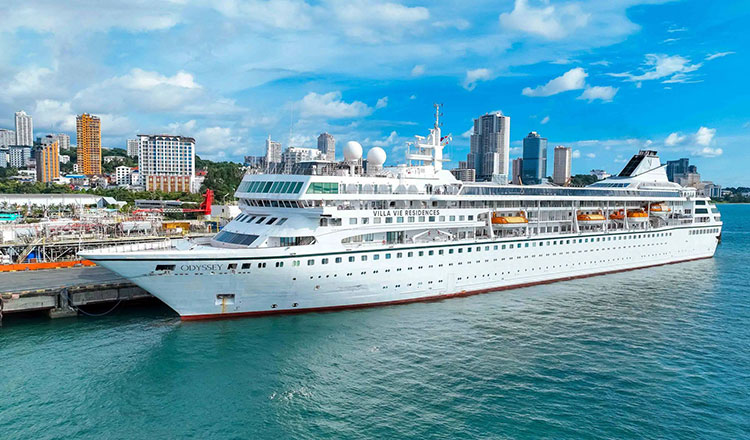
The 650-passenger-capacity vessel left Sihanoukville shortly after midnight on Wednesday, bound for Singapore, where it is expected to be auctioned to the highest bidder. It departed without its about 200 passengers, who had been forced to disembark on Saturday amid the cruise operator’s financial difficulties.
The incident attracted international attention, not only because of the unusual circumstances surrounding the cruise’s abrupt suspension but also because of the way some media outlets portrayed its stop in Cambodia.
The Financial Times published a headline describing the passengers as having ended up in a Cambodian “scam town”, while other international coverage similarly emphasised Sihanoukville’s reputation as a centre for online fraud operations.
The framing prompted criticism from Cambodian analysts, who said the humanitarian response to the stranded travellers should be distinguished from the country’s ongoing struggle against online scams.
Chheng Kimlong, president of the Asian Vision Institute, said Cambodia’s response should be understood through its longstanding commitment to humanitarian principles, recalling the government’s reception of the Westerdam cruise ship in February 2020 during the Covid-19 outbreak.
At the time, Cambodia welcomed the vessel after several countries and territories had refused it permission to dock, earning international recognition as a small country with a big heart.
Kimlong said the same humanitarian principles guided the government’s response to the Odyssey, emphasising that the immediate priority was ensuring the safety and well-being of passengers and crew members.
“The greatest humanitarian act is focusing on the safety and well-being of all tourists and the crew members on board before we resolve any other matters,” he said.
He said Cambodia’s humanitarian obligations should be considered alongside its compliance with international law and applicable domestic legislation.
Kimlong said the claims linking the ship’s departure to a scam centre were politically motivated and lacked sound reasoning, noting that the narrative overlooked the assistance provided to foreign visitors facing an unexpected crisis.
He said Cambodia should communicate its efforts to combat international cyber fraud more effectively, stressing that telecom fraud was a global challenge rather than a problem exclusive to any one country.
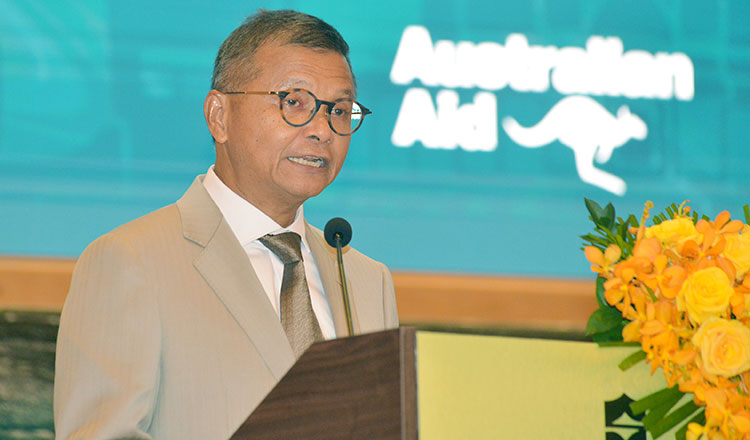
Kin Phea, director-general of the International Relations Institute of Cambodia, said permission for the fuel-depleted ship to dock at the port showed the country’s willingness to welcome foreign visitors regardless of their nationality, particularly when they faced difficulties.
He said the Odyssey’s crew and passengers may have expected Cambodia to extend the same humanitarian goodwill shown during the Westerdam episode.
However, Phea said some international media coverage had overshadowed the assistance by repeatedly associating the vessel’s arrival with Sihanoukville’s notoriety for online scams.
He cited headlines by The Wall Street Journal and other publications that described the vessel as having become stranded in a “scam city”, arguing that such reporting failed to distinguish between humanitarian assistance and the country’s separate challenges with cybercrime.
“One cannot take humanitarian aid and package it together with scam perceptions here. They simply ought to separate the two. They should be fair; they shouldn’t conflate our humanitarian support with scams,” he said.
Nevertheless, Phea said Cambodia’s online scam problem was real and that the country had yet to eliminate it.
He said Cambodia was disproportionately associated with the problem whenever negative incidents occurred, making it difficult to rehabilitate its international reputation.
Establishing a counter-narrative, he said, would require more than statements of political commitment, legal frameworks and institutional arrangements.
“Cambodia must establish a counter-narrative to clear its name. However, merely having a good narrative isn’t enough. It requires announcing sharp measures backed by tangible results,” he said.
The controversy also produced a contrasting account from the people directly affected by the ship’s suspension.
Sherrie Cornett, one of the passengers, defended Cambodia in a social media post, expressing dismay at the negative portrayal of the country and praising the treatment she and other travellers had received.
“As one of the ‘stranded’ passengers, I am appalled to see that headline. We have all been treated with nothing but kindness and generosity. The support of the Cambodian government and people has been remarkable,” she said.
Cornett said she had never felt safer or more cared for elsewhere and described the Cambodian people as having welcomed the passengers like family.
She added that she and several friends had decided to extend their stay to explore more of the country.
“My friends and I have decided to extend our stay to explore more of this beautiful country and to experience more of these beautiful people. Small country, ENORMOUS hearts!” she said.
Meanwhile, the circumstances behind the Odyssey’s sudden suspension point to a financial crisis within its operating company rather than any wrongdoing by its passengers in Cambodia.
Villa Vie Residences, which marketed the vessel as a permanent residential cruise offering a continuous journey around the world, faced mounting financial difficulties, including lawsuits, cash-flow problems and delayed payments to crew members.
Around 150 crew members were reportedly left in Cambodia without pay, with some telling NBC News that their salaries had already been delayed for several months.
One Indian crew member said he had not received his salary since September, and added that workers had become aware of the company’s deteriorating financial condition through repeated payment delays.
The ship’s founder and executive chairman, Mike Petterson, previously said the company had 30 to 90 days to pursue a restructuring, expressing hope that a solution could still be reached.
However, the vessel’s lender took responsibility for its operational expenses, including crew payments, fuel and security, while broaching the possibility of selling the ship.
The Odyssey, which departed Belfast on October 3, 2024, was designed to accommodate up to 650 residents and advertised voyages covering more than 425 destinations in 147 countries. Cabin prices ranged from $59,000 to $439,000, in addition to monthly fees of up to $7,000.
Cambodian authorities mobilised support for the passengers and crew after the vessel arrived in Sihanoukville, with senior government officials, provincial authorities and tourism agencies coordinating assistance, information and arrangements for visitors.
The episode revived comparisons with the Westerdam incident, raising broader questions about how Cambodia’s international image is shaped when humanitarian crises intersect with its reputation for online scams.
For the two analysts, the challenge is not simply to challenge negative headlines but to demonstrate through consistent action that Cambodia can protect its reputation, uphold humanitarian responsibilities and produce measurable results in its campaign against transnational cybercrime.