Synopsis: The prime minister outlines a 15-year framework to digitise state records, comparing their value to gold at the centenary exhibition of the National Archives.
The government launched an exhibition yesterday to mark the 100th anniversary of the establishment of the National Archives, with Prime Minister Hun Manet pledging to conserve, protect and modernise Cambodia’s documentary heritage to safeguard historical evidence and the nation’s collective memory for future generations.
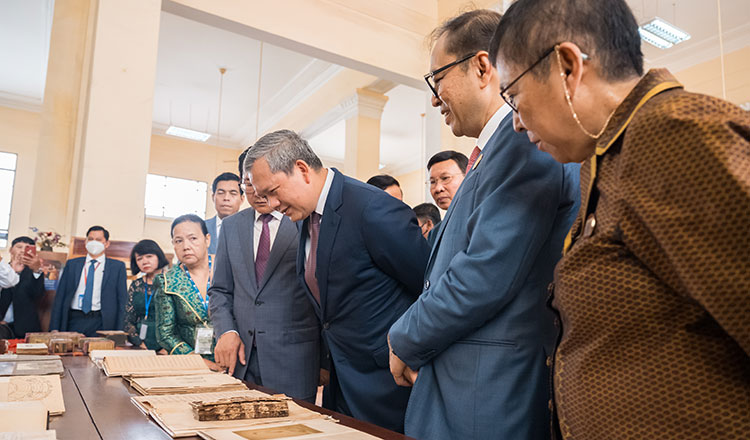
The exhibition commemorating the National Archives’ centenary was held under the theme “A Century of Memory: Towards Promoting National Identity”. The event in Phnom Penh highlighted the archives’ role as an invaluable institution for safeguarding the country’s historical records and national identity.
Speaking at the event, Mr Hun Manet compared the value of the National Archives to that of precious metals.
“The National Bank stores gold bars, while the National Archives houses documents that are more valuable than gold,” he said
He said that while gold holds great value, the historical documents preserved in the National Archives are priceless. They serve as original evidence of history and national identity, which cannot be altered to suit any individual’s personal agenda.
Mr Hun Manet added that Cambodia has a long-standing tradition of documenting its history. The National Archives represent not only an important part of the country’s heritage but also a vital resource for safeguarding national interests, particularly when Cambodia faces issues concerning its borders or other national challenges.
As an example, he cited the preservation of royal correspondence sent by the late King Father, Preah Borom Ratanak Kaudh, to France. Such documents demonstrate how historical records can substantiate past events and Cambodia’s diplomatic relations.
To keep pace with technological advances and meet the research demands of the digital age, he called for the modernisation of the National Archives, the National Library and the National Museum, as well as the development of a national digital archive system.
Under the proposed system, historical and important administrative documents would be scanned and stored as digital images or data, creating an online platform that would enable researchers, students and the public to search for and access records more easily. At the same time, measures would be needed to regulate access rights and ensure data security to protect sensitive documents and critical state information.
Beyond digital modernisation, Mr Hun Manet highlighted the need to preserve traditional crafts, particularly the art of sleuk rith (palm-leaf manuscript engraving), which faces a shortage of skilled practitioners and successors.
He instructed the Ministry of Culture and Fine Arts to work with associations, training schools and communities with expertise in the craft to develop training programmes and provide support to both instructors and students.
He said that sleuk rith is a rare traditional skill requiring dedicated training and succession planning. Some public schools, he noted, face difficulties offering such courses because of a shortage of both instructors and students.
He added that cooperation with schools and communities would help preserve the craft while providing financial support and incentives for students to learn it, ensuring that the knowledge and artistic legacy of Khmer ancestors are passed on to future generations.
He also instructed the ministries to survey locations across the country where sleuk rith is still practised, identify and bring together experts, and organise competitions to raise public interest in the tradition.
Mr Hun Manet commended National Archives officials and staff for their dedicated efforts to preserve and restore historical documents. He called on Cambodian citizens and researchers to help document and compile the country’s history using original source materials.
He directed state institutions to prioritise the proper organisation and preservation of the documents produced by their respective agencies, stressing that today’s administrative records would become invaluable historical evidence in the years to come.
The centenary exhibition also highlights the historical and cultural ties between Cambodia and the Francophone world, particularly as the country prepares to host the 20th Francophonie Summit, an event expected to draw international attention to Khmer cultural and historical heritage.
The National Archives originated from the establishment of a system for managing and preserving state documents in Indochina during the French colonial period. In 1917, Paul Boudet, a specialist in library and archival affairs, was dispatched to develop principles and procedures for managing and classifying archival records.
Under this framework, plans were made to establish five archival repositories in major cities across Indochina: Phnom Penh, Hanoi, Saigon, Hué and Vientiane.
The repository in Phnom Penh was constructed in 1924 and officially opened on October 1, 1926. Following Cambodia’s independence from France in 1953, the library and archival repository in Phnom Penh were designated as the National Library and National Archives.
In 2019, following an administrative restructuring within the Office of the Council of Ministers, the National Archives was placed under the General Department of the Royal Gazette and National Archives. In 2025, the Department of National Records was renamed the Department of National Archives.
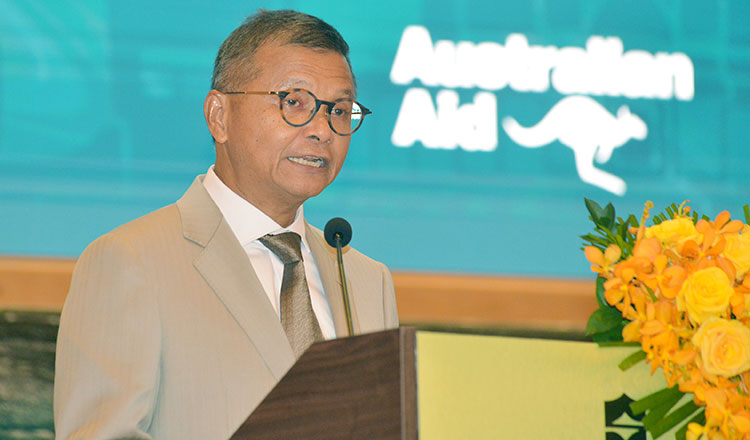
According to Vongsey Vissoth, Minister in charge of the Office of the Council of Ministers, the National Archives holds a collection spanning approximately 2,000 linear metres. It includes historical archives, ancient books, newspapers, maps and significant administrative records, all of which serve as valuable sources for research and for understanding Cambodia’s historical development.
Vissoth said that in the modern era, the National Archives should not be viewed merely as a repository for old papers or documents stored in a warehouse. Rather, it represents the collective memory of the nation and its institutions.
It serves as a reliable source of information and a foundation for analysis, evaluation, research and informed decision-making, while also providing lessons for national development, he said.
He added that archives constitute a valuable national treasure and a core element of national identity, with profound historical, administrative and legal significance. They also serve as an important resource for human resource development.
In response, the Office of the Council of Ministers is preparing a concept paper outlining a vision and strategic framework for modernising the National Archives over a 15-year period, from 2026 to 2040.
Mr Hun Manet has authorised the integration of the National Archives and the National Library under the Office of the Council of Ministers, aiming to modernise both institutions more effectively while making significant savings in human and financial resources.
- Tags: Cambodia, Khmer heritage