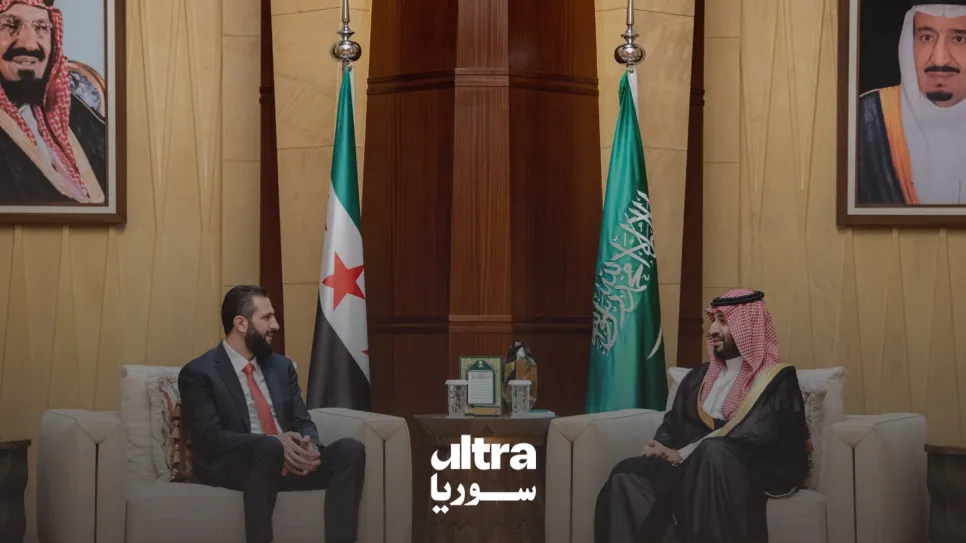
President Ahmad al‑Sharaa’s recent visit to the Kingdom of Saudi Arabia has revived debate over Damascus joining the “Mecca Alliance.” The discussion gained momentum after Foreign Minister Asaad al‑Shibani stated—following his visit to Pakistan on August 21—that Syria was examining the possibility of acceding to the “Mecca Joint Defence Agreement.” President al‑Sharaa’s visit to Riyadh, amid intensified military operations in Yemen and the potential renewal of American‑Iranian confrontation, has further sharpened questions about Syria’s prospective accession, the gains it might secure, and the roles it could assume within the alliance comprising Saudi Arabia, Pakistan and Türkiye.
Syria’s Strategic Needs
The agreement, signed on August 7, establishes a joint defence framework among Saudi Arabia, Pakistan and Türkiye to strengthen collective deterrence. Under its provisions, an armed attack on any signatory is treated as an attack on all, alongside commitments to broaden defence cooperation.
Political analyst Abdullah al‑Hamad believes Damascus is seriously pursuing accession, noting that the issue featured prominently in President Sharaa’s meeting with Crown Prince Mohammad bin Salman. He argues that Syria seeks to raise the political and security costs of any escalation against it by expanding its network of regional partnerships—whether to deter Israeli military action or to mitigate the consequences of Iranian influence.
Al‑Hamad underscores Syria’s pressing need for military and defence support as it rebuilds its army and rehabilitates its security institutions. Accession, he contends, could offer Damascus access to defence technology, training programmes and potentially heavy weaponry at a time when conventional military assistance remains limited.
Political researcher Dr. Hamza al‑Muhaimid adds that Syria views its relations with Saudi Arabia and other alliance members as a cornerstone for enhancing its regional standing and breaking its isolation. He adds that this follows Syria’s accession to the Global Coalition Against Daesh (ISIS), as well as discussions about potential regional roles for Damascus after a meeting between President Donald Trump and President al‑Sharaa on the sidelines of the NATO summit in Ankara.
Al‑Muhaimid further argues that Damascus seeks economic gains and the restoration of its geopolitical role as a strategic corridor linking the Gulf to Türkiye and Europe through maritime transport, rail networks and oil and gas pipelines. This role has gained heightened importance amid ongoing disruptions to global maritime trade, particularly in the Strait of Hormuz and the Bab al‑Mandab Strait.
Scenarios for Accession
Syria’s accession to an alliance comprising states of considerable political, military and economic weight raises questions regarding the nature of its participation and the roles it could assume—especially given that Syria’s previous involvement in the International Coalition against terrorism has not yet translated into a clear enhancement of its security and military capabilities.
Al‑Hamad outlines several potential scenarios. Foremost among them is direct accession, given Syria’s strategic location as a transit point between the Gulf and Türkiye. He also considers alternative forms of participation, including joint counter‑Daesh initiatives, political and intelligence partnerships, and advanced mechanisms for information sharing.
In parallel, al‑Muhaimid highlights the potential expansion of military cooperation, particularly in training, capacity building, field coordination and joint operations. Gulf states continue to face challenges posed by cross‑border networks engaged in drug and weapons smuggling; Syria and Jordan serve as critical frontlines in countering these activities due to their geography.
He adds that Syria could prove a valuable partner for the alliance given its regional role and its relations with Washington, as well as its ability to facilitate coordination with Baghdad and Beirut within frameworks supported by the United States and Europe.
Mutual Security Interests
Reuters quoted an American official claiming that Saudi Arabia had requested Syrian troop deployment in operations against the Houthis in Yemen—an assertion denied by the media advisor to the Syrian President, Ahmad Zaidan. Nevertheless, the report illustrates the types of mutual security interests that could emerge from Syria’s accession, and the roles Damascus might play short of direct combat.
Al‑Hamad identifies several avenues through which Syria could support the alliance without deploying troops, foremost among them intelligence sharing. He notes that Damascus possesses two principal sources of intelligence: first, the accumulated expertise and data held by factions that fought Daesh, Hezbollah, Iranian proxies and Iraqi armed groups; second, the documents and archives left behind by the security and military institutions of the former regime, which may contain critical information relevant to regional security.
Al‑Muhaimid highlights the potential value of military expertise accumulated by revolutionary factions over years of conflict—particularly in urban warfare, guerrilla tactics and counter‑insurgency. He argues that this experience, gathered over fourteen years, could constitute a significant Syrian contribution to regional security cooperation.
He concludes that Syria’s geographical and political position affords it added weight within the alliance, enabling it to serve as a point of convergence between Riyadh and Ankara, strengthen bilateral coordination and open the door to broader regional arrangements.
This article was translated and edited by The Syrian Observer. The Syrian Observer has not verified the content of this story. Responsibility for the information and views set out in this article lies entirely with the author.