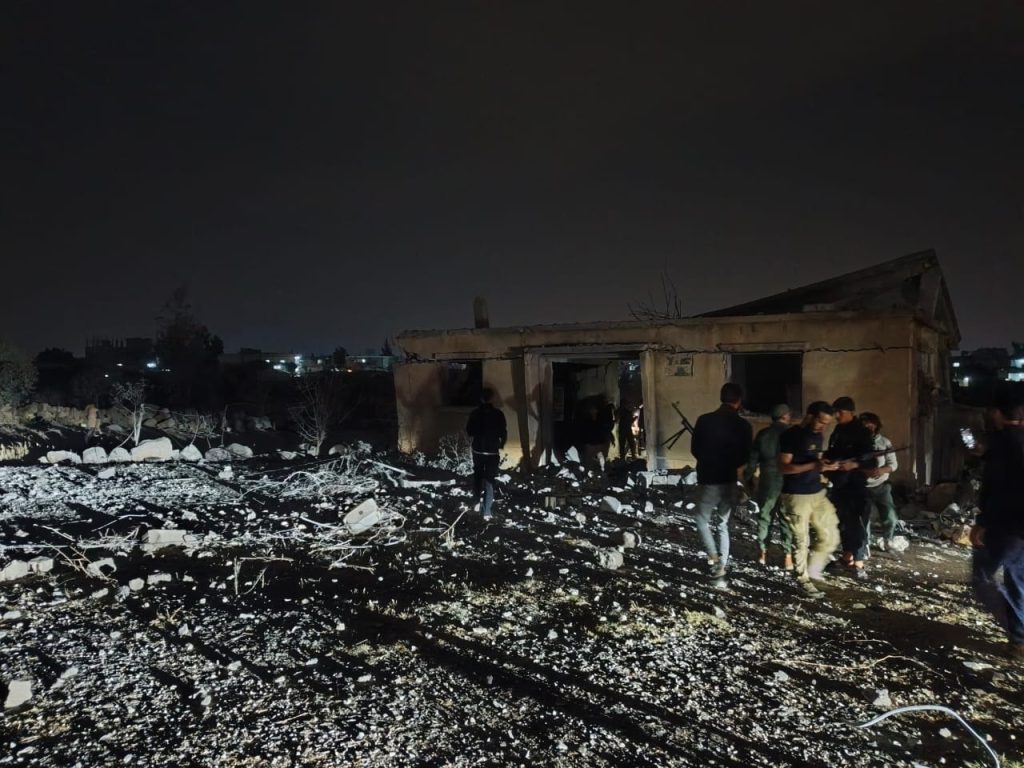
Jordanian airstrikes on the Daraa countryside, which reportedly left civilians dead and injured, have subjected Syrian-Jordanian relations to one of their most difficult tests since the fall of the Assad regime. Following a period of political and security rapprochement, and the announcement of plans for a strategic partnership between Damascus and Amman, the strikes have revived sensitive questions about national sovereignty, the limits of cross-border military action, the effectiveness of bilateral security coordination and the considerations behind Jordan’s decision to undertake an operation of such gravity.
The crisis is particularly sensitive because it comes at a time of marked improvement in relations between the two neighbours. Since the collapse of the former Syrian regime, Jordan has emerged as an important regional partner for Damascus, particularly in border security and efforts to combat drug trafficking and organised crime. The two governments have also sought to expand cooperation in energy, water, transport and trade, hoping to establish a more stable and structured relationship after years of tension and upheaval.
These efforts suffered an abrupt setback following a terrorist attack on a church in Jordan’s Karak governorate. Jordan subsequently launched airstrikes against sites in the Daraa countryside, saying it was targeting terrorist groups. According to Syrian official statements, the strikes killed and wounded civilians, including women and children, and were carried out without prior coordination with the authorities in Damascus.
The speed with which events moved from the attack in Karak to the airstrikes in Syria raises serious questions about the intelligence behind Jordan’s decision and the extent to which that intelligence was verified and scrutinised before military action was authorised.
A Decision Under Domestic Pressure
Jordan’s decision must be considered against the domestic atmosphere following the church attack. Terrorist violence, particularly when it targets places of worship and claims civilian lives, places governments under intense political and public pressure to respond swiftly, reassure their citizens and demonstrate their ability to protect them.
In Jordan’s case, such pressures may have hastened the decision to use military force. Jordanian security services reportedly arrested suspects in connection with the attack on Monday morning, while the airstrikes on Syrian territory took place that same evening. The short interval raises doubts about whether sufficient intelligence had been gathered to identify targets across the border, assess their nature and establish any connection with the terrorist attack.
These questions become more pressing in light of official Jordanian statements indicating that no external links or prior planning had been established in relation to the cell responsible for the church attack. If no foreign connection was identified, what intelligence justified the strikes in Daraa? Were the targeted sites genuinely connected to the incident, or did the military decision rest on other information that has yet to be disclosed?
The information contained in published accounts of the incident does not, at present, provide sufficient evidence to conclude that Jordan acted on misleading intelligence or that a particular party deliberately exploited domestic tensions to draw Amman into an ill-judged confrontation with Damascus. Nevertheless, the possibility warrants investigation, especially given that some regional actors may have an interest in undermining Syrian-Jordanian rapprochement and keeping Syria’s southern border a source of instability.
The issue extends beyond the reliability of intelligence to the process by which intelligence assessments become political and military decisions. During crises, the desire to demonstrate resolve can lead decision-makers to favour swift action over the careful verification of information and assessment of possible consequences.
This phenomenon is well documented in studies of decision-making and is associated with what psychologists call motivated reasoning. Officials may become more inclined to accept information that supports their preferred course of action while discounting warnings that could delay it.
Modern history offers sobering examples of the disastrous consequences of such failures. In December 2009, Humam al-Balawi, who claimed to possess intelligence that could lead to senior al-Qaeda figures, exploited the eagerness of American and Jordanian intelligence agencies to penetrate the organisation. He carried out a suicide bombing at Forward Operating Base Chapman in Afghanistan, killing seven CIA personnel. Subsequent investigations exposed failures in vetting and security procedures.
In August 2021, an American drone strike in Kabul, carried out amid pressure to respond to an attack on US forces, killed ten civilians, including seven children. The targeted vehicle was subsequently found to belong to an aid worker rather than a member of Islamic State.
These comparisons do not establish that Jordan’s strikes in Daraa followed the same pattern. They do, however, illustrate the dangers of military decisions taken in a charged atmosphere, when the urgency of retaliation can eclipse the demands of rigorous intelligence verification.
Syrian Sovereignty and the Limits of Military Action
Beyond the questions surrounding intelligence assessments, the airstrikes raise important legal and political issues concerning the use of military force on another state’s territory.
International law rests on respect for state sovereignty and territorial integrity. It prohibits the use of force in international relations, subject to narrowly defined exceptions, principally the right of self-defence under the applicable legal conditions and authorisation by the United Nations Security Council.
Jordan is entitled to protect its security and confront terrorist threats in accordance with international law. Any military operation conducted within Syrian territory, however, requires a clear legal basis.
The absence of prior coordination with Damascus, as confirmed by the Syrian authorities, is therefore a significant issue that calls for an explanation of the legal grounds on which Amman acted. It also raises the question of why the existing channels of security cooperation between the two countries were not used, whether to exchange intelligence or to request that Syrian authorities take action against suspected individuals or locations.
This question carries particular weight because security cooperation between Damascus and Amman has previously yielded results in combating smuggling and organised crime, according to officials on both sides. Bypassing those channels therefore invites scrutiny of the confidence placed in their effectiveness, as well as the circumstances that may have prevented their use before the strikes.
The civilian casualties also require an investigation into whether the operations complied with the relevant rules of international humanitarian law, particularly the principles of distinction between civilians and military objectives, proportionality in attack and the obligation to take feasible precautions to avoid civilian harm. Civilian deaths alone do not establish a violation of these principles. They do, however, make a thorough examination of the targets, the intelligence underpinning the attacks and the means employed all the more necessary.
Between Condemnation and Preserving the Partnership
Politically, Syria’s official response has sought to combine condemnation of the strikes with an effort to prevent the incident from developing into a broader crisis with Jordan.
The Syrian Foreign Ministry described the operations as a violation of national sovereignty and the principles of good neighbourliness, confirming that no prior coordination had taken place. At the same time, it warned against attempts by suspicious parties to damage relations between the two countries and sow discord between their peoples.
This approach reflects an awareness of the sensitivities of the present moment. Syria is attempting to rebuild its institutions and restore effective control over its territory and borders. It must assert its sovereignty and demonstrate its capacity to protect its citizens. At the same time, stable relations with neighbouring countries remain essential, particularly with Jordan, a key partner in southern Syria’s security and in the country’s economic reintegration into the Arab region.
Jordan, for its part, has a direct interest in a stable Syria capable of securing its borders. Any deterioration in security in southern Syria would have immediate repercussions for the kingdom, affecting efforts to combat smuggling and organised crime, as well as cross-border trade and movement.
Continued uncertainty over the circumstances of the airstrikes could therefore prove more damaging to bilateral relations in the long term than the incident itself. Left unresolved, mutual suspicions could weaken security cooperation and encourage political and media campaigns that deepen tensions and erode trust.
The desire to preserve bilateral relations must nevertheless leave room for accountability over civilian casualties. Nor can diplomatic expressions of reassurance serve as a substitute for establishing responsibility. Lasting stability requires a clear account of what happened, the identification of those responsible and credible assurances against the recurrence of such operations.
A Test of Trust and the Future of Relations
Damascus and Amman now face a dual challenge: addressing the humanitarian and sovereignty implications of the airstrikes while preserving the partnership they have sought to build since the fall of the Assad regime.
The necessary response begins with a transparent investigation into the circumstances of the operation. This should examine the intelligence on which the decision rested, the nature of the targeted sites, any connection between those sites and the terrorist attack in Karak, and the reasons why coordination with the Syrian authorities did not take place.
The investigation should also establish the circumstances in which civilians were killed or injured, identify responsibility and ensure accountability wherever errors or violations are proven. Victims and their families must have access to appropriate redress and compensation.
Equally important is a review of the mechanisms governing security and military coordination between the two countries. Clear procedures are needed for dealing with cross-border threats, allowing a rapid response while respecting each country’s sovereignty and protecting civilian lives.
The crisis may also provide an opportunity to reconsider the foundations of the Syrian-Jordanian partnership. General political understandings and occasional security contacts could give way to more clearly defined institutional arrangements, specifying responsibilities, communication channels and procedures for handling intelligence and urgent security threats.
Perhaps the gravest danger exposed by the strikes is the fragility of trust when confronted with an unexpected security crisis. Both countries have made progress in overcoming the legacy of previous tensions. Preserving those gains will require a degree of transparency and responsibility commensurate with the scale of their shared interests.
Legitimate anger over the deaths of Syrian civilians should not obscure the suffering of the victims of the terrorist attack in Karak. Equally, the terrorism inflicted on Jordan cannot justify ill-considered military operations that endanger Syrian civilians. The security of the two countries is closely intertwined, and respect for sovereignty and the protection of civilian life are indispensable to the stability of both.
Ultimately, the success of Damascus and Amman in overcoming this crisis will be measured by more than a reduction in hostile rhetoric or the resumption of official contacts. The real measure will be their ability to establish what happened, secure justice for the victims, remedy weaknesses in security cooperation and put safeguards in place to prevent a recurrence.
Geography has made Syria and Jordan neighbours; history and shared interests oblige them to cooperate. Whether that proximity can be sustained as a stable partnership will depend on the ability of both states to defend their sovereignty, protect their citizens and manage disagreements without sacrificing the trust they have worked to build.
This article was translated and edited by The Syrian Observer. The Syrian Observer has not verified the content of this story. Responsibility for the information and views set out in this article lies entirely with the author.