Synopsis: Ministry of Agriculture, Forestry and Fisheries will fully manage rescue operations as international partner shifts focus to habitat protection.
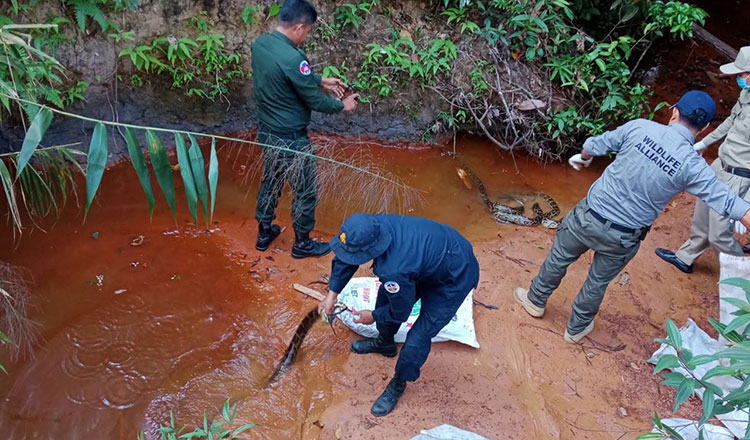
The Ministry of Agriculture, Forestry and Fisheries (MAFF) has assumed full control over the Care for Rescued Wildlife programme after a 25-year partnership with Wildlife Alliance.
According to a joint statement issued by MAFF and Wildlife Alliance on Wednesday, the management handover was completed at the end of September following decades of joint work in wildlife rescue, rehabilitation and veterinary care.
The transition allows MAFF to lead the programme’s daily operations, while Wildlife Alliance shifts technical support towards forest protection and broader conservation efforts across Cambodia.
“After 25 years of transformative partnership in wildlife rescue, rehabilitation, and conservation, MAFF and Wildlife Alliance are entering a new chapter in their shared mission to protect Cambodia’s natural heritage,” the statement said.
The two institutions said the handover represents a planned progression towards national governance, with MAFF now equipped to assume complete operational management.
Throughout the partnership, MAFF and Wildlife Alliance developed local technical expertise and established standards for wildlife rescue, rehabilitation and veterinary care.
Both organisations said the programme’s activities would continue under Cambodian management within national administrative and budgetary frameworks.
Over the 25-year partnership, $15.2 million was invested directly into the Care for Rescued Wildlife programme, according to the statement.
The funding supported operations including animal nutrition, veterinary care, infrastructure improvements, rehabilitation programmes and facility installations.
Investments included a water filtration plant and boundary fence at the Phnom Tamao Wildlife Rescue Centre, the Wildlife Release Station in Koh Kong, and conservation sites in Angkor and Prambei Mom.
The two organisations credited donors, civil society partners and supporters with helping establish and sustain the programme.
They acknowledged Suwanna Gauntlett, the Cardamom Carbon Company, Wallace Research Foundation, The Aspinall Foundation and the Eleonora McDonald Trust.
While MAFF leads core operations, Wildlife Alliance said its conservation work in Cambodia continues through efforts in forest landscapes.
These include the Southern Cardamom and Samkos REDD+ Projects, which focus on protecting forest habitats for Cambodia’s rescued wildlife and native species.
The organisations added that the transition represents a change in operational responsibility rather than an end to cooperation.
MAFF will lead the care of rescued wildlife under national systems, while Wildlife Alliance continues providing technical support and working on forest protection in partnership with the ministry.