By Isha Qarsoon
Four months ago, President Hassan Sheikh Mohamud declared that Somalia had moved from a Provisional Constitution (PC) to a Final Constitution. The declaration followed constitutional amendments adopted by Parliament without three steps explicitly required by the PC: agreement with the Federal Member States (FMSs) on the division of powers and resources, consultation with the states and the public, and ratification by the Somali people. In two essays published shortly thereafter, Isha Qarsoon argued that the amendments had not completed Somalia’s federal project. Instead, they had replaced the federal bargain embodied in the PC with a different constitutional order that unilaterally reallocates powers among the Federal Government (FGS), the FMSs and local governments newly established as a separate constitutional tier carved out of the FMS constitutional domain under the PC. The amendments also changed presidential and parliamentary terms from four years to five.
What has happened in the four months since is more revealing than the new constitutional text. Hassan Sheikh was elected to a four-year term and had previously said the new arrangement would apply to the next government. He nevertheless claimed the fifth year for himself and began implementing the amended Constitution. One of its most consequential provisions created a Supreme Judicial Council with broad authority over the courts, and the government has begun nominating its members for parliamentary approval. Yet both the President and Parliament remain in office only because the new five-year term has been applied to the current incumbents. Parliament is now being asked to approve a Judicial Council that will help constitute and govern the new judiciary. If the amendments were unconstitutionally adopted, the defect therefore extends well beyond the President’s fifth year. It reaches Parliament’s continued tenure and the federal laws it passes, the Judicial Council it approves, and ultimately the judiciary that Council will help create, reproducing the original constitutional defect across the executive, legislature and judiciary.
President Hassan Sheikh
More immediately, Villa Somalia is using that additional year to reshape who governs the FMSs before the next federal election. The Constitution does not authorize the federal president to choose state leaders, remove incumbents he no longer supports or reorganize regional politics around his preferred candidates. No other law gives him that authority. Yet Hassan Sheikh is intervening directly in state political processes, using federal money, appointments, security forces and the power of the presidency. The FMSs remain formally autonomous, but Mogadishu is increasingly deciding who leads them.
Yet even as Villa Somalia consolidates political control over the institutions and state governments it can reach, the FGS remains unable to govern much of the country it claims. Puntland has further consolidated its self-government. Jubaland continues to operate outside effective federal control. Somaliland remains beyond Mogadishu’s reach. Northeast State is aligned with Mogadishu but geographically separated from it and contested by both Puntland and Somaliland. Across much of central and southern Somalia, Al-Shabaab continues to govern territory that is part of Somalia.
Together, these developments show how differently Somalia is governed from the country described in the amended Constitution. That Constitution created a new map of its own, adding local governments as a separate constitutional tier and weakening the autonomy of the FMSs. But even that is not the map by which Somalia is actually governed. This essay describes the country as it exists in practice.
Start in Somaliland. For more than three decades, little has changed. Hargeisa has governed itself since its declared secession in 1991. Mogadishu has neither negotiated a settlement that brought Somaliland back into the state nor changed the situation by force. Somalia continues to claim Somaliland as part of the Republic, and the international community continues to recognize that claim. Neither fact changes who governs there. Somaliland remains entirely outside Mogadishu’s reach.
The Northeast State lies between Somaliland and Puntland. Mogadishu recognizes and supports it, while Hargeisa and Garowe claim all or parts of its territory. The FGS presented its creation as an expansion of the federal order into northern Somalia. It also gave Villa Somalia another regional administration aligned with Mogadishu and another possible source of support in the next federal election. Yet the new state is cut off by land from the federal center. Any overland route from Mogadishu must cross Hirshabelle and Galmudug, where government control is already interrupted, and then Puntland, which has rejected the presence of federal forces in its territory. Somaliland offers no alternative route for the FGS.
Federal officials can still fly into Las Anod, assuming air access remains open, but ordinary life depends on roads. Goods, traders, patients, students and families move into Somaliland or through Puntland, and anyone traveling overland toward the rest of the Federal Republic must pass through Puntland. Federal recognition may give a small political class appointments and direct access to Villa Somalia, but it does not change where Northeast State sits or how its people move. That leaves Northeast State politically tied to Mogadishu but physically dependent on its neighbors. It will need working relations with Garowe, Hargeisa or both regardless of its relationship with the FGS. Recognition changed its political status, not its geography. How long that arrangement can last is uncertain.
Farther east is Puntland. Unlike Somaliland, it does not claim independence from Somalia. Unlike Northeast State, it does not look to Mogadishu to sustain its political position. Garowe governs Puntland through its own institutions, commands its own forces and decides who may organize armed units inside its territory. Its recent declaration that no federal forces remain in Puntland merely acknowledged that Mogadishu no longer exercises military authority there.
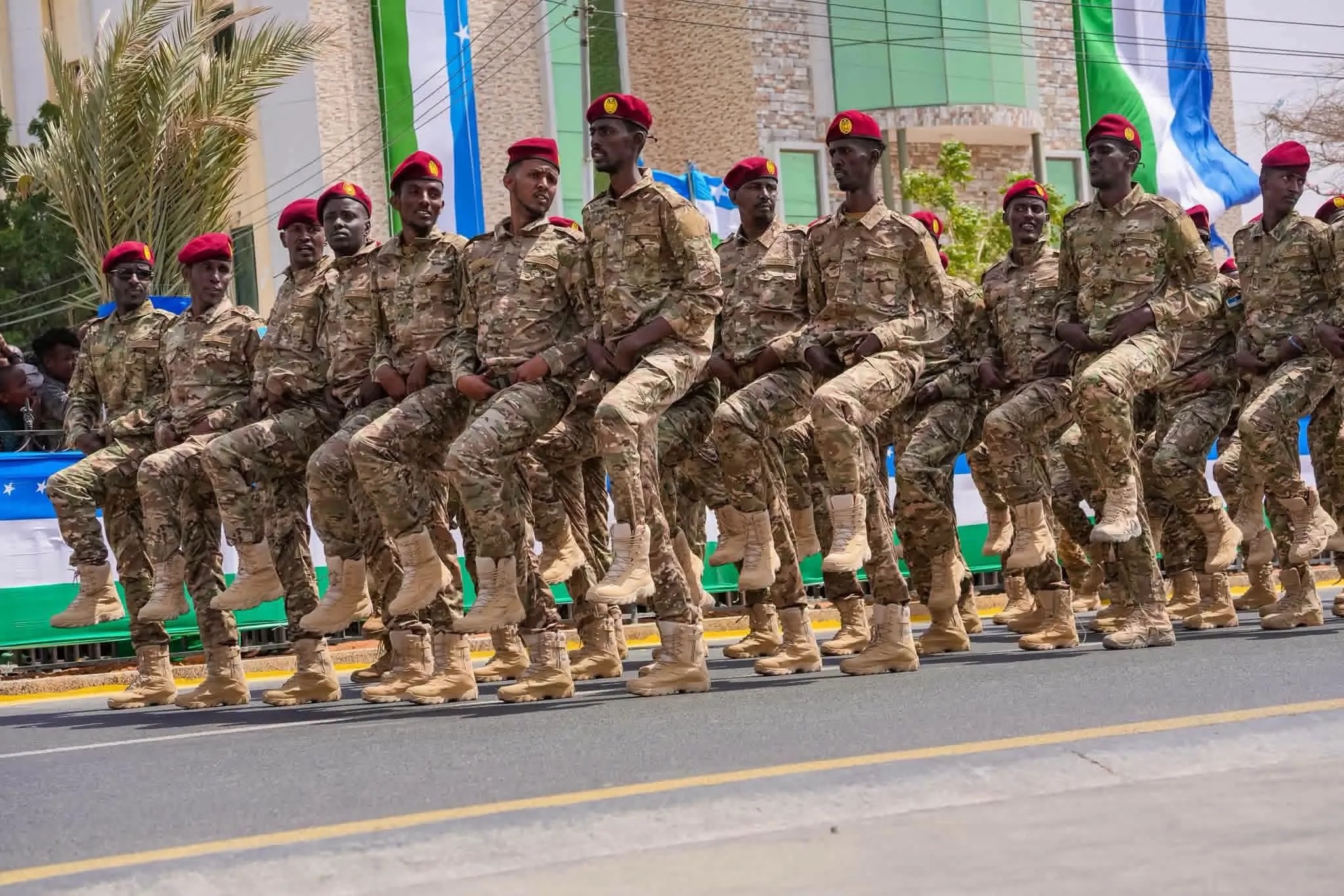
Even before the latest clashes, Puntland was turning increasingly toward itself rather than Mogadishu. Its twenty-eighth anniversary was marked by unusually elaborate celebrations of Puntland’s institutions, security forces and political identity. It was not a declaration of independence, but the celebration showed how far Puntland has moved from the federal center. The speeches, ceremonies and displays focused on Puntland’s government, its forces and its future, not on its place in a functioning federal system.
South of Puntland lies the part of the country most often described as the FGS’s base. That description is misleading. South West, Galmudug and Hirshabelle have not been tied to Mogadishu through an agreed and functioning federal arrangement. Villa Somalia has instead increasingly shaped their leadership, political succession and the arrangements through which regional power is exercised.
South West is the clearest example of how selectively Villa Somalia invokes constitutional authority. Hassan Sheikh treated the new five-year federal term as extending his own presidency, although he had been elected for four years. But when Abdiaziz Laftagareen resisted Mogadishu’s constitutional and electoral program, the FGS declared his mandate expired and rejected the political process organized by South West itself. Federal forces moved into Baidoa, Laftagareen resigned, and Villa Somalia took control of the succession. The process that followed produced a president backed by Hassan Sheikh’s party after major candidates withdrew and complained that the result had been arranged in advance. The issue was not adherence to a new constitutional order. It was who controlled the political outcome.
Galmudug is beginning to follow South West’s path. Ahmed Qoorqoor supported Hassan Sheikh’s constitutional program, but Villa Somalia did not support him for another term. Relations deteriorated when Qoorqoor resisted federal interference in Galmudug’s security command. Hassan Sheikh’s party then selected Libaan Shuluq as its candidate. Qoorqoor initially refused to step aside as Mogadishu challenged his control over the state’s security forces. After weeks of pressure and negotiations over his departure, he withdrew from the race and endorsed the FGS’s electoral plans. The prime minister then traveled to Dhusamareb as Villa Somalia pressed ahead with Shuluq’s candidacy. In Abudwaq, opponents of the federally backed candidate warned: “We will not be treated like Baidoa.”
In Hirshabelle, Hassan Sheikh’s involvement is even more direct. He played a central role in creating the state during his first presidency and has repeatedly intervened in its leadership. On August 4, he met the Hawadle ugaas and senior politicians to discuss who should become the next Hirshabelle president. The Hawadle leadership reportedly left the choice of its candidate to Hassan Sheikh himself. Since the presidency is expected to pass to a Hawadle candidate, the federal president now has a direct role in choosing who may next govern the state.
South West, Galmudug and Hirshabelle are the three FMSs where Villa Somalia has gone furthest in determining who governs. In South West, it forced a change of leadership. In Galmudug, it has pushed aside an incumbent it no longer supports. In Hirshabelle, Hassan Sheikh is now directly involved in choosing the next president. The states remain formally autonomous, but decisions over who leads them are increasingly being made in Mogadishu.
But controlling a state presidency does not mean governing the state. A president backed by Villa Somalia may sit in Baidoa, Dhusamareb or Jowhar while large areas beyond the capital remain outside his government’s reach. Government authority is concentrated in the main towns and along some roads. In parts of Galmudug, Hiraan and Middle Shabelle, government forces cannot move freely, secure the roads or prevent Al-Shabaab from exercising authority over local communities.
Al-Shabaab fills that gap with government of its own. It collects taxes, controls movement, settles disputes and enforces its decisions. Its reach extends even into some government-held towns, where businesses and residents pay it because the government cannot protect them from retaliation. Its rule is coercive and illegitimate, but in many communities it is the authority people encounter in their daily lives. A map showing all of Galmudug, Hirshabelle and South West as governed from Mogadishu therefore bears little resemblance to the country on the ground.
Farther south is Jubaland. It remains part of Somalia in law, but Kismayo does not take political or military direction from Villa Somalia. When Mogadishu rejected Ahmed Madobe’s reelection and sent federal forces into Jubaland, the regional government resisted. Federal troops were defeated at Ras Kamboni in December 2024, and hundreds crossed into Kenya. Madobe remained in office and Mogadishu failed to remove him.
The defeat did not create Jubaland’s autonomy. It exposed the limits of federal power. Mogadishu could issue decrees and arrest warrants against Madobe, but it could not enforce them in Kismayo. It sent federal troops to change who governed Jubaland and failed. That separates Jubaland from South West, Galmudug and Hirshabelle, where Villa Somalia has been able to shape who governs.
Somaliland remains outside Mogadishu’s authority. Puntland governs itself and rejects the present federal arrangement. Northeast State is recognized by Mogadishu but separated from it by territory the FGS does not control. In South West, Galmudug and Hirshabelle, Villa Somalia has increasingly shaped who governs, even as large parts of those states remain beyond the reach of federal and regional authorities. Jubaland remains part of Somalia, but Mogadishu has failed to determine who governs there.
This is Somalia’s governance map four months after Hassan Sheikh declared the provisional constitutional era over. It is not the map set out in the Constitution he declared final. It is the country as it exists today.
Isha Qarsoon
Email: IshaQarsoon1@gmail.com
——
Isha Qarsoon is a platform dedicated to addressing critical issues pertaining to good governance, corruption, and social challenges.