Your support helps us to tell the story
From reproductive rights to climate change to Big Tech, The Independent is on the ground when the story is developing. Whether it’s investigating the financials of Elon Musk’s pro-Trump PAC or producing our latest documentary, ‘The A Word’, which shines a light on the American women fighting for reproductive rights, we know how important it is to parse out the facts from the messaging.
At such a critical moment in US history, we need reporters on the ground. Your donation allows us to keep sending journalists to speak to both sides of the story.
The Independent is trusted by Americans across the entire political spectrum. And unlike many other quality news outlets, we choose not to lock Americans out of our reporting and analysis with paywalls. We believe quality journalism should be available to everyone, paid for by those who can afford it.
Your support makes all the difference.Read more
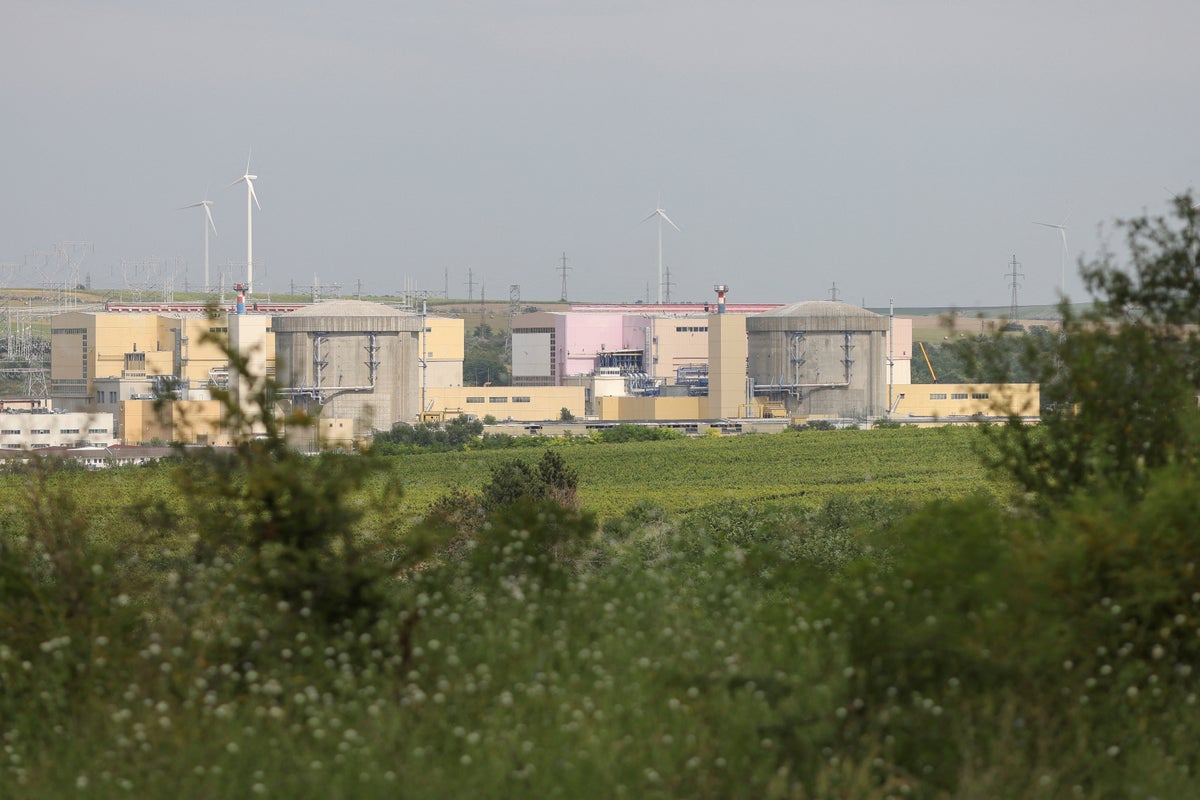
Romania is in a desperate race against time, deploying rock-filled barges into the Danube in an urgent bid to divert water to its sole operational nuclear reactor.
The drastic measure aims to secure a few more days of power generation amidst a severe drought and tight electricity supplies.
Record low water levels in the Danube, crucial for cooling reactor turbines, have already forced the shutdown of one reactor at the Cernavoda plant. Authorities have resorted to unprecedented steps to maintain the second reactor, including detonating a rock obstruction earlier this week.
The two reactors, operated by Nuclearelectrica, supply a fifth of the country’s electricity. The drought is also impacting hydropower plants, while energy imports are constrained by similar conditions in neighbouring nations.
A satellite image shows reduced water levels along the sandbanks of the Danube River at the Bulgarian-Romanian border, near Oryahovo, Bulgaria. (Reuters)
While previous efforts like the blast and riverbed dredging offered a temporary reprieve, a Nuclearelectrica executive warned that the remaining reactor could cease operations within five to six days if the newly sunken barges fail.
Romeo Urjan, the plant’s director, told Digi24, “If the barges generate a water surplus this deadline extends to nine to 10 days.”
The Danube’s flow in Romania fell to an all-time low on Thursday of 1,400 cubic metres per second, about a third of the August average. The state water management agency said it would begin controlled submersion of the four barges one at a time from 1200 GMT, aiming to establish a barrier and redirect water from a river branch toward the plant. Urjan said the impact would be felt one day later.
“That is an extraordinary response, but it should not be mistaken for an energy strategy,” ING Bank said of the Danube works in a note. “Blasting rock out of a riverbed may keep a reactor operating for a few more days, but it does not create new generation capacity, reinforce cross-border interconnections or accelerate storage deployment.”
EU member Romania relies on a mix of gas, coal, hydro, nuclear and renewables for electricity generation but needs billions of euros in investment to replace ageing facilities and boost battery storage and grid interconnections.
Young men by the Danube after water levels receded, near Calarasi, Romania. (Reuters)
The river runs through Germany, Austria, Slovakia, Hungary, Croatia, Serbia, Romania, Bulgaria, Moldova, and Ukraine
Water has dropped so low in the Danuber that the hulks of dozens of World War II German battleships are emerging into view, distracting from the summer heat crisis.
In the middle of the river separating Serbia and Romania near the Serbian port of Prahovo, a rusty hull is now visible along with a broken mast where the Nazi flag used to fly.
The ships, some still laden with weapons, belonged to Nazi Germany’s Black Sea fleet that the Germans deliberately sank as they retreated from Romania and as Soviet forces advanced deeper into Europe near the end of the war.
Historians say up to 200 German warships were scuttled in September 1944 near Prahovo in the Danube gorge as they came under Soviet fire. The idea behind the deliberate sinking was to slow down the Soviet advance in the Balkans. But Nazi Germany surrendered months later, in May 1945.