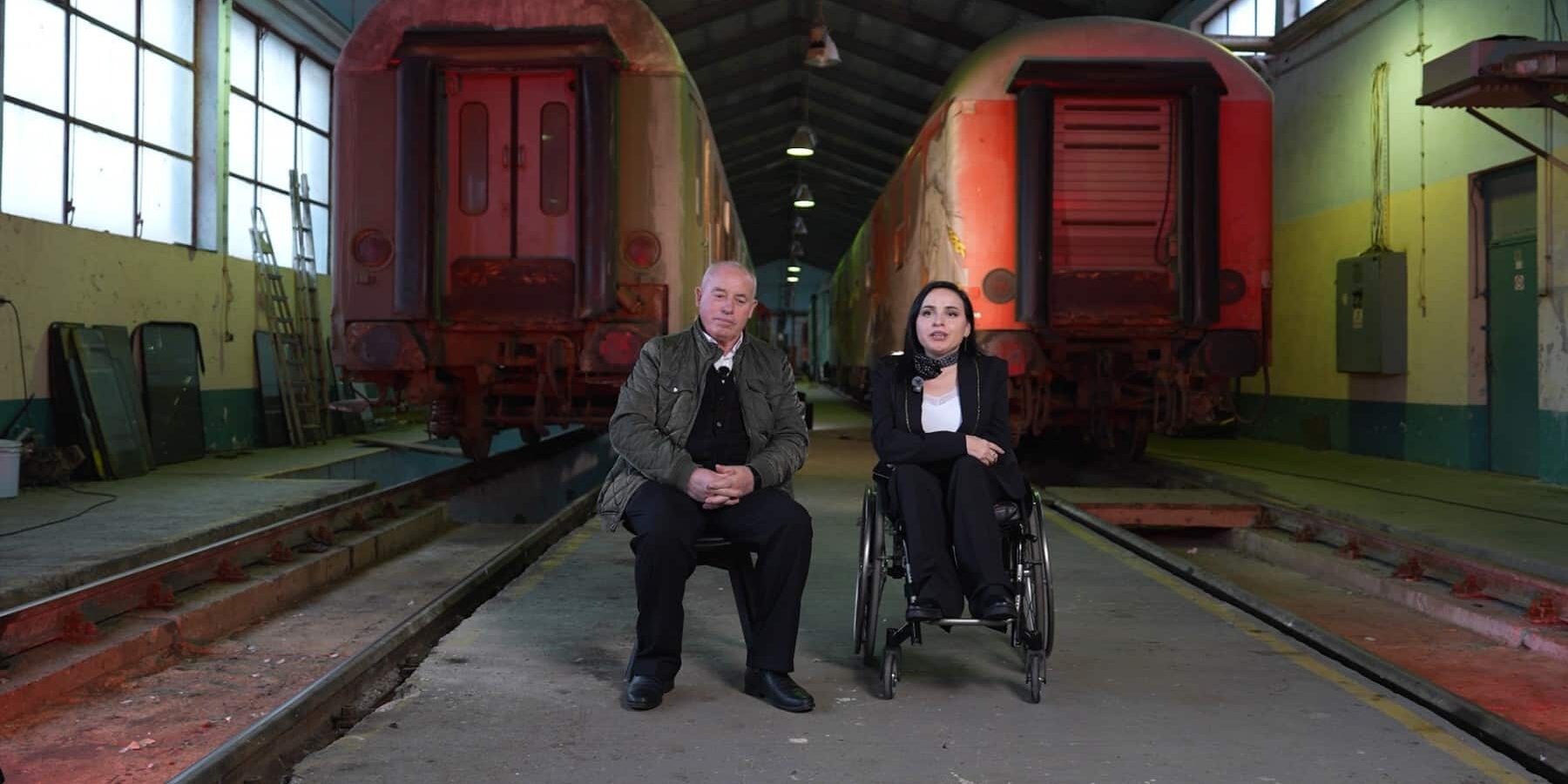
Her father recalls: “They took my car because they liked it. It was a [Volkswagen] Golf Mk2,” he says. His disabled children were “left in the mud” by the side of the road, he adds.
“We had no wheelchairs,” Ganimete notes. “My mother and father carried us everywhere.”
One by one, Sali carried each of the children onto a village bus that was already crowded with other displaced Kosovo Albanians. “We spent the whole night in there,” he recalls.
“There must have been more than 100 people in that bus,” says Ganimete. “My father held my two brothers on his lap, and my mother held me.”
As the bus waited to leave, she watched Serbian forces separate young men from the crowd. “They took them to a garage and beat them. We could see it from the bus.”
She also remembers police demanding money and gold jewelry from refugees.
After spending the night on the bus, they were ordered to head towards Malisheva the next morning.
“When we arrived, Serbian police and paramilitaries had set up a checkpoint. I saw people being killed there. I thought: ‘This is where our lives will end,’” says Sali.
As they travelled through Kosovo, scenes of destruction unfolded around them. “We saw houses burning the entire way. We saw bodies lying by the roadside,” he adds.
A shocking memory that has stayed with him is of a young man trapped beneath his overturned tractor trailer in Rahovec: “I could hear him screaming, but nobody could help him. Today, there is a memorial to him there.”
At the border with Albania, the Serbian police became suspicious of one of Morina’s sons.
“They told me: ‘This one is wounded. Where are you taking him? He’s a KLA soldier.’ I explained that he had a disability and couldn’t walk. I pulled up his legs so they could see,, he says.
That moment remains among Ganimete’s worst memories: “I’ll never forget how my father lifted my brother to show his legs. The policeman narrowed his eyes, lowered his head, and walked away.”
“My older brother walked until he was four,” Ganimete recalls. “Then he developed a fever and was diagnosed with muscular dystrophy. My younger brother was born with the condition. I also walked until I was three or four before developing symptoms. Our other brother and sister do not have the disease.”
After being displaced from their home, their parents had to carry all three children around. “For our family, carrying us was an extra burden compared to everyone else,” she says.
Holding back tears, she says that as a child, “I often thought that maybe it would have been easier if one of us three had died, just to make things easier for our parents.
“What would life have meant for us if our father had been killed?” she asks.
Without their parents, she says, the three children could not have catered to their own most basic needs. “Our parents are irreplaceable,” she observes.