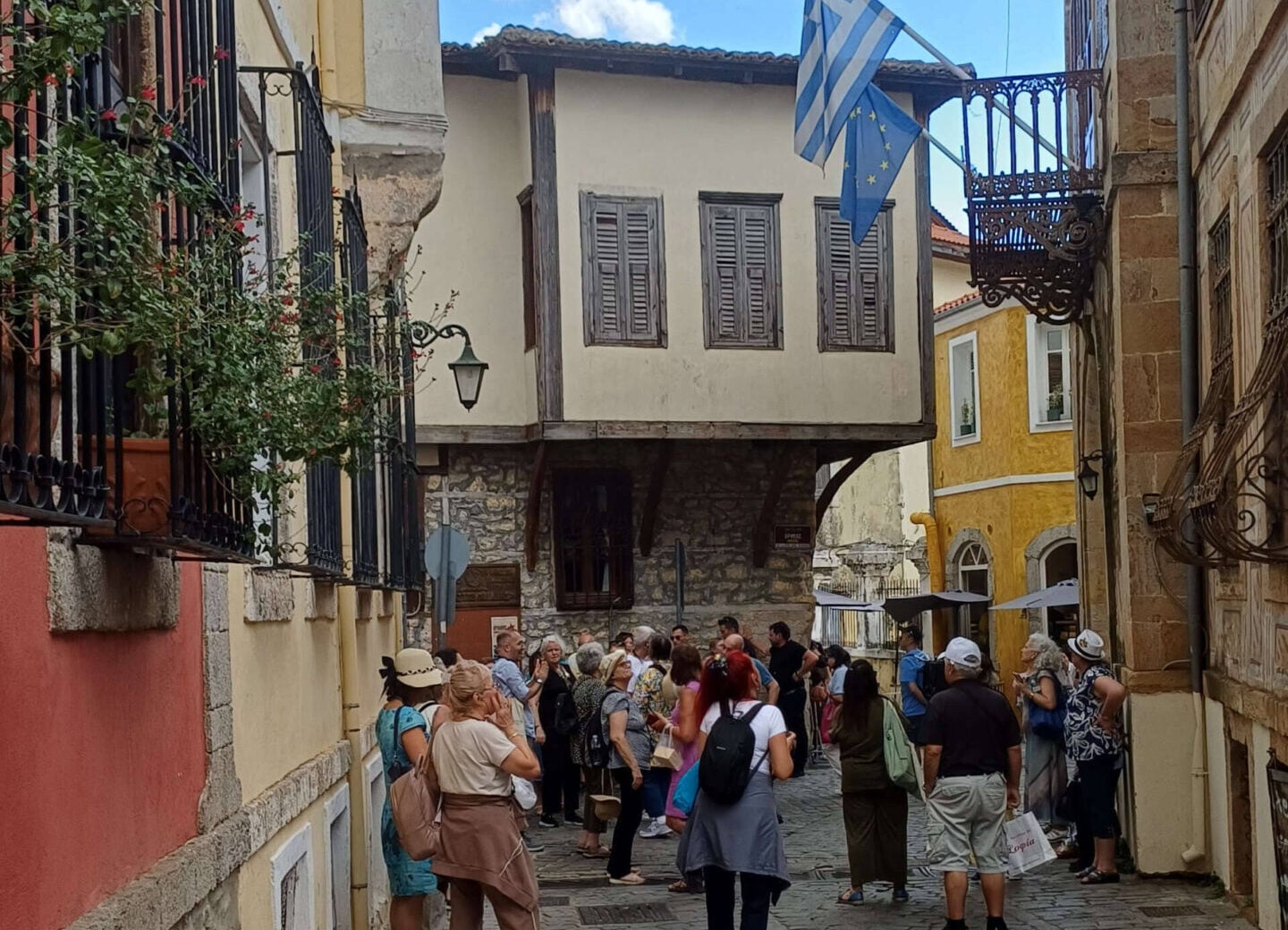
On 20 July Neos Kosmos had an excellent article on the recent Senior Hospitality program organised by the Hellenic Ministry of Foreign Affairs and the YMCA of Thessaloniki. The focus of the program was on Macedonia in Northern Greece.
Thirty-eight participants from nineteen countries participated, including from Melbourne, Perth, Sydney and Adelaide. Being one of those participants, I had the opportunity to reflect on the importance and relevancy of the tour for both the participants and our ancestral home country, Greece. The Hospitality program offered many areas deserving consideration, however, I would limit the discussion to three areas. Namely, the retention of the Greek language in the Greek Diaspora; the benefit of the program to Greece; and historical issues in Northern Greece.
Clearly, what brought participants in the tour group together was their claim to Greek ancestry and perhaps their adherence to the Greek Orthodox Faith, but not language, as most of them did not speak the Greek language. A more nuanced understanding of the Greek language issue could not be explored during the trip as language barriers impeded my effort. However, it is worth contemplating those factors that brought the demise of the Greek language in some countries and not others. Though one fact was clear, those participants who did not speak the Greek language, were most likely third, fourth or fifth generation descendants of Greek migrants in their respective countries.
There are multiple possible explanations contributing to the demise of the Greek language in the countries where descendants of Greek migrants no longer speak the Greek language. It is possible that in countries with a small Greek population, the first Greek migrants may have been dispersed across the country with very few in one area and therefore lacking the resources to organise themselves sufficiently well to develop the necessary structures conducive to language retention. It is also possible that prevailing host country assimilationist policies discouraged, or in the extremes prohibited the organised teaching of the Greek language, rituals and practices to younger generations of Greek background.
Contrast this with Greek communities in countries such as Australia, and the disparity is quite apparent. In Australia, pre-World War 2 (WW2) Greek migrants established a small nucleus of structures such as the then Greek Orthodox Community of Melbourne and Victoria, a few brotherhoods and Greek businesses upon which the post WW2 mass influx of new Greek migrants relied upon and able to build on. Add to these, the abolition of the White Australia policy in the early 1970s, which enabled the development of a successful multicultural society, all created a fertile ground for migrant communities in Australia to flourish linguistically, culturally, politically and economically.
More importantly though, the presence of a multitude of smaller Greek community hubs, Greek Orthodox parishes and regional brotherhoods throughout the Melbourne metropolitan area, as well as rural regional areas with a significant population of Greek migrants, all formed a web of decentralised, easily accessible Greek language afternoon schools. Moreover, the plethora of private Greek language schools, and a select number of Victorian Government schools teaching the Greek language during the week and on Saturday morning and it becomes apparent the reach was far and wide, and any primary and secondary school aged student could learn the language if they wished to do so. Well, we all remember the determination of our parents to see we learn Greek, irrespective of whether we as young kids wanted to play after school with our friends. We all begrudged that then but later were grateful our parents’ insistence helped us retain our ancestral language and bilingualism, not to mention the advantage this proved to be for some of us professionally, and for the majority enormously helpful when visiting Greece.
To all the above, we must not forget the helpful part the small subsidies Greek afternoon schools received for each student from the Australian Government and the willingness of Greek parents to pay a fee, often a financial sacrifice for them. This ensured their offspring retained a certain fluency in both the written and spoken Greek language and in keeping those schools financially afloat, especially the smaller ones. The posting of Books and teachers by successive Greek governments was also helpful.
Encouragingly, Melbourne forms a pivotal place, although not the only one, where Greece could look for, to formulate informed policies that could ensure the survival of the Greek language in the diaspora.
Meeting Greeks from around the Globe who did not speak the Greek language and had little contact with fellow Greeks was fascinating. I recognised that for some of those participants, it was an opportunity to acquaint themselves with their ancestral Greek roots. From a political and national perspective, what does Greece gain from hosting these programs?
Certainly, the islands are in danger of sinking under the flood of tourists, whilst Macedonia and generally Northern Greece, has been the neglected cousin. It would seem to me that even, fellow Greece-based Greeks often lacked the knowledge about this part of Greece. I am aware that Greece has little industry and Macedonia is an underdeveloped tourist destination. I can therefore understand the desire of the Greek government to develop this part of Greece as a tourist destination. It makes sense.
I also believe that there is another, less tangible, reason. In our complex geopolitical environment, countries need all the support they can get, and the sizeable Greek diaspora can prove to be a valuable lobbying source to steady tensions arising with neighbouring countries and volatile regions within close proximity to Greece, such as the Middle East and the Black Sea.
However, there is a third issue that I would like to touch on. Visiting Macedonia, one can see an area rich in history, linguistically, culturally and environmentally. The mountains and vegetation of Macedonia and Epirus are breathtaking. Their terrain hides villages that have spoken many languages, including Greek, Arvanitika, Slavic, Bulgarian, and Vlach. The cities had communities of Jews, Muslims and other minorities. Their geography, especially their forested terrain, mountains, and isolated villages, allowed for protection, but also the development of localised linguistically and culturally rich areas.
This allows us to conclude that Northern Greece was linguistically and culturally a more diverse, less ethnically homogeneous and multicultural region prior to its liberation from the Ottoman empire.
While understandable, it is regrettable that Greece embarked on a policy of Hellenizing and homogenizing the cities and villages of Northern Greece after liberation from the Ottoman Empire in 1912. In so doing, it deprived future generations of its bilingual populations of second and often more languages and the retention of multicultural communities. Paradoxically, Greece’s diasporic sons and daughters craved the retention of their Greek language and culture, which Greece encouraged both subtly and materially by posting Greek books and teachers to assist language schools in the diaspora, while concurrently denied to their cousins in Northern Greece.
As mentioned in the previous paragraph, Hellenization was understandable. Naturally, the involuntary approach adopted by Greece, for fear of neighbouring countries meddling with ethnic minorities as a pretext to lay claim to parts of Northern Greece and the inability of policy makers in Greece to conceive diversity as a far greater strength, than homogenization, was often resented by those affected by this policy.
Could the involuntary nature of implementing this policy have been handled more benignly? Perhaps, but given the prevailing geopolitical environment then, I doubt that any Greek Government would have been brave enough to risk it and pay the prize of political oblivion in the ballot box, e.g. see the demise of the Syriza party, following the recognition of Northern Macedonia. I also doubt whether the current political and social environment is sufficiently ripe to allow for a mature debate on the issue of pluralism in Greece. However, given that Greece is embedded into the European Union and feeling more secure economically and militarily, I would hope a more diverse pluralistic Greece would emerge soon, where diasporic Greeks would feel their ancestral country is not only advocating diversity in the diaspora but also puts it into practice within Greece itself.
While the Hospitality Program for Seniors organised by the Greek Ministry of Foreign Affairs and YMCA Thessaloniki provided a rich glimpse of the antiquities and modern life in Northern Greece as a means of opening the region to more tourists, it also aimed at strengthening Greece’s ties with its diaspora as a means of building up its intangible capital. On this basis, it proved to be a worthwhile endeavour, and I would wholeheartedly endorse its continuation.