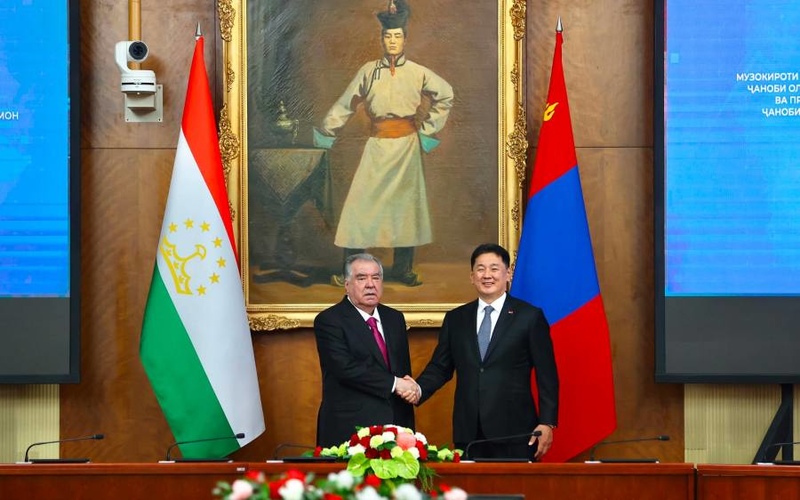
AKIPRESS.COM – President of Mongolia Khurelsukh Ukhnaa and President of Tajikistan Emomali Rahmon held official talks in Ulaanbaatar on June 21, Montsame reported.
The two leaders reviewed more than three decades of friendly relations and cooperation since the establishment of diplomatic ties and exchanged views on the future development of bilateral relations, as well as regional and international issues of mutual interest.
President Khurelsukh noted that the reciprocal state visits by the two heads of state within the past year demonstrate the shared commitment of both countries to further strengthen bilateral ties. He also highlighted that President Rahmon’s previous state visit to Mongolia in 2009 made a significant contribution to deepening friendship between the two peoples and advancing bilateral cooperation.
President Rahmon expressed confidence that the current visit would further strengthen political trust and provide fresh momentum for expanding practical cooperation. He also commended the steady development of bilateral relations since diplomatic ties were established and reaffirmed Tajikistan’s commitment to enriching the partnership with new areas of cooperation while enhancing economic relations.
President Khurelsukh underscored the importance Mongolia attaches to its relations and cooperation with the countries of Central Asia, particularly Tajikistan.
The Presidents welcomed the signing of 11 intergovernmental and inter-agency agreements during the visit, covering trade, economy, education, youth, sports, geology, mineral resources, environment, and industry.
During the talks, the two sides agreed to align the long-term development policy of Mongolia, “Vision-2050”, with the National Development Strategy 2030 of Tajikistan and explore opportunities to implement joint projects and programs in trade, economy, agriculture, energy, transport, logistics, environmental protection, education, culture, and tourism.
President Khurelsukh highlighted the leading role of Tajikistan in renewable energy, particularly hydropower in Central Asia, and said the two countries could cooperate in professional training and the exchange of expertise in the sector.
The two sides also agreed to develop long-term cooperation in supporting the green transition, combating climate change, and strengthening regional energy integration.
They agreed that the relevant Ministries would work together to remove obstacles in the transport sector and facilitate more efficient transport and logistics routes between the two countries.
As landlocked developing countries, Mongolia and Tajikistan also expressed their shared commitment to linking Mongolia’s “Transit Mongolia” initiative with Tajikistan’s “Transit Country” strategy and the Central Asia Regional Economic Cooperation (CAREC) Program to increase trade and economic connectivity.
The leaders agreed to strengthen cooperation in agriculture and livestock husbandry, particularly in veterinary services, and to establish the necessary legal framework for sectoral cooperation.
They also agreed to explore opportunities to produce value-added joint products by combining Mongolia’s wool and cashmere resources with Tajikistan’s cotton and textile industries.
President Khurelsukh emphasized that the CAREC Ministerial Meeting to be hosted in Mongolia in September 2026 will play a key role in deepening regional economic cooperation and establishing a foundation for multi-sectoral initiatives, inviting Tajikistan to participate at a high level.
The two sides welcomed the Mongolia-Tajikistan Business Roundtable held during the visit, saying it would help strengthen ties between the business communities of the two countries.
They agreed to establish the Mongolia-Tajikistan Business Council and begin supplying Mongolian meat, wool, cashmere, and leather, alongside Tajik fruits, berries, and textiles, to each other’s markets.
The two heads of state reaffirmed their commitment to implementing joint projects and programs in tourism by linking the “Feel the Friendship” brand of Tajikistan with the “Go Mongolia” brand of Mongolia, fostering people-to-people exchanges, and advancing cooperation in physical culture, arts, and creative industries.
President Khurelsukh proposed student exchanges under intergovernmental scholarship programs, with a focus on training specialized personnel in livestock farming, hydropower, and irrigation.
The sides agreed to strengthen cooperation within the framework of the United Nations and other international organizations, actively working together to ensure global peace and security, particularly in protecting the interests of landlocked developing countries on the regional and international stages.
President Khurelsukh commended Tajikistan for being one of the first countries to join as a member of the International Think Tank for Landlocked Developing Countries (ITTLLDC).
He also renewed the invitation to Tajikistan to participate in the 17th Conference of the Parties (COP17) to the UN Convention to Combat Desertification, which Mongolia will host next month.
The heads of state agreed that aligning national initiatives, such as Mongolia’s “One Billion Trees” and “Food Supply and Security” with Tajikistan’s “National Strategy for Green Development 2040” and “National Food Security Program through 2030”, will make a vital contribution to sustainable development.