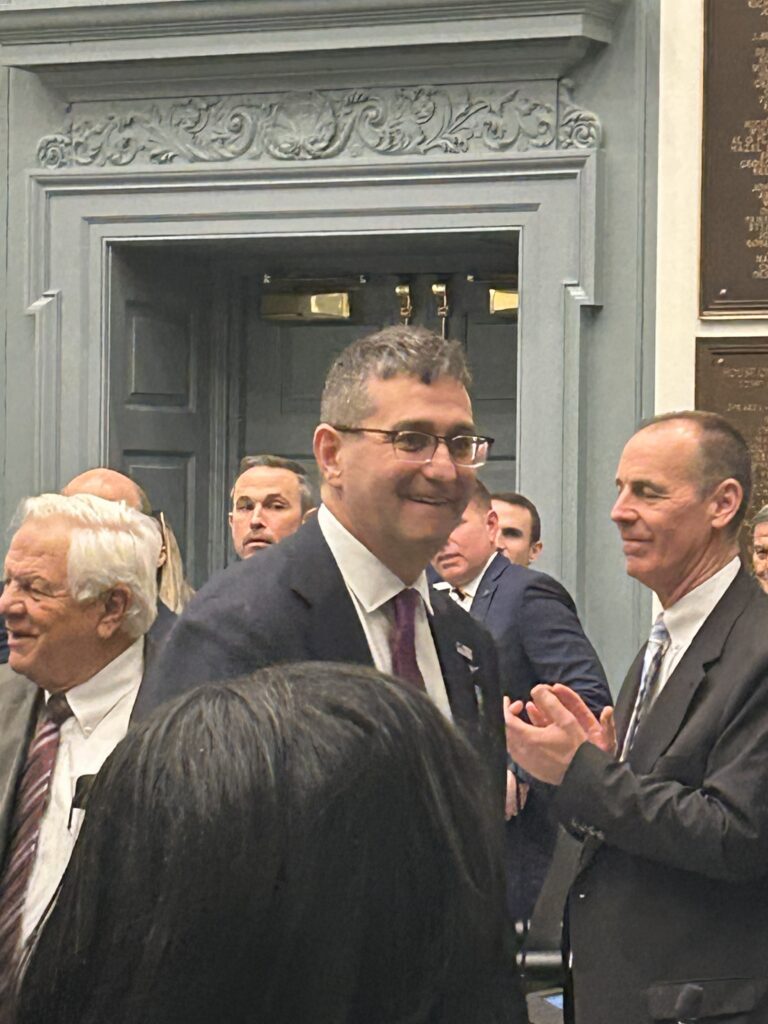
Gov. Meyer Exits SOS 2026. Picture by Brent Burdge, Delaware Live.
Delaware officials are moving on several fronts to reshape the state’s healthcare system, pursuing new rural health investments, expanded public health leadership, workforce initiatives and regulatory changes aimed at improving access to care.
Supporters say the efforts could help address persistent gaps in primary care, chronic disease management and provider availability, particularly in Kent and Sussex counties. But the agenda also raises questions about whether federal funding will be sustained, whether new programs can be implemented quickly enough to affect patients, and whether loosening state review of healthcare expansion could reduce oversight in a market where costs remain a major concern.
The initiatives come as Gov. Matt Meyer’s administration seeks to position healthcare as a central policy priority. The state has advanced a Rural Health Transformation Program, opened procurement processes for rural health projects, backed changes to Delaware’s Certificate of Public Review system, and created the state’s first Office of the Surgeon General.
Rural Health Funding Targets Longstanding Gaps
A centerpiece of the administration’s strategy is Delaware’s Rural Health Transformation Program, which state health officials describe as a long-term effort to expand access to care and support rural communities. The program focuses on expanding healthcare access, making chronic disease management more affordable, growing the healthcare workforce and preparing the health system for future needs.
The effort is aimed most directly at Kent and Sussex counties, where residents can face provider shortages, transportation barriers and limited access to primary care, dental care, mental health services and specialty care. Proposed or emerging projects include health hubs, mobile and fixed-site care access points, community-based programs, chronic disease interventions and workforce development efforts.
Still, the rural health plan depends heavily on federal dollars and multi-year implementation. Delaware received an initial rural health award, but the final amount available over the full program period remains uncertain and may depend on federal decisions, state performance and implementation milestones. That uncertainty could affect how many projects move forward, how quickly they scale and whether programs remain sustainable once grant funding ends.
Workforce Plans Look Beyond Immediate Shortages
Another plank of the state’s approach is increasing the healthcare workforce pipeline. Rural health materials have identified a Delaware medical school and expanded residency programs as possible long-term responses to physician shortages. Advocates argue that training more clinicians in Delaware could make it easier to retain them, especially in underserved communities.
But workforce strategies such as a medical school would take years to produce new practicing physicians, and they would require significant operating support. In the near term, rural communities may still rely on recruitment incentives, loan repayment programs, telehealth, team-based care and support for non-physician clinicians to fill gaps. Critics of large institutional investments may also question whether money would have a faster impact if directed toward existing providers, federally qualified health centers, behavioral health services or transportation supports.
Regulatory Reform Draws Support and Caution
The state is also revisiting Delaware’s Certificate of Public Review program, its version of a Certificate of Need law. The program requires certain healthcare facility expansions, major equipment purchases or capital projects to receive state review before moving forward. Supporters of reform say the process can slow expansion, discourage competition and make it harder for providers to respond to population growth and service gaps.
Recent legislation has eased some requirements, including reducing review for certain major medical equipment purchases while preserving state oversight for larger capital projects and significant bed-capacity increases. Backers describe the changes as a way to reduce delays without eliminating guardrails.
Opponents or skeptics of broad deregulation may see the issue differently. Certificate of Public Review systems are intended to prevent unnecessary duplication of services, protect public planning interests and control the spread of expensive facilities or technologies that could drive up healthcare costs. The policy challenge for lawmakers is whether Delaware can speed needed expansion while still ensuring new investments serve patients rather than simply increasing market share for providers.
New Surgeon General Adds Public Health Voice
In July, Meyer established Delaware’s first Office of the Surgeon General and appointed Dr. Neil Hockstein as the state’s inaugural surgeon general. The office, housed within the Delaware Department of Health and Social Services, is intended to provide evidence-based public health guidance, coordinate health priorities and serve as a visible medical voice for the administration. The model resembles the federal surgeon general’s public-facing role, which the U.S. Department of Health and Human Services describes as providing the public with scientific information on how to improve health and reduce the risk of illness and injury.
The Delaware Healthcare Association praised the appointment, saying Hockstein’s clinical and policy experience would support collaboration with hospitals and other providers. Meyer has framed the office as a response to public health misinformation and the need for trusted guidance on prevention, access to care, youth mental health, loneliness and other emerging health concerns.
Dr. Chris Casscells, a retired orthopedic surgeon and director of the Center for Health Policy at the Caesar Rodney Institute, said the appointment also should be viewed in light of Meyer’s earlier decision to appoint Hockstein to lead the Delaware Health Care Commission. Casscells said he is concerned that the commission has experienced “regulatory capture,” arguing that ChristianaCare has gained increasing influence over healthcare policy in Delaware.
Dr. Christopher Casscells, Director – Center for Health Policy, Caesar Rodney Institute
At the same time, Casscells said Hockstein’s personal relationship with Meyer and his clinical background could give the governor a direct source of advice on what healthcare policymakers often call the “Triple Aim”: improving access to care, improving quality of care and lowering the price of care. Casscells said, “I wish Neil well in his efforts and applaud his continued support toward the “Triple Aim” objectives. He framed that potential benefit as distinct from his concern that Delaware’s existing healthcare oversight structures may already be too vulnerable to influence by dominant providers.
Supporters of state-level surgeon general offices argue that governors benefit from having a visible medical adviser who can translate evidence into public guidance, strengthen health messaging and coordinate across agencies on prevention, health equity, social determinants of health and health-system safety. They also see the role as a way to provide a trusted scientific voice at a time when public health guidance has become more politically contested.
At the same time, the new office will have to prove its practical value. Delaware already has a Department of Health and Social Services, a Division of Public Health and a Health Care Commission. Critics of similar state offices have warned that the role can become politicized, duplicate existing health-department authority or create confusion about who is actually in charge of public health policy. In Louisiana, lawmakers questioned whether a new surgeon general position could “create chaos or maybe even division” inside the health department and whether it would add another layer of government bureaucracy.
Casscells also questioned whether Delaware, as a small state, needs a separate surgeon general office at all. He pointed to Florida’s use of a state surgeon general during the COVID-19 crisis as an example of the role being used as a visible focal point for pandemic response and treatment access. Florida opened state-supported monoclonal antibody treatment sites during the pandemic, though those efforts later became entangled in federal disputes over authorization of certain treatments as variants changed.
Across the states that have used a surgeon general or similar role, the case for the office has generally centered on combining medical expertise with policy coordination. The concern is that its impact depends heavily on how clearly its powers are defined, how well it fits with existing health agencies and how insulated it is from partisan pressure.
The states that have established a state surgeon general or similar role are Pennsylvania, Michigan, Arkansas, Florida, California, Louisiana and Delaware. Pennsylvania created a physician general position in 1996; Michigan followed with a state surgeon general post in 2003; Arkansas and Florida created posts in 2007; California established the role in 2019; Louisiana created the position in 2024; and Delaware became the seventh state to do so in 2026.
Technology Upgrades Could Reduce Friction
Delaware is also investing in health information technology, including expanded payer and provider access to the Delaware Health Information Network. State officials say improvements could support real-time insurance eligibility verification, prior authorization, population health tools and program evaluation.
Such upgrades could reduce administrative burden for providers and patients, especially in smaller rural practices with limited staff. But health technology projects can also be difficult to execute, requiring data sharing agreements, cybersecurity safeguards, training and buy-in from providers and payers. If systems are not easy to use, the promised efficiencies may take longer to materialize.
Implementation Will Determine Impact
Taken together, Delaware’s recent healthcare policy moves amount to an ambitious attempt to expand access, build workforce capacity, modernize care delivery and strengthen public health leadership. The agenda reflects a belief that the state must take a more active role in shaping the healthcare system rather than relying solely on existing providers and market forces.
Whether the changes achieve their goals will depend on execution. State leaders will need to show that rural health funds translate into measurable improvements, that workforce investments reach underserved communities, that regulatory reform expands access without weakening oversight, and that the new surgeon general’s office adds clear value to existing health agencies through well-defined authority and credible, nonpartisan communication. Casscells’ critique adds another test: whether the office can advise the governor independently while avoiding the regulatory capture and provider dominance he says have weakened other Delaware healthcare oversight bodies.
For Delaware patients, especially those in rural areas, the stakes are straightforward: shorter waits, more nearby care options, better coordination and lower costs. For policymakers, the harder test will be balancing speed with accountability as the state turns a broad healthcare agenda into results.
Brent is a 35-year resident of Delaware, having retired after a 38 year career in Operations & Supply Chain with Dupont and Axalta. He is active politically and focuses primarily on Delaware legislative activities.