The immediate question for lawmakers is whether Senate Bill 350 is the right fix. The longer-term question for voters is whether Meyer’s handling of reassessment shows the kind of planning, transparency and judgment Delaware needs.
DOVER — Gov. Matt Meyer is urging lawmakers to fix a New Castle County school-tax problem before the General Assembly adjourns June 30, arguing that apartments and other multifamily housing should not be taxed like commercial property.
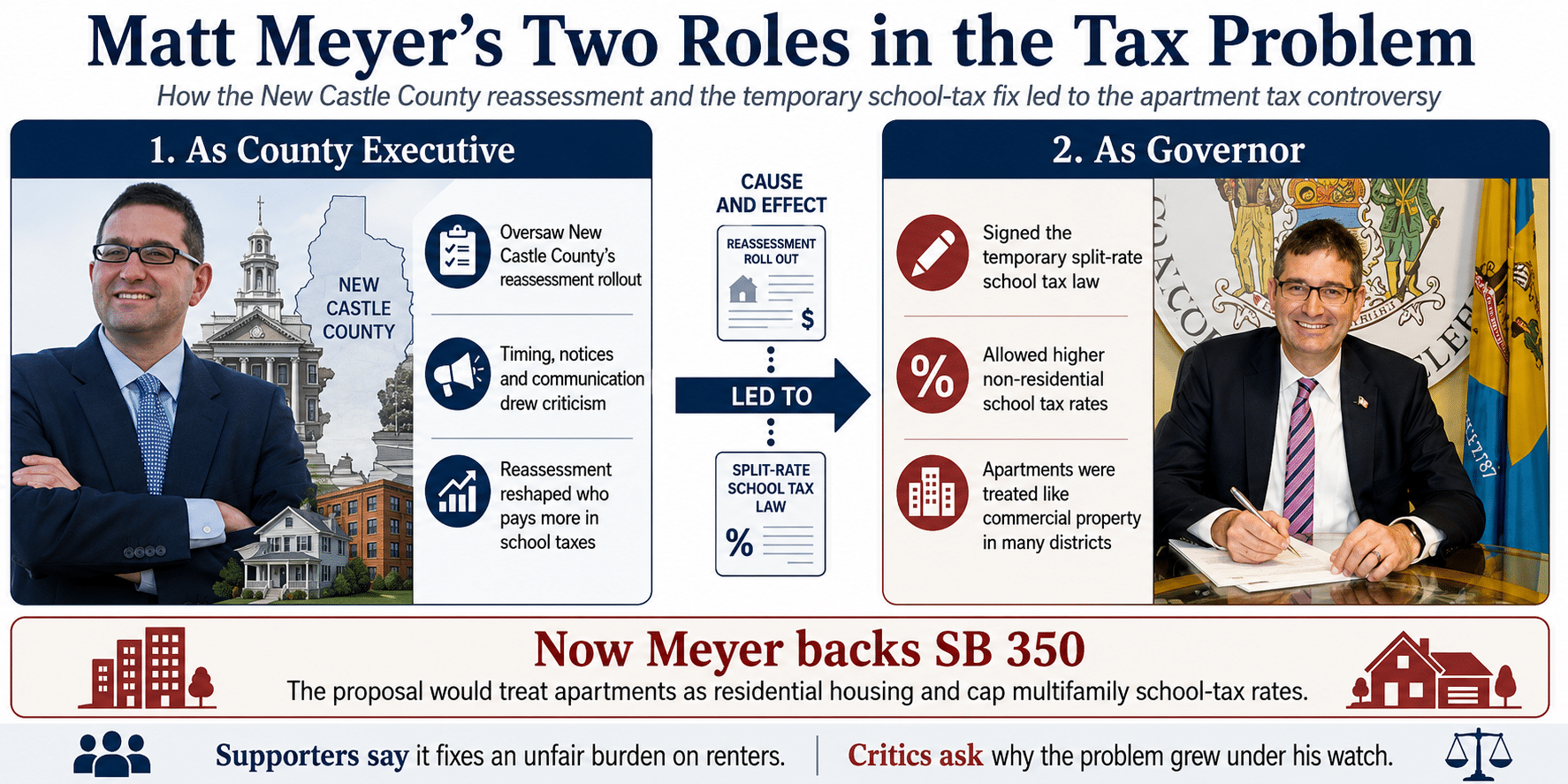
But the request also puts Meyer in a politically difficult position: He is asking lawmakers to correct a problem rooted in the reassessment process he oversaw as New Castle County executive and the emergency tax legislation he later signed as governor.
In a letter to Senate President Pro Tempore David Sokola, House Speaker Melissa Minor-Brown and members of the General Assembly, Meyer urged support for Senate Bill 350 or similar action to address what he called a “gross inequity” in school property taxes.
Read the full letter from Governor Matt Meyer
His argument is straightforward: “A home is a home, whether you own it or rent it.”
Meyer said some New Castle County school districts, after reassessment, charged apartment communities at nearly twice the rate applied to single-family homes and small rental properties. In some districts, he wrote, the result was that a 1,400-square-foot two-bedroom apartment carried roughly the same school-tax burden as a 4,000-square-foot single-family home.
Meyer said apartments, manufactured housing and affordable housing developments should be treated as residential property, not placed in the same tax category as warehouses, office parks and industrial sites. He warned that higher taxes on apartments ultimately show up in higher rents, deferred maintenance or fewer new affordable and workforce housing projects.
The fix he is supporting, Senate Bill 350, would create four statewide property classes: one-to-four-family residential property, multifamily residential property, non-residential commercial and industrial property, and mixed-use property. The bill states that one-to-four-family housing and multifamily housing together make up Delaware’s residential housing sector and would cap school-tax rates on multifamily property at no more than 120% of the rate applied to one-to-four-family residential property. The bill was introduced June 19 and, as of the General Assembly’s bill-tracking page, was awaiting consideration in the Senate Executive Committee.
Meyer says the bill would not reduce total school district revenue and would not apply to school districts that do not use split tax rates, meaning it would have no impact in Kent or Sussex County. Instead, he frames the proposal as a fairness measure for renters and a correction to a tax structure that undermines Delaware’s stated goal of building more dense, affordable housing.
That is the policy case.
The accountability question is harder.
The reassessment controversy began with a court-driven process meant to correct decades of outdated property assessments. New Castle County had not reassessed property since 1987, and the statewide reassessment followed litigation over Delaware’s old assessment system.
Meyer did not create that legal mandate. But he was New Castle County executive while the county’s reassessment process was being managed, and New Castle County’s rollout became the most controversial in the state.
County Executive Marcus Henry, Meyer’s successor, later told state legislators that the prior county administration delayed tentative reassessment notices until after the 2024 election. According to Spotlight Delaware, Henry said Tyler Technologies was prepared to release tentative valuation notices in summer 2024, but the former administration said no and notices did not go out until mid-November.
That timing matters because tentative notices give property owners a chance to review assessments and begin the informal appeal process before tax bills are finalized. At the legislative hearing, New Castle County’s attorney described the notice as the first chance residents would have had to lower potential increases. State Sen. Eric Buckson argued that the delay helped create the backlog and public outcry that followed.
Meyer has denied claims that he intentionally delayed the release of reassessment information. But even if voters accept that denial, the broader leadership question remains: Did his administration manage one of the most consequential tax changes in county history with enough urgency, transparency and public communication?
The second stage of the problem came after Meyer became governor.
In August 2025, lawmakers met in special session to respond to public anger over reassessment. Among the measures passed was House Bill 242, which allowed New Castle County school districts to split tax rates between residential and non-residential property for the 2025-26 school year. The bill applied only to New Castle County, allowed school districts to charge non-residential property up to twice the residential rate and was signed by Meyer the same night it passed.
That emergency fix was designed to reduce sticker shock for homeowners. But it created a new problem for apartment communities because multifamily housing was treated as non-residential for school-tax purposes in the split-rate structure.
Landlords and property groups later sued the state, New Castle County and school districts, arguing that the split-rate system was unlawful and inequitable. During arguments reported by Delaware Public Media, plaintiffs said the highest cost would fall on apartment renters, “those that are least able to afford” the increase. The state and school districts defended the law as a temporary response to an urgent problem, with school district counsel arguing there were only 10 days between passage of HB 242 and the deadline for districts to submit changes.
That sequence is what makes Meyer’s current letter politically significant.
On one hand, his proposed fix addresses a real concern: If Delaware wants more affordable housing, workforce housing and smart-growth development, it makes little sense to tax apartment communities as though they are commercial or industrial properties. Higher operating costs on apartments do not disappear. They are part of the economics of rent, maintenance and future construction.
On the other hand, Meyer is now asking lawmakers to urgently repair a system that was shaped by decisions made under his leadership at both the county and state levels. As county executive, his administration oversaw the reassessment rollout. As governor, he signed the special-session bill that allowed the split-rate structure now at the heart of the apartment-tax dispute.
That does not mean Meyer alone caused the problem. The courts forced reassessment. The General Assembly passed the special-session legislation. School districts chose how to use the split-rate authority. County classifications affected how properties were treated. And lawmakers from both parties were trying to solve a fast-moving taxpayer backlash.
But leadership is measured not only by whether a public official responds to a crisis. It is also measured by whether that official saw the crisis coming, communicated clearly, and avoided creating a second problem while trying to solve the first.
That is the trust issue now facing Meyer.
Voters can fairly ask why the reassessment rollout became so chaotic in New Castle County, why apartment residents were not better protected in the emergency tax fix, and why a correction is now being demanded in the final hours of session.
Meyer’s answer is that Senate Bill 350 would restore fairness, protect renters and align the tax code with Delaware’s housing goals.
His critics’ answer is that the governor is trying to fix a fire that began, at least in part, on his watch.
Both points can be true.
The immediate question for lawmakers is whether Senate Bill 350 is the right fix. The longer-term question for voters is whether Meyer’s handling of reassessment shows the kind of planning, transparency and judgment Delaware needs from its governor.
Delaware LIVE collaborates with a network of professional journalists to cover a diverse range of stories across various fields. Staff Writers include experienced journalists and young professionals. If you have questions, please feel free to contact [email protected] or our publisher, George D. Rotsch, at [email protected]