Photo: borgenproject.org
By Angry GenXer
HAVANA TIMES – Cuban voices from the official camp, or those “supportive” of the government, promote an image of “social justice” and accessible well-being for everyone, in “equity,” while the multiple crises and the latest manifestations of social classes run rampant across this land.
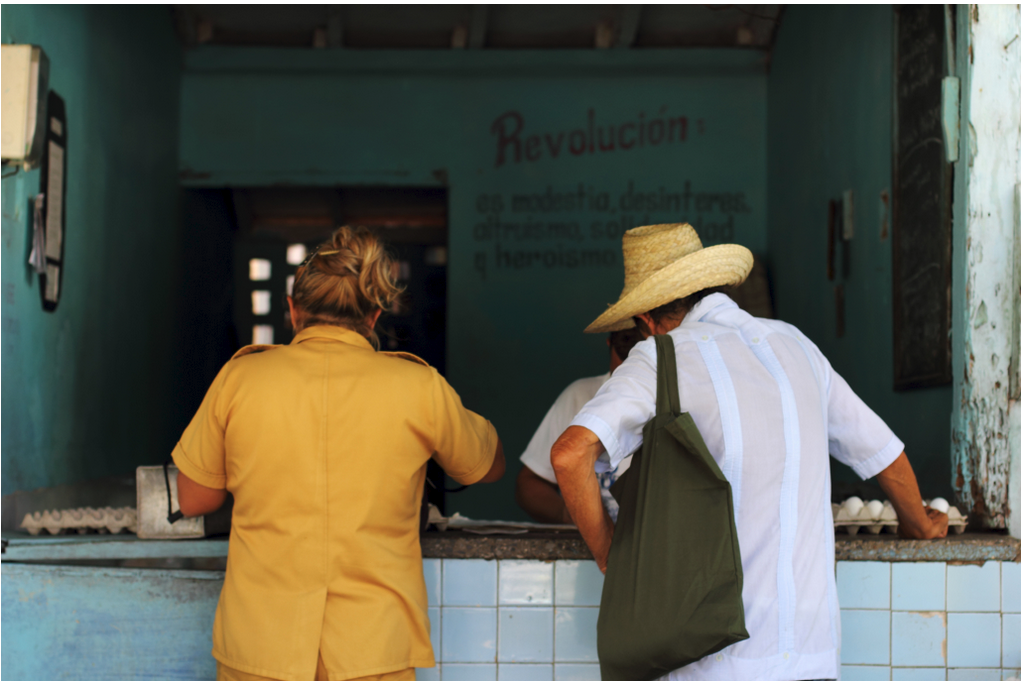
In Cuba, it has long been common to hear the phrase “there is hunger/I’m hungry.” Obviously, this is not like the Nazi concentration camps, besieged Leningrad during World War II, or Spain’s General Weyler’s reconcentration camps in Cuba itself during the anti-colonial war of 1895–98. So then, what are we talking about?
Cuban government media frequently mentions the terms “food security” and “vulnerability,” both part of the lexicon of certain international agencies. The first increasingly appears in the context that “each municipality must provide its own food”; the second is used to describe “people in situations of vulnerability”: a broad spectrum within the citizenry, made up of those who are financially less advantaged within today’s predatory climate.
But what lies behind such words?
Food Security or Food Insecurity?
For Cuban economist Pedro Monreal (in Paris), rather than food security, we should be speaking of food insecurity — for which no official measurements are published — and the key question today is whether we are moving toward a “condition of severe food insecurity,” considering the situation in each household.
It turns out there are simple ways to find out.
In a recent Facebook post, Monreal cited an article by ECLAC (the UN Economic Commission for Latin America and the Caribbean) that included a very simple survey to measure the food insecurity suffered by a person or family. The answers are simple: yes or no.
I felt the impulse to take the survey myself, just to have a point of reference. But first, let’s consider who I am: a precarious worker, without stable employment, living in a peripheral town near Havana.
Filling Out the Survey
1. Have you worried about not having enough food to eat? Yes, all the time.
2. Have you been unable to eat healthy or nutritious food? That’s the case. I generally consume basic natural foods (bought through the ration store or farmers’ markets), but I regularly feel the lack of animal protein (I’m not vegan); on the occasions when I have more money, I often resort to canned goods, processed meats, “junk food,” or prepared foods whose healthiness I can’t really assess (since neither the ingredients nor the preparation methods are known). I compensate for the lack of vitamins and micronutrients with supplements sent to me from abroad.
3. Have you eaten little variety of food? Yes. Most of my meals consist of the local “basics”: rice, beans, spaghetti, sometimes (not always) root vegetables, fruits, and salads, and only occasionally eggs, meat, or fish. Every now and then I add something “interesting” for variety, but only when there’s money (prices are high).
4. Have you had to skip a meal? Yes. It’s been over a decade since I regularly ate breakfast. I only eat lunch and dinner. The few times I’ve been away from home, I have been able to eat breakfast, but here I usually don’t. When I have enough money, I sometimes eat some kind of pastry or “bread with something…” along with my morning coffee.
5. Have you eaten less than you thought you should? Yes. It happens to me frequently, especially not so much in terms of total quantity, but in terms of variety.
6. Has your household run out of food? No, never completely so far.
7. Have you felt hungry but did not eat? Yes, it happened to me last summer, when I lost a lot of weight because I had very little income from the jobs I was doing.
8. Have you gone without eating for an entire day? No, never so far.
According to Monreal, if the answer is “yes” to any of questions 3 through 6, that indicates moderate food insecurity; if it is “yes” to 7 or 8, the insecurity is severe.
Our reality in crisis
Beyond all the official rhetoric or even legislation, what the survey measures is the reality experienced by those of us living through the crisis. And with a study like this, the Food Monitor Program estimated in 2024 that 21% of the Cuban population was experiencing food insecurity.
I’m a typical case. None of my neighbors has permanent access to meat or fish. At best, a chicken or some ground meat, or in special cases (some celebration), a pork steak… that’s simply what you see in my neighborhood. The most common source of animal protein is eggs, while fruits and vegetables — strangely, for a tropical country — are scarce or have become progressively more expensive.
“Food insecurity is a process that usually advances gradually along a scale of severity,” Monreal points out. It is a socioeconomic condition that measures the lack of food or the risk of running out of it. It is the prelude to hunger, which “manifests itself when food insecurity is severe and prolonged.” It is what we see in so many abandoned Cubans rummaging through garbage looking for scraps of food, or — in the best-case scenario — something to recycle or resell to earn a minimal income. It is also visible in acquaintances, neighbors, or friends who keep losing weight. And it is part of the daily anguish that fills the voices of Cuba on social media.
Photo: elpais.com
Vulnerability or Poverty?
To be vulnerable is to be exposed to the risk of something bad happening. To be poor is already to be living in a clearly painful reality. For the UN, vulnerability and food (in)security are two sides of the same coin: vulnerability is the cause, and insecurity is the effect. Food insecurity is the prelude to hunger, and hunger is the consequence of “inequality and extreme poverty.”
There are many causes behind the vulnerability of a country. However, Cuba has long been a class society, and quite a few specialists are no longer afraid to use the term “poverty.” You won’t hear it on TV or in Granma (the official newspaper of the Communist Party), but there are several excellent books of scientific research published in Cuba on the subject.
Economist and Professor Javier Perez Capdevila (University of Guantanamo) recently pointed out on Facebook that official discourse speaks of “vulnerable people” as though they were “a small, clearly identifiable group.” But if internationally validated perspectives are applied, vulnerability turns out to be a condition of “sustained exposure to risk and the inability to cope with it.” In Cuba, inflation, dollarization, dependence on remittances or informal markets, and precariousness themselves expose countless families to “structural vulnerability, even if it is not officially recognized.” According to ECLAC, if 50% of a household’s income goes toward buying food, vulnerability is high, and many studies confirm that Cuba has far exceeded that threshold.
Vulnerability is also tied to instability, which prevents people from trusting the future and building reliable life projects, as well as irregular access to basic services (transportation, healthcare, water, communication, electricity), something that unquestionably strikes the majority of Cubans living here.
So, speaking of “vulnerable people” as though they were a minority group makes a general reality invisible: the exception has become the norm, and the government avoids acknowledging that vulnerability has become generalized. “Almost all Cubans are the most vulnerable,” Capdevila concludes. Or POOR, to say it plainly.
Is this the “Cuban socialism” we are being called upon to die for?
Read more from Cuba here on Havana Times.