Dignity in the Face of the Venezuelan State’s Cruelty
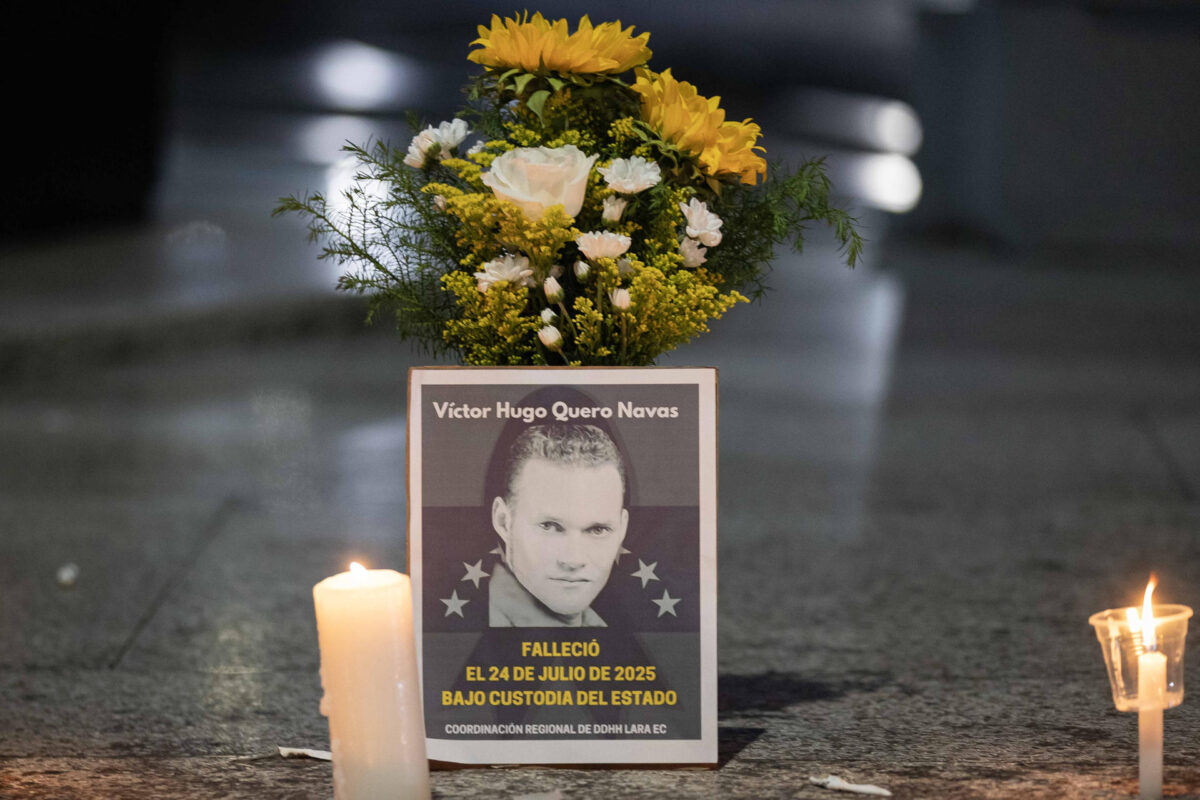
Photograph showing an image of the late Víctor Hugo Quero this Friday, during a vigil called by relatives of political prisoners in his honor, in Caracas, Venezuela. EFE/Ronald Peña R
Truth is the only antidote against the repetition of horror. And it is the only path to justice in Venezuela.
Editorial by Efecto Cocuyo
HAVANA TIMES — The Víctor Hugo Quero Navas case exposed a chain of failures that cannot be understood as negligence, but rather as a pattern of institutional violence. From his arbitrary detention and forced disappearance to his death in custody, the Venezuelan State violated every fundamental guarantee.
The tragedy of the political prisoner is not an isolated incident, nor a bureaucratic mistake, nor the decision of officials acting under the pretext of obeying orders. It is further proof of a system that has made state terrorism its mechanism of existence, protected by impunity.
The ordeal endured by his mother, Carmen Teresa Navas, who for 16 months wandered through a labyrinth of denials before finally finding her son’s body in an anonymous grave, reveals a cruelty that goes beyond authoritarian bureaucracy and enters the realm of the inhuman.
The confirmation of such horror has led Venezuelans from different political tendencies to unite in a single demand: justice.
The Quero Navas case exposed a chain of failures that reveals a pattern of institutional violence. From his arbitrary detention, forced disappearance, and death, the Venezuelan State violated every fundamental guarantee:
Due process: It is still unclear what crimes he was accused of or whether he was ever brought before a court during the entire time he was imprisoned.
Violation of the duty of custody: The State is responsible for the physical integrity of those under its control.
Extended torture: Keeping an 81-year-old woman searching for her son “under every stone,” knowing that the system had already buried him, constitutes cruel and degrading treatment toward the family.
Institutional complicity: The involvement of more than eight agencies in this wall of silence exposes a structure designed to protect impunity, not citizens. The entire story is one of violence — from the moment he was detained to the moment he was buried as an unclaimed corpse.
The exhumation and subsequent burial under Catholic rites on May 8 provided spiritual closure for the family, but the legal wound remains open.
It is not enough to know where Víctor Hugo is; it is imperative to know how he died and who conspired to conceal his whereabouts. In this context, the demand by human rights organizations to apply the “Minnesota Protocol” is non-negotiable. Only a technical, independent, and exhaustive investigation — free from the inconsistencies of the official narrative — will be able to determine responsibility within this chain of command.
Truth is the only antidote against the repetition of horror. And it is the only path to justice. The message sent in the absence of truth and justice is that in Venezuela, even in the much-proclaimed “new political moment,” any citizen can be erased without consequences.
At the end of this Dantean episode emerges the figure of Carmen Teresa Navas. Her persistence managed to break through the wall of silence that sought to bury her son’s memory. She confronted the institutional “monster” with the only weapon power has been unable to confiscate from her: dignity.
Like hundreds of Venezuelan mothers, Carmen Teresa’s struggle has not been only for her son. It is a demand on behalf of all Venezuelans who today remain in the jaws of injustice. May her example serve as a compass so that the demand for truth does not stop until justice is achieved.
First published in Spanish by Efecto Cocuyo and translated and posted in English by Havana Times.
Read more news here at Havana Times