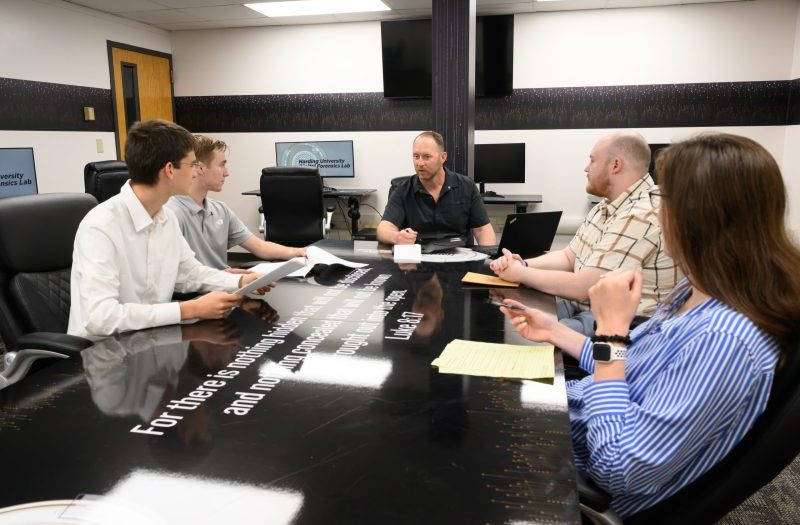
Harding University in Searcy is preparing students for their futures — a future where technology continues to expand, heightening the demand for more professionals in a variety of fields. Through key programs such as the digital forensics lab, the Bachelor of Science in artificial intelligence and the forthcoming cybersecurity graduate program, Harding professors are making sure these students are ready to meet that future head-on.
Bachelor of Science in Artificial Intelligence
Housed in the computer science department, the Bachelor of Science in artificial intelligence is one of four majors the department offers. All AI-specific classes are taught by Joe Faith, the director of the AI program at Harding, who has a doctorate in engineering.
“I have a lot of training specifically on this style of development, so as a result, we can offer a more complete suite of skills to the students that other programs just don’t have either the manpower or the capacity to handle at this time,” he said.
AI is a rapidly changing field, which can make it challenging to teach, but Faith said the department makes semester-by-semester updates to the curriculum to stay up to date on the latest AI tools and information.
As a Christian university, there is also a lot of emphasis on learning to harness AI ethically.
“We feel it’s important as Christians for us to be involved in this space pretty heavily,” Faith said. “How can we try to align these models or constrain them in ways that you can be a good steward for your customers’ data?”
Faith also tries to cultivate a collaborative environment in his classrooms with lots of project-based learning, as well as making sure the students get to know and support one another. The department’s core classes usually have class sizes of 15 to 40 students at the most.
“You’re not in a lecture hall with 200 people trying to figure out what’s going on, where you need a pair of binoculars to see the board or something,” Faith said.
The AI undergraduate program accepted its first cohort of students in 2025, and the novelty of the program has students and faculty alike excited for the future of the degree.
“We’re constantly innovating,” Faith said. “We’ve got some really cool things on the books for the next few years.”
Joe Faith
For more information about AI at Harding, click here.
Master’s in Cybersecurity
Harding University’s new master’s degree in cybersecurity is currently enrolling its first class, which will start in fall 2026
The program is a 10-class, 30-hour online master’s. There is also a dual-degree component for undergraduate students, where they can work on the master’s degree while finishing the undergraduate program.
“We wanted to focus on something that our faculty is good at and has experience with, and also provide something that’s relevant and real for the demanding workforce,” said John Stone, director of the cybersecurity program and doctor of education.
Three graduate certificates will also be available in cybersecurity leadership, cybersecurity operations and digital forensics.
“Obviously, there are a lot of online programs that exist, but I think Harding’s reputation as a place of integrity and ethics plays a part in this world, because cybersecurity is a place where those things are very important,” he said.
Stone said that, especially in the technology space, it is important to continually learn. The master’s program and certificates will give people a chance to do that. He said the fact that it is online will make it very accessible to people who are already working full-time jobs in the field.
“One of the good things about the master’s degree is that it can be a springboard to shift careers,” he said. “If someone is in a programming job or a computer science job and is seeing the industry moving more toward cybersecurity, this gives them the ability to complete a master’s rather than get another undergrad [degree].”
He said cybersecurity is a growing field because of AI, and the demand for people with cybersecurity skills will only rise.
“Everything uses technology, and everything needs a secure technology space, so having these skills are very valuable professionally, but also in terms of long-term skill sets as you grow in your career,” Stone said.
John Stone
For more information about the program, contact Stone at jstone@harding.edu.
Digital Forensics Lab
The digital forensic lab is one space on campus where students working toward a cybersecurity degree can put what they are learning in class to work in order to make a real-world impact. Run by specialized law enforcement professionals and certified under the ANSI National Accreditation Board, the crime lab gathers evidence to help solve real crimes.
Jeff Cavitt, director of the lab, said the work is not like the CSI people see on TV, where investigators are collecting fingerprints from physical crime scenes. Rather, they are working to gather evidence from phones, computers and other technology involved in crimes.
Harding students who meet the prerequisites can work in the lab as investigative aids. The work they do at the lab is vital because it can take a long time, and often police forces do not have the manpower to keep up with the demand, Cavitt said.
“We’re able to help detectives save a lot of time and effort because they don’t have to actually go in and do the review themselves,” he said. “We’re actually the ones doing it, and then once we get all that done, we send that back to the detectives.”
The work done at the digital forensic lab can make or break a case, not to mention being an invaluable experience for students in preparation for their careers.
“We’re doing something different, something that you don’t really have at other universities,” Cavitt said. “Having the ability to see the insides of how digital forensics work is really key for these students to be one step ahead when they graduate.”
Jeff Cavitt
For more information about Harding University and the digital forensics lab, visit harding.edu.
READ ALSO: Coming Back From the Freakin’ Moon: Viral Arkansas Space Enthusiast Looks Forward to Splashdown