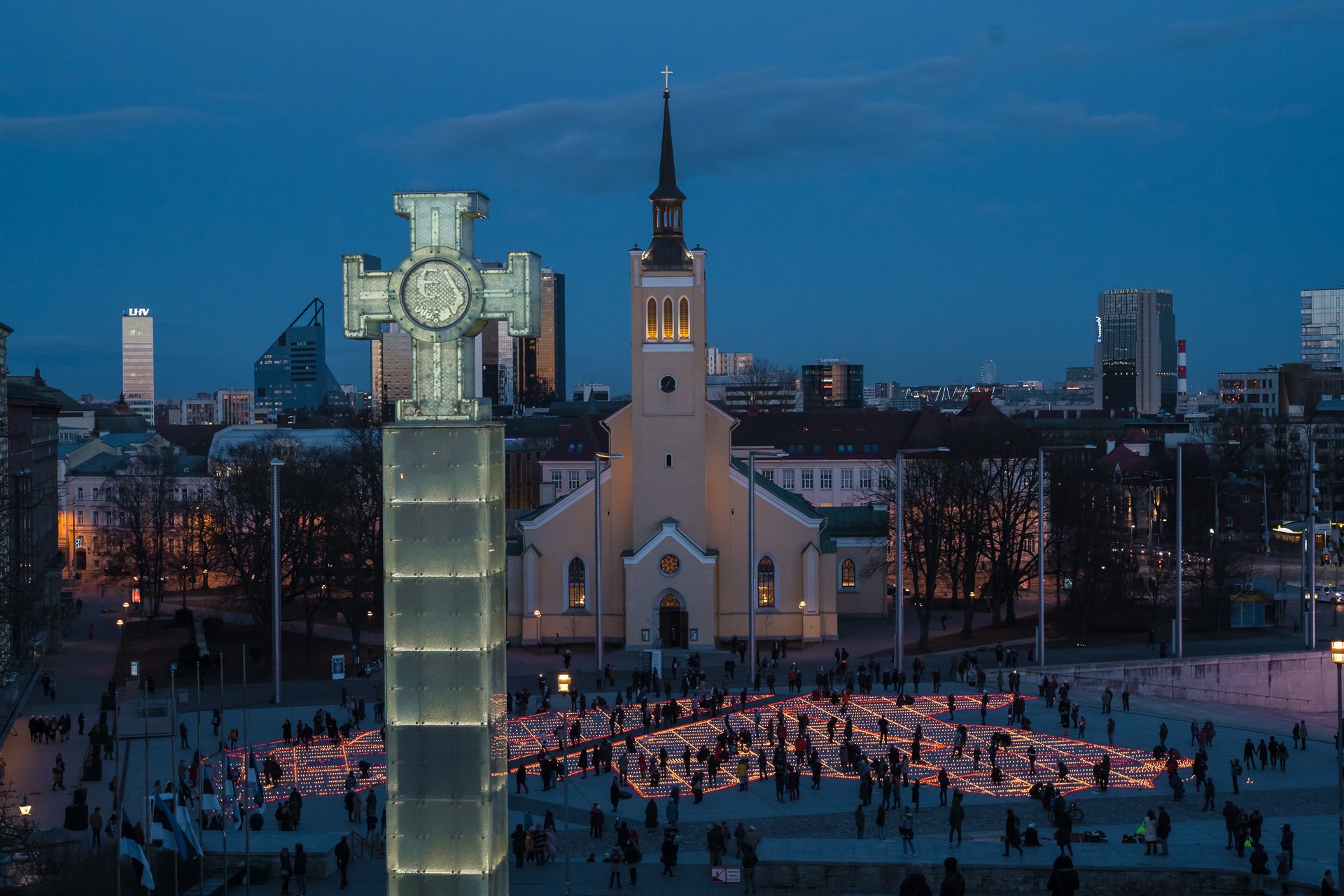
On 25 March 1949, the Soviet regime deported 20,000 Estonian men, women, and children to Siberia; in just a few days, nearly three per cent of the country’s population was seized and sent to remote, often inhospitable regions.
In the summer of 1940 the Soviet Union occupied Estonia, Latvia and Lithuania as a result of the infamous Molotov-Ribbentrop Pact signed between Nazi Germany and the Soviet Union on 23 August 1939. In the aftermath of the Second World War, Estonia lost approximately 17.5% of its population.
The Soviet occupation brought with it an event that until then had only been read about in history books and which became the most horrific memory of the past centuries – mass deportations that affected people of all nationalities living in Estonia. The two deportations that affected Estonia most, on 14 June 1941 and 25 March 1949, are commemorated annually as days of mourning. The March 1949 deportation was the largest, when more than 20,000 people, mostly women and children, were deported from Estonia.
Prologue to the deportations
On 23 August 1939, the Soviet Union and Nazi Germany signed the Molotov-Ribbentrop Pact, the secret protocols that divided Central and Eastern Europe into spheres of influence. On 1 September 1939, Germany launched the Second World War by attacking Poland. On 17 September, the other party to the pact, the Soviet Union, began to play its part, invading Poland from the east and concentrating large forces on the borders of the three Baltic states and Finland.
Although the Estonian government declared its complete neutrality at the beginning of the Second World War, on 28 September 1939 the Soviet Union used direct military threats to force Estonia to sign a so-called mutual military assistance pact, which led to the establishment of Soviet military bases in Estonia.
Similar treaties were also imposed on Estonia’s southern neighbours, Latvia and Lithuania. The seriousness of Soviet pressure and threats was demonstrated by the fact that when Helsinki refused to conclude such a treaty with Moscow, the Soviet Union began to invade Finland in what is known as the Winter War. The international community responded to this Soviet act of aggression by expelling the Soviet Union from the League of Nations.
Soviet troops marching in Tallinn.
The Soviet Union occupied and forcibly annexed Estonia, along with Latvia and Lithuania, in the summer of 1940 on the basis of the aforementioned Molotov-Ribbentrop Pact. On the initiative of the Soviet authorities, illegal parliamentary elections were held in the Baltic states with falsified results, which were not recognised by the democratic Western countries.
The Soviet authorities immediately unleashed a reign of terror that also targeted Estonia’s ethnic minorities, such as Jews and Russians. Special emphasis was placed on the elimination of the nation’s cultural, economic, political and military elite.
During the war, Nazi Germany invaded part of the Soviet Union and occupied Estonia from July 1941 to September 1944, after which the Soviet Union re-established its occupation.
Preparations for repressions
Even before the occupation, the Soviet Union had begun preparations to unleash terror on Estonian civil society. The aim of the communist terror was to suppress any possible resistance from the very beginning and to instil great fear in the people in order to prevent any kind of organised general resistance movement in the future.
In Estonia, the planned extermination of prominent and active people, as well as the expulsion of large groups of people, was intended to destroy Estonian society and economy. The lists of people to be repressed were drawn up well in advance. The files of the Soviet security organs show that the Soviet security organs had already collected data on persons to be repressed in the early 1930s.
According to the instructions issued in 1941, the following persons in the territories to be annexed to the Soviet Union and their family members were to be subjected to repression: all members of the former governments, senior state officials and judges, senior military personnel, former politicians, members of voluntary national defence organisations, members of student organisations, persons who had actively participated in anti-Soviet armed struggle, Russian emigrants, members of the security police and police officers, representatives of foreign companies and, in general, all persons with contacts abroad, entrepreneurs and bankers, clergymen and members of the Red Cross. About 23 per cent of the population belonged to these categories.
An illustration of Soviet deportations. Image by Kresy-Siberia.org
The Soviet security organs began their repressive activities in Estonia even before its formal annexation by the Soviet Union during the occupation. In June 1940, people were arrested for political reasons, and from then on the number of arrests increased.
On 17 July 1940, the last commander-in-chief of the Estonian Defence Forces, Johan Laidoner, and his wife were exiled to Penza. On 30 July 1940, the President of the Republic of Estonia, Konstantin Päts, and his family were exiled to Ufa. Both General Johan Laidoner and President Konstantin Päts died in Soviet captivity.
Mass deportations
The preparations for the mass deportations began at the latest in 1940 and were part of the overall violence directed against the territories occupied by the Soviet Union in 1939-1940. The Ukrainian and Belarusian territories were the first to be affected by deportations.
The first written reference to the exile of Estonians to Siberia can be found in the papers of Andrei Zhdanov, Stalin’s commissar who oversaw the destruction of Estonia’s independence in the summer of 1940.
Itinerary of deportation trains.
The first deportation took place on 14 June 1941, when more than 10,000 people were deported from Estonia.
After the Second World War, when the Soviet Union reoccupied Estonia (after a brief period of Nazi German occupation), the Soviet authorities began discussing the possibility of a new mass deportation.
The secret preparations lasted for over two years, and in March 1949 the occupying forces were ready for another deportation. In the course of the operation that began on 25 March 1949, more than 20,000 people – almost 3 per cent of the Estonian population in 1945 – were rounded up in a matter of days and sent to remote areas of Siberia.
The deportation was demanded by the Communist Party in order to complete “collectivisation” and “eliminate the kulaks as a class”. Almost a third of those designated as “kulaks” managed to escape their captors. In the words of the local Communist Party secretary, Nikolai Karotamm, other families were “grabbed” to “fill the quota”.
People were taken from their homes and loaded on the trucks carrying them to the train stations.
The majority of the 1949 deportees were women (49.4 per cent) and children (29.8 per cent); the youngest deportee was less than one year old; the oldest was 95 years old. At least two babies were born on the train. A file still exists on four children who were sent from Rakvere to Siberia without their parents, after being held hostage for two days in an attempt to trap their parents.
Particularly inhumane was the second deportation of children who had been deported in 1941 and were allowed to rejoin their relatives in Estonia at the end of the war.
About 5,000 Estonians were sent to Omsk Oblast, the region directly affected by the Semipalatinsk nuclear test site. Between 1949 and 1956, some 260 atomic and fusion bomb explosions were carried out there. The victims of radiation sickness were left without medical treatment for decades. Sick people and parents of babies born with abnormalities were told that they had contracted brucellosis from animals.
“Body Memory” (2011), a film by Ülo Pikkov, music by Mirjam Tally. The Estonian stop-motion animation “Body Memory” takes as its central concept the idea that our body remembers, not only individual experiences, but also the sorrow and pain of our predecessors. It’s a powerful visualisation of subconscious processes and the hidden horror of deportation. The film was inspired by historical events: the Soviet deportations from Estonia in the 1940.
It was not until the late 1950s that deportees who had survived their ordeal were able to return home, but despite partial rehabilitation they remained second-class citizens in the Soviet Union. Many remained under the surveillance of the security services, their confiscated property was never returned to them, and no formal amnesty was ever granted.
* This article was originally published on 25 March 2014 and lightly amended on 25 March 2024.