At the Viinistu Art Museum on Estonia’s northern coast, Estonian painter Anu Muiste’s solo exhibition Form and Play uses surreal, dreamlike imagery to explore motherhood, personal identity and the inescapable gaze of others.
In her new solo show, Form and Play, Anu Muiste has produced a series of striking and surreal paintings that initially toy with abstract and organic forms but ultimately give way to figurative pieces that offer poignant social commentary.
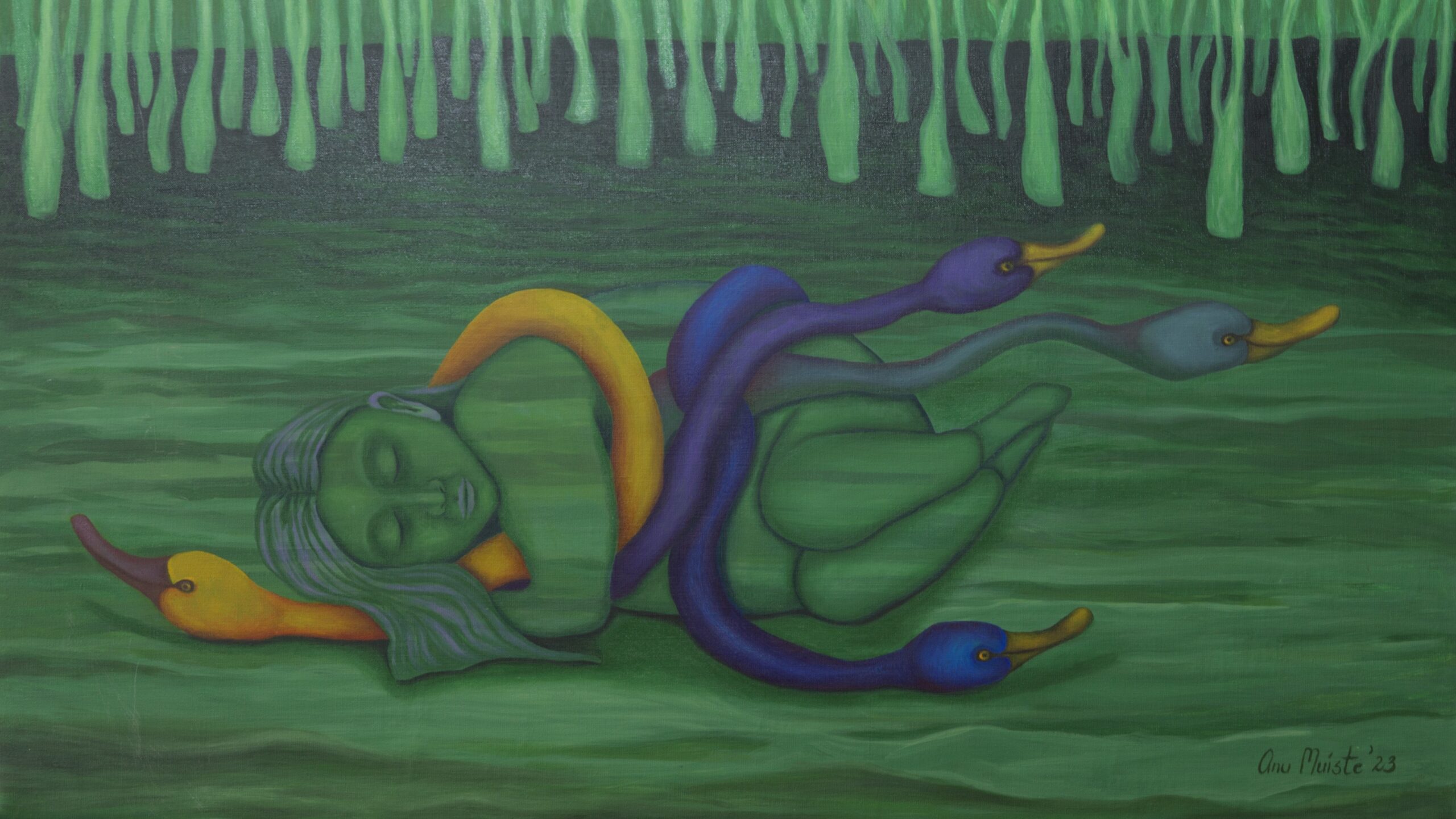
Form and Play consists of 25 paintings strung up in a pair of old fish silos at the Viinistu Art Museum. Muiste’s abstract works, “Silence” and “Softness”, evoke a plaintive state of mind, whereas her organic pieces, “Night Rituals” and “Abundance”, call our attention to the natural world’s regenerative capacity.
Anu Muiste, Coming Back from a Night Sea Journey (2026), acrylic on canvas.
That said, Muiste is at her best when she combines her abstract and organic painting prowess in three figurative canvases, “Dreamcatcher”, “The Game” and “Hideout”, that make subtle and somewhat unnerving statements about fantasy, personal identity and social psychology.
Most of Muiste’s figurative pieces blend the distortion characteristic of surrealism with neo-naïve traits in which bold and vibrant colors, flattened perspectives and primitive forms are used to give paintings a childlike quality.
“Dreamcatcher” is comprised of an uncanny human figure walking through a wide-open meadow that rests beneath a big blue sky. The figure consists of arms and legs that are twisted together to resemble a dreamcatcher, and the arms gently embrace a series of fantasies that have taken the form of brightly colored stones.
Anu Muiste, Dreamcatcher (2026), oil on canvas. The work presents imagination as both a refuge and a source of entanglement.
The bright colors, capacious landscape and gentle embrace are consistent with Muiste’s reading of “Dreamcatcher” in which “the work invites us to preserve our imagination and trust the inner world where everything is still possible”. However, the dreamcatcher label and uncanny human figure suggest there is more to the painting than Muiste explicitly admits.
In traditional Ojibwe culture, dreamcatchers were talisman designed to protect children from evil spirits. And when seen from this angle, the figure in the center of Muiste’s “Dreamcatcher” looks less like a collection of harmless fantasies and more like a shield designed to protect a hidden human being from whatever dangers might be lurking in her surroundings.
Focusing closely on the central figure in “Dreamcatcher” elicits an even more disturbing result. For as we linger over the painting, the contorted arms and legs meld with the oblong stones to give us the impression that this figure has tied herself into knots and gotten lost. So, it seems that daydreaming opens us up to a world of possibilities, but those possibilities can be just as restricting and disorienting as they can be liberating and illuminating.
The restriction of possibilities is a key theme in Muiste’s most powerful painting to date: “The Game”. It portrays two women perched near the border between a bright green meadow and a technicolor forest comprised of blue trees and a violet sky. The woman in the background is holding an oversized walnut close to her stomach, whereas the woman in the foreground is set to run with her nut as if she were a winger in a rugby match. Finally, a series of walnut shells rest gently on the meadow, and they’re filled with soil from which young saplings grow.
Anu Muiste, The Game (2026), acrylic on canvas. The surreal scene explores motherhood, personal identity and the roles women are expected to carry.
According to Muiste’s official interpretation of “The Game”, “the forest becomes a stage where women are players in the great game of life [in which] they carry roles – some assigned to them, some chosen by themselves”. Since the walnuts resemble placentas and the shells are shaped like cribs, “The Game” is clearly about motherhood and childrearing and “the great game of life”. But like “Dreamcatcher”, “The Game” is far more intriguing than Muiste’s stated account leads one to believe.
On closer inspection, we see that the woman pregnant with child in the background has much of her face hidden behind a veil of thick blonde hair, implying that her personal identity has been effaced for the sake of motherhood. Similarly, the woman in the foreground who seems set to run with her child is wearing urban dress shoes in an otherwise rural setting, and this suggests that women have little choice but to juggle their parental obligations while chasing professional success.
Alas, the loss of personal identity and the pressure to balance childrearing with professional ambition is not the end of the story. For the blue trees in the background are barren, implying that a woman’s childbearing years are limited and that men have little sense of what carrying a child entails. So, women are often alone in “the great game of life”. And while they may freely choose to have kids and careers, their version of the great game is far from easy.
Given the difficulties women face in life, it is hardly surprising that “The Game” is hung directly next to a painting entitled: “Hideout”. “Hideout” depicts a landscape in which a piercingly hot sun is setting just above the horizon of a lake. Purple and pink clouds float above the sun, whereas the lake below seems encircled by a mountain range. In the foreground, a river briefly runs through a meadow, before breaking through the mountains and draining into the lake. In the shade being cast over the meadow, a doll-like blonde woman in a light blue dress is sitting down and resting her back against the base of a steep cliff.
Anu Muiste, Hideout (2026), acrylic on canvas. A solitary figure seeks shelter beneath an intense, watchful sun.
On Muiste’s telling, “Hideout” portrays a “quiet and secluded place where one can find peace from the surrounding world”, and she says, “the work speaks of inner silence, a sense of safety, and the need to find a place to be with oneself”. This reading fits with a solitary woman seeking shade in a remote location on a hot summer day, but again there is more to Muiste’s painting than she explicitly admits.
The bright white and red-hot sun Muiste has situated in the center of her painting hardly looks safe. And its pulsating and piercing quality suggests that “Hideout” is less about finding a peaceful place for reflection and more about escaping a powerful spotlight that stands for the probing and penetrating eyes of others.
Of course, this interpretation indicates additional burdens women face in the great game of life: ie, the constant scrutiny over their outward appearance and the long-standing social expectation that they present as dolled-up, pleasing and polite. So, it’s easy to see why the woman in “Hideout” is searching for a quiet and secluded place to be silent with herself.
Unfortunately, no such place exists. For while the woman in Muiste’s painting is protected from the sun, she is nevertheless exposed to the gaze of each and every visitor to the Viinistu Art Museum. And although her eyes may be closed in a final attempt to shield herself from the judgement of others, the unspoken message running throughout Muiste’s exhibition is clear: in the great game of life, there is no hiding and there is no escape.
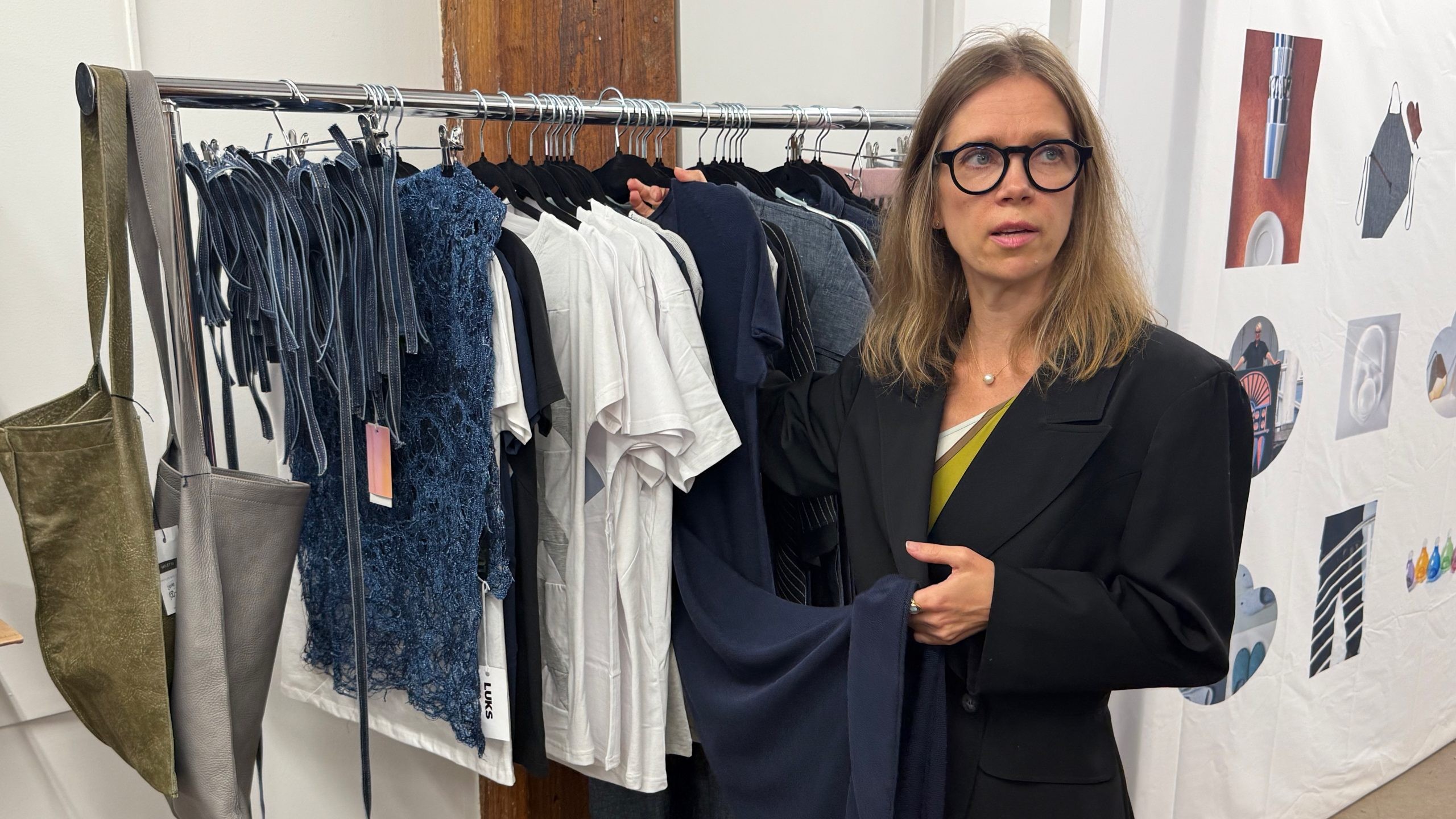
Estonian artist Anu Muiste at her solo exhibition, Form and Play, in the Barrel Gallery at the Viinistu Art Museum. Photo by Harry Tiits.
***
Form and Play is on display in the Barrel Gallery at the Viinistu Art Museum from 4 July to 7 August 2026.