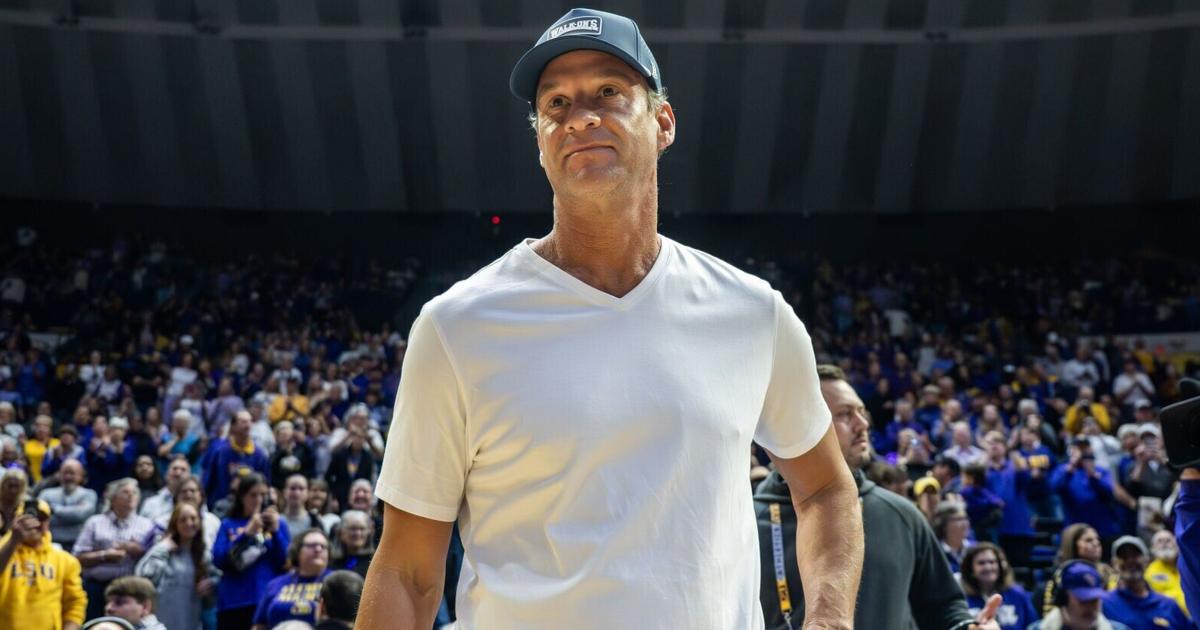
There was a time when college football coaches such as LSU’s Lane Kiffin didn’t exist in a win-now echo chamber pressurized by 24/7 media cycles.
But this isn’t to say everything was peachy.
“Coaching football is a rotten life,” former Michigan coach Bennie Oosterbaan, one of just three college football coaches to win a national title in his first season, told Time magazine just a few years after his glorious debut in 1948.
“I’m on top now, and there is a lot of backslapping,” Oosterbaan said. “Let me lose the opener or a couple of other games next fall, and then watch how I’m blasted.”
Oosterbaan, considered the “best offensive mind in college football” by his predecessor, soured on scheming. When he left Michigan in 1958, he said “the pressure” got to him.
“Not from my bosses or the fans,” Oosterbaan said. “I mean the pressure that builds up inside a head coach whether he wins or loses.”
The coaching profession applies pressure. Kiffin, a renowned offensive mind in today’s era, said he doesn’t fret about outside expectations because none are greater than his own.
But the LSU job is a pressure-cooker.
It’s a place where three coaches — Nick Saban, Les Miles and Ed Orgeron — have won national titles this century. It’s a place where Brian Kelly was axed, with $54 million left on his contract, because 34-14 with no playoff appearances wasn’t good enough.
To put it lightly, Kiffin must win. To put it not so lightly, LSU fans are “nuts,” according to Hall of Fame coach Urban Meyer, who proclaimed ahead of the Fourth of July weekend that Kiffin has to win a national title in 2026 — or at least come close — to stay in the fans’ good graces.
“He’s gotta be within a swing of it,” said Meyer, who won a national title in his second season at Florida and his third at Ohio State. “That’s one place, I remember when I retired, I said ‘Good, I’m never going there again’ — because (LSU) fans are nuts.”
It’s questionable whether Meyer’s take is fair, but talk of Kiffin’s title timeline was fair game as soon as he jumped from Ole Miss ahead of a playoff run because he considered Baton Rouge more fertile soil to build a contender.
Kiffin has promised the Tigers will win a title during his tenure, though he didn’t offer a specific timeline. But the question is certainly being asked locally and nationally.
How long should it take?
There is a perception that titles can be won more quickly these days because of transfers and athlete pay. Curt Cignetti just led one of the least successful programs in college football history, Indiana, to the mountaintop.
But many of Cignetti’s stars followed him from James Madison, a Cinderella script that can’t be repeated. It wasn’t until the coach’s second year, with a Heisman Trophy-winning quarterback, Fernando Mendoza, that the Hoosiers won it all.
The 2025 CFP included five coaches in their second seasons, including Texas A&M’s Mike Elko, Alabama’s Kalen DeBoer, Tulane’s Jon Sumrall and James Madison’s Bob Chesney. The only first-year coach was Pete Golding, who took over for Kiffin in the postseason.
Title contenders typically take time to build. In two 12-team playoffs, the average tenure of coaches in the tourney was 4.8 years. The average was seven years for coaches in the final trio of four-team playoffs, right after NIL started in 2021.
Coaches can build toward the playoff quickly, but national titles in Year 1 are rare, and they have not translated to long-term happiness.
The only coaches other than Oosterbaan to win titles in their first seasons were Miami’s Dennis Erickson and Larry Coker. Erickson, who won it all in 1989 and did it again in 1991, jumped to the NFL and bounced between levels, with fading success, for two decades. Coker, a champion in 2001, was out of a job within five years.
At LSU, there’s a pace in which football coaches win titles. Saban arrived in 2000 and claimed his in 2003. Miles took charge of the Tigers in 2005 and won it all in 2007. Orgeron succeeded Miles in 2016 and took home the trophy in 2019.
It usually takes a few years. Even in this era, where rosters can turn over in the portal, those new pieces have to mesh. Sometimes, they need to mature.
Indiana starters in 2025 averaged 4.3 years in college ball, including 11 players who were either fifth- or sixth-year seniors. LSU’s projected 22 is a bit younger, averaging 3.5 years.
“We’re going to have the teams and rosters back to the way they were playing when (LSU was) great. I don’t know how fast, that might not be today,” Kiffin said in June, “but it’s going to happen.”