EVERETT — Opening statements began Monday for a trial that will decide how to split the bill for an environmental cleanup along Everett’s waterfront.
Superior Court Judge Jon Scott will hear arguments from the Port of Everett and timber company Weyerhaeuser regarding waste materials left at the Mill A site, located at 3500 Terminal Ave.
“Weyerhaeuser, now a multi-billion-dollar company, has the ability to pay for the cleanup,” said Aric Jarrett, an attorney for the port. “The Port of Everett, a small public municipality, does not.”
Starting in the 1890s, the Mill A site was home to Weyerhaeuser’s sawmill and pulp mill operations. The waste materials from decades of industrial lumber activities that ceased in 1980 resulted in pollution at the site, according to the state’s Department of Ecology website.
“This is not a case where a polluter is trying to avoid the bill,” said Weyerhaeuser attorney Bart Williams. “Weyerhaeuser has consistently stated that it is ready and willing to pay its fair share for cleanup costs. Rather, this is a case about the owner of a property, the Port of Everett, trying to exploit the regulatory process to get a previous owner to pay a disproportionate and unfair share of the remediation costs.”
Most of the contamination comes from sawdust and woodchips, Jarrett said, adding that 350,000 cubic yards of wood waste sits on the bottom of Port Gardner Bay. The Department of Ecology also lists contaminants including metals, polycyclic aromatic hydrocarbons (PAHs), polychlorinated biphenyls (PCBs), phenols and dioxins/furans. Upland contaminants include metals, PAHs, petroleum and several semi-volatile organic compounds (SVOCs).
“Not only did those chemicals harm the fish and oysters and other sea life at the time that they were discharged,” Jarrett said. “But those chemicals still pollute today at concentrations that threaten human health and the environment.”
The Port bought the site in 1983 and, up until the mid-2000s, used the facility for log handling and storage before transitioning to container cargo handling.
In 2008, the Port initially filed this lawsuit to get funding from Weyerhaeuser for the cleanup. After both parties entered the cost-sharing agreement in 2012, the lawsuit was filed as inactive.
The cost-sharing agreement coincided with an Agreed Order the Port, Weyerhaeuser and the Washington Department of Natural Resources entered into with the Department of Ecology, outlining Mill A’s cleanup, according to Ecology’s timeline.
Per the cost-sharing agreement, Weyerhaeuser would provide 60% of the funding while the Port would contribute 40%, Jarrett said.
“The Port did not believe and does not believe that it is 40% liable for the contamination, but that it agreed to interim allocation simply to move the cleanup forward,” he said.
Six years into the Agreed Order, Weyerhaeuser canceled the parties’ cost-sharing agreement. This left the Port responsible for advancing the order with no matching funds, Port CEO Lisa Lefeber told The Daily Herald in October.
In 2024, the Port requested the court lift the lawsuit’s stay and issue a new trial date.
More than two years later, Williams argued Monday that the Port should actually be responsible for 80% of the costs, dropping the timber company’s contribution to a third of the previous agreement.
The Port believes, Jarrett said, Weyerhaeuser should be held accountable for its decades of pollution and to the standards of the Model Toxics Control Act.
“The primary purpose of MTCA is that polluters should pay to clean up their own mess,” Jarrett said.
The act helps fund and direct the investigation, cleanup and prevention of sites contaminated by hazardous substances.
While Weyerhaeuser said it’s willing to contribute to the cleanup costs, Williams argued the Port is the one standing to gain from the cleanup.
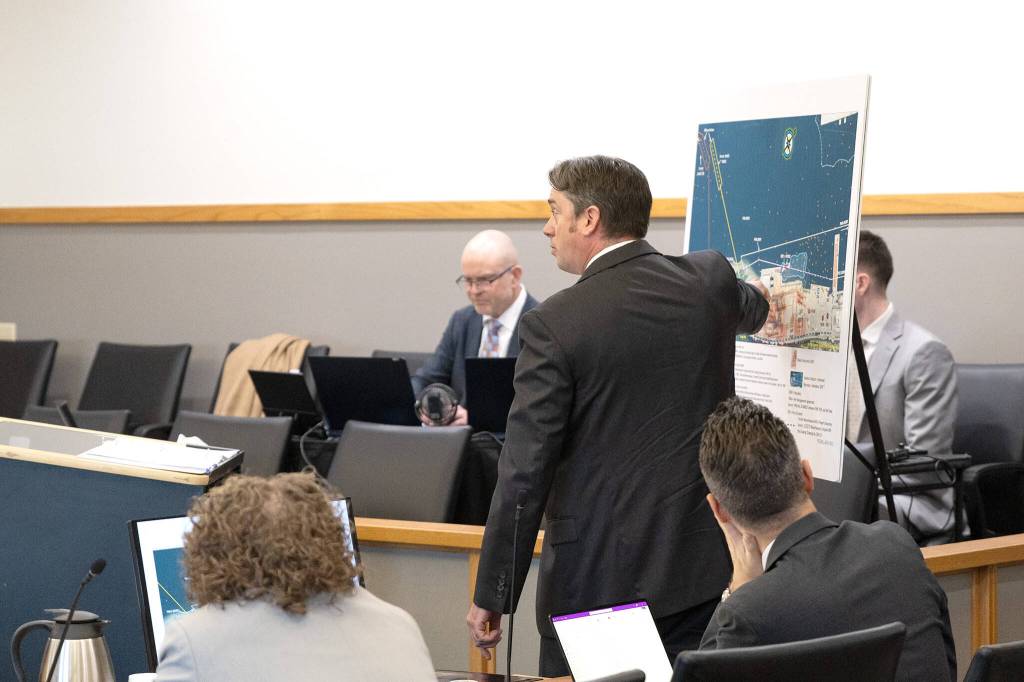
He pointed to the proposed confined disposal facility, which works to retain contaminated dredged materials while discharging clean water. Williams said the facility could serve as a base for an extended berth, giving ships more places to dock near the South Terminal.
“Which is exactly what the Port of Everett long said it wanted to do,” he added.
Williams went on to allege that the Port modified how it presented information to benefit more from the regulatory process.
“There is nothing wrong with killing two birds with one stone. There’s nothing wrong with getting a cleanup remedy that also benefits the Port’s business objectives,” he said. “What is not okay is to ask the court to not factor that benefit into the calculation of what is equitable for Weyerhaeuser.”
The Port countered that it was the state Department of Ecology that approved the facility to be placed in one of the seven sediment management areas.
“Selection of the preferred remedy is made by Ecology,” Jarrett said. “It is not made by the Port. It is not made by the Weyerhaeuser.”
The department, Jarrett said, had rejected this argument about the Port’s economic benefits previously.
“Ecology’s selected remedy is designed to contain a staggering volume of contamination left behind by Weyerhaeuser,” he said.
In the lead-up to the trial, the Port experienced another setback in the cleanup when Ecology pulled $87 million in current and future grant funds. The Department attributed the decision to limited resources, lack of matching funds and slow spending of previous grants.
Weyerhaeuser offered to immediately pay $4,734,372 for past unreimbursed remedial costs and committed up to $25 million toward future remedial costs in an attempt to help the Port regain its state funding.
Despite the offered match, Lefeber said in October the Port doesn’t see a mechanism to access it while the trial is underway, which is expected to last around four weeks.
Jenna Millikan: 425-339-3035; jenna.millikan@heraldnet.com; X: @JennaMillikan